
Ciutat Vella
The Gothic Quarter: a neighbourhood that invented itself
Two hours in the old city working out what is genuinely medieval and what was built for a trade fair
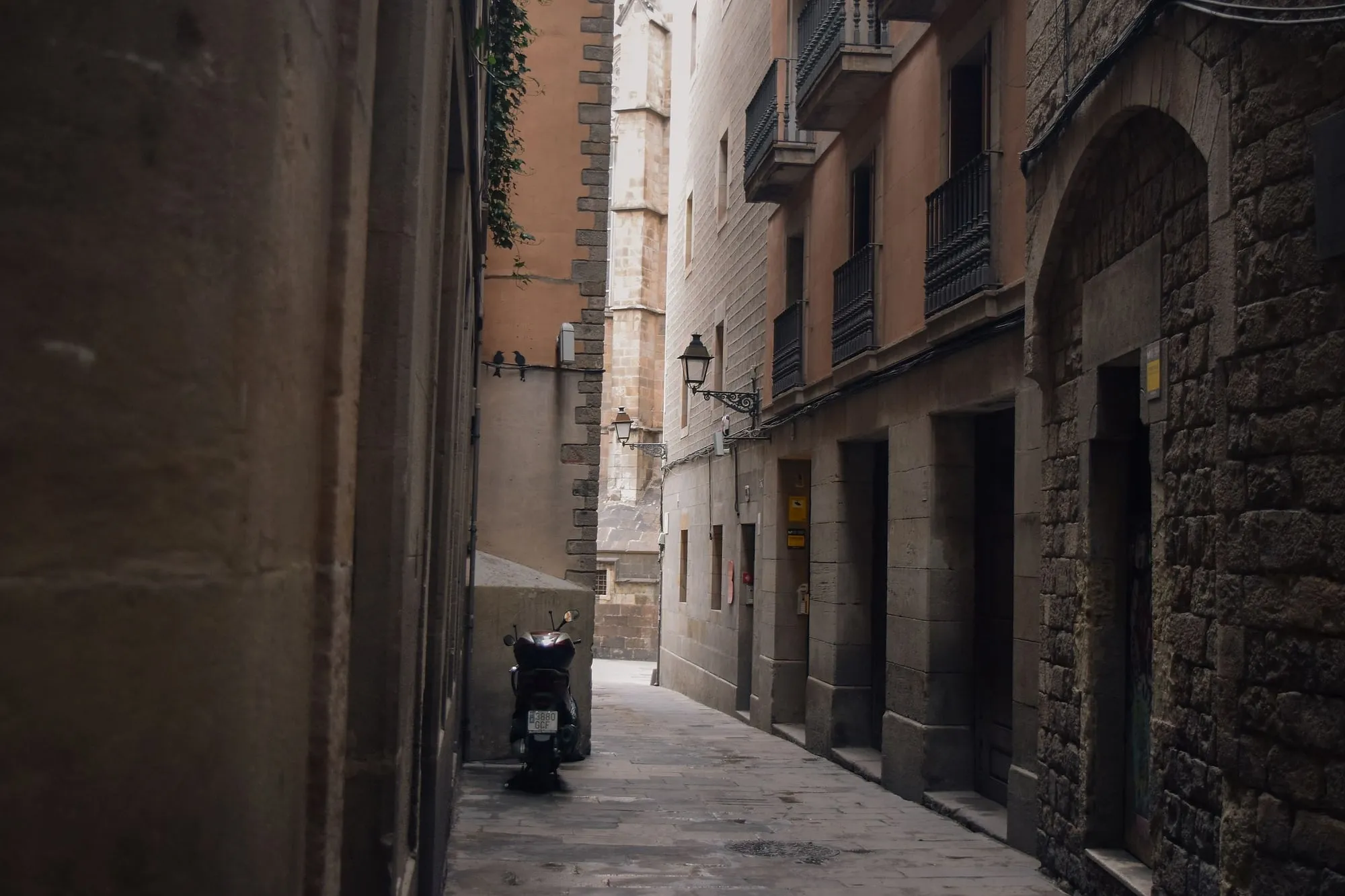
A good deal of what gets pointed at in the Gothic Quarter is under a hundred years old. This is not a scandal or a secret — it is documented. From 1927, with the 1929 International Exposition approaching, the streets around the cathedral were reconstructed and monumentalised until the old town looked more medieval than it had ever actually been.
What came out of it is one of the best pieces of urban stagecraft in Europe, and this walk is about exactly that: what is fourth century, what is twentieth, and why the difference matters less than you would think. It is an argument, told by an actor rather than read off a clipboard. He does not play a character on this one: that happens on the Gaudí walk, which is the only one of the five performed in character.
It is the tour people talk about most in the reviews, and since August 2026 it is finally on the calendar: Mondays and Wednesdays at 14:00, booked and paid for here.
There is also a Gothic Quarter night tour, same streets with nobody in them, on Fridays and Saturdays at 21:30. And if you would rather be somewhere the coaches never reach, the Gràcia walking tour goes the other way out of the centre.
What you see, in order
The part that really is Roman
Plaça Nova
The gate is Augustan, and so is the small archway still standing in it. The towers were bolted onto it three centuries later. The curtain of wall that joined them was demolished in 1823, the windows near the top went in around 1909 and 1920, and the aqueduct arch beside them is — in the city's own words — a recreation made last century. Old stone, modern picture. Worth starting there, because from this point on it only gets more complicated.
The bridge that is not medieval
Carrer del Bisbe
The carved bridge in every photograph went up in 1928. Joan Rubió i Bellver designed it for the Diputació de Barcelona, while the streets around the cathedral were being reconstructed and monumentalised for the 1929 International Exposition. It is a covered passage between two buildings, not a way across a street. It is not medieval and never claimed to be. It claimed to look it.
A temple inside a block of flats
Carrer del Paradís
The columns of the Temple of Augustus, nine metres tall, tucked inside the courtyard of an ordinary building. Three were found here at the end of the nineteenth century, inside the later buildings that had grown around them. The fourth was assembled around 1879 out of temple fragments picked out of rubble, stood in Plaça del Rei for eighty years, and joined the others in 1956. No plaque outside, no queue.
The square with the scarred wall
Plaça de Sant Felip Neri
The pockmarks on the façade come from an air raid on 30 January 1938, not from a firing squad as was claimed for decades — the city corrected that publicly. Forty-two people died here, twenty of them children who had taken shelter in a basement on the square. This is the stop where nobody talks.
The quarter as a stage set
Plaça del Rei
Here the question closes: if half of medieval Barcelona was built in the twentieth century, does it count for less? The short answer is no, and the long one is what makes the walk worth doing.
Included
- A working actor for a guide — told, not read off a clipboard
- Twenty people maximum — in Ciutat Vella that is the legal cap
- Free cancellation up to 24 hours before
Never more than 20 people
In Ciutat Vella the council caps a guided group at 20. We stop at 20, which is well inside it and means everyone hears everything.
Before you book
Do we go inside the cathedral or any museum?
No. This is a street-level walk. Guiding inside the cathedral or a museum requires a Generalitat-accredited guide, which is a different qualification.
Why a maximum of twenty?
Because in Ciutat Vella a district decree sets it, in force since March 2023. Here it is not our choice, it is the law.
Is there a night version?
Yes, and you can book it: Fridays and Saturdays at 21:30. It is this one: The Gothic Quarter after dark.
Is it suitable for children?
Yes. Adult fare from 12, child fare 3 to 12, under-3s free.
Where exactly does it start?
Plaça Nova, standing in front of the two Roman gate towers, with the cathedral on your right. Metro Jaume I (L4) or Liceu (L3), five minutes on foot from either. It is the square the tour then spends its first fifteen minutes in, so nobody has to move to begin.
How much walking is there?
The whole route fits inside four streets — Plaça Nova to Plaça del Rei is three hundred metres in a straight line — so it is around two kilometres in two hours, doubling back. Flat, but all worn stone and cobbles with a few narrow steps. Shoes matter more here than on any other route we run.
What happens if it rains?
It runs. The streets are so narrow that the balconies do half the work of an umbrella. If the weather is genuinely dangerous we move you to another date or refund you in full.
When does it run?
Mondays and Wednesdays at 14:00, booked and paid for here. Two days rather than seven on purpose: on a weekday the afternoon leaves two and a half clear hours between the morning walk and the six o'clock one, and this fits inside them without anyone running. If you need another day, write and we will look at it.