
Montjuïc
The floor of this terrace is 420 square metres of scrap, and it is not by the man everyone credits
The best viewpoint on Montjuïc has a floor made of scrapyard iron and broken bottles, and it exists because of a deal struck in 1960.
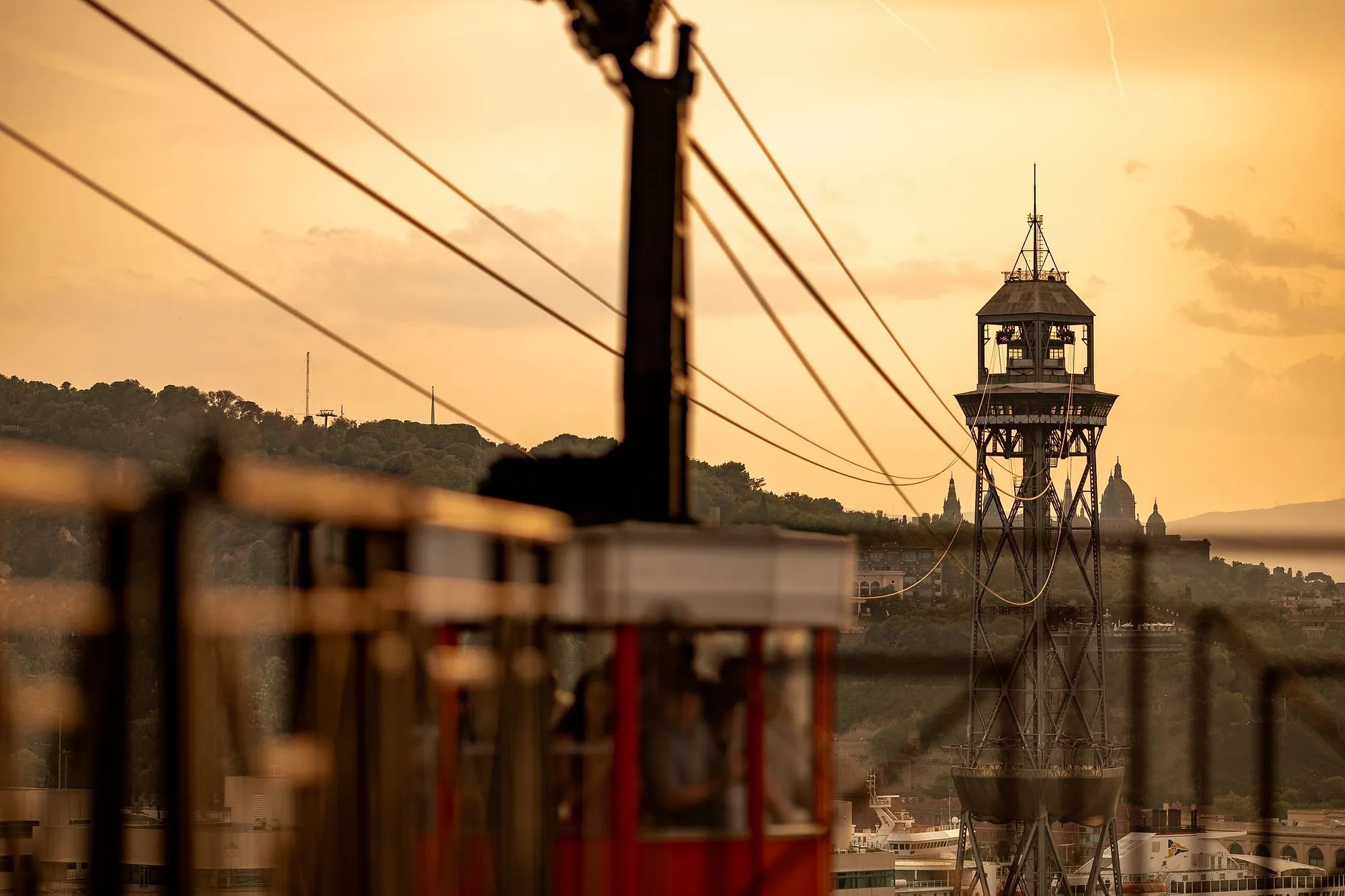
Montjuïc has a lot of viewpoints and one of them has a floor worth flying to see.
The Mirador de l’Alcalde sits on the seaward flank, below the castle, above the port. It is four stepped levels down the slope, with a pool on the second collecting water from a cascade that comes from a pool on the third, and it ends at the top in a small square. People go for the view, take the photograph of the container terminals, and walk back to the cable car without ever looking down.
The floor
Look down.
It is a pavement mosaic of 420 m² designed by Joan Josep Tharrats. For its making, materials as diverse and original as pebbles, setts, bricks, tiles set on edge, bottle bottoms, concrete pieces, various iron pieces (chains, cogwheels, filaments, nuts and bolts, plates from scrapped machinery) or fragments of covers of the underground urban services’ inspection chambers were used, among others.
Four hundred and twenty square metres of a Franco-era municipal terrace, paved in scrapyard. Chains. Gearwheels. The lids of drains. Broken bottles set into the ground.
The Ajuntament classes it as part of the artistic heritage of Barcelona, which is a slightly startling status for a floor made of what the city had lying around, and entirely the right one.
The attribution everyone gets wrong
You will be told this pavement is by Carles Buïgas — the engineer of the Magic Fountain, the man whose name is attached to more of this hill than any other.
It is not. The municipal page separates the two objects in consecutive sentences:
As for the fountain in the centre of the park, mayor Porcioles asked for its design from the author of the Magic Fountain, Carles Buïgas.
and then, separately, the pavement of 420 m² by Tharrats.
Buïgas made the fountain. Tharrats made the floor. They are different works by different people, and the confusion is easy to explain: one of those names is famous on this hill and the other is not.
⚠️ And do not attribute the gardens to Joaquim Maria Casamor, either. Casamor designed a great deal of Montjuïc — the cactus garden, for one — and his name gets attached to the rest by association. The municipal page for this park does not name him. We looked.
Why the gardens exist at all, which is the uncomfortable part
Here is the sentence that explains a whole quadrant of the hill.
In the year 1960, general Franco ceded the castle of Montjuïc to the city on the condition of installing there, among other things, a military museum. This, besides the adaptation of the fortress for new uses, brought about and stimulated the urbanisation and landscaping of the surroundings of the monument and, in general, of the Miramar area.
Read it slowly.
The castle on this hill had been a prison and a place of repression, and the city wanted it back. It got it back in 1960, with a string attached: a military museum inside it. And the consequence of that transaction was not confined to the fortress. It reorganised the mountainside — roads, gardens, terraces, viewpoints, the whole Miramar sector.
So the pleasant thing you are standing on, with the cypress hedges and the cascade and the extraordinary floor, is a by-product of a dictator handing back a fortress on his own terms. That is not a reason to avoid it. It is the reason to know what you are looking at, which is the entire point of this website.
The works ran from 1962 to 1969, in stages, and it opened with José María de Porcioles as mayor — the mayor whose name is on more of 1960s Barcelona than anyone would now like.
How to use it
Go at the end of the afternoon, coming down from the castle rather than up from the port. You arrive at the top level and descend through it, which is the way the four levels were composed to be read.
Then actually look at the ground. Give it two minutes. Find a cogwheel. Find a manhole cover. Once your eye adjusts you cannot stop seeing them, and the mosaic turns from decorative texture into a catalogue of what 1960s Barcelona threw away.
Look at what you are looking at. Below you is the working port — the terminals, the breakwaters and the cruise berths — not the pretty bit of coast. This is the view of the machine that made the city rich.
And do not confuse it with the other viewpoint. The Mirador del Migdia is on the south flank, was one of the last sectors of the hill left to urbanise at the end of the twentieth century, and was planned at the same time as the Olympic Ring. The Ajuntament describes it as having an image more forest than garden. It is a different place with a different character, and the two get mixed up constantly.
⚠️ We are not printing opening hours. Parks change theirs with the season and the city publishes its own.
Where this sits on the hill
The Mirador de l’Alcalde is a five-minute walk from the castle and sits directly above the harbour. It belongs with the castle’s history, with the gardens made in the old quarries, and with the lighthouse further round the same flank.
Our Montjuïc walk runs Tuesday and Thursday afternoons. We are closed on 25 December and 1 January.
Where this comes from
- Jardins del Mirador de l'AlcaldeAjuntament de Barcelona · Parcs i JardinsThat the garden is distributed «en replans que aprofiten el fort pendent de la muntanya», with a pavement that «forma part del patrimoni artístic de Barcelona»; that «l'any 1960, el general Franco va cedir a la ciutat el castell de Montjuïc amb la condició d'instal·lar-hi, entre altres coses, un museu militar», and that this «va comportar i estimular la urbanització i l'enjardinament dels voltants del monument i, en general, de l'àrea de Miramar»; that «les obres es van iniciar el 1962 i es van executar en diverses etapes fins al 1969, any de la seva inauguració, amb José María de Porcioles a l'alcaldia»; that «quant a la font que hi ha al centre del parc, l'alcalde Porcioles en va encarregar el disseny a l'autor de la Font Màgica, Carles Buïgas»; that «es tracta d'un mosaic de paviment de 420 m2 dissenyat per Joan Josep Tharrats», with the full list of materials used; and that the park is organised in four levels, ending at the top in a small square.
Everything above that carries a date, a figure or a name is checked against these before it is published. Where we could not find a source, the page says so.
Quick answers
- What is the Mirador de l'Alcalde?
- A terraced garden and viewpoint on the seaward side of Montjuïc, below the castle, laid out in stepped levels down the slope. The Ajuntament describes it as distributed «en replans que aprofiten el fort pendent de la muntanya», connected by flights of steps, with a pavement between them that «forma part del patrimoni artístic de Barcelona».
- Who designed the mosaic pavement?
- Joan Josep Tharrats. The municipal page is unambiguous: «es tracta d'un mosaic de paviment de 420 m2 dissenyat per Joan Josep Tharrats». It is frequently attributed to Carles Buïgas, who designed something else here — the fountain.
- What is the pavement made of?
- Rubbish, deliberately. The Ajuntament lists «còdols, llambordes, maons, rajoles posades de cantó, culs d'ampolla, peces de formigó, peces de ferro diverses (cadenes, rodes dentades, filaments, caragols i femelles, planxes procedents de maquinària desballestada) o fragments de tapes de registres dels serveis urbans del subsòl» — pebbles, setts, bricks, tiles set on edge, bottle bottoms, concrete, chains, cogwheels, filaments, nuts and bolts, plates from scrapped machinery, and pieces of manhole covers.
- Did Carles Buïgas work here?
- Yes, on the fountain and not on the floor. The Ajuntament: «quant a la font que hi ha al centre del parc, l'alcalde Porcioles en va encarregar el disseny a l'autor de la Font Màgica, Carles Buïgas». Same hill, same architect of the Magic Fountain, different object.
- Why were these gardens built?
- Because of a condition attached to a handover. The municipal page says that in 1960 Franco ceded the castle of Montjuïc to the city «amb la condició d'instal·lar-hi, entre altres coses, un museu militar», and that this, besides adapting the fortress, «va comportar i estimular la urbanització i l'enjardinament dels voltants del monument i, en general, de l'àrea de Miramar».
- When was it built?
- Works began in 1962 and were carried out in stages until 1969, the year it opened, with José María de Porcioles as mayor.
- Is it accessible?
- The Ajuntament says the levels are joined by stone steps but that many of the lawn beds have small paths that make the park «un espai completament accessible, ja que permeten recórrer-lo sense haver de superar cap graó» — traversable without taking a single step. That is the city's description of its own park, and worth checking against the day you go.
The tours this piece is about
More in the journal
Montjuïc
- They built the roof on the ground and then lifted it forty-five metres into the air
- The gardens on Montjuïc are the reason people who live here come up the hill
- The city tells you who carved the cat and will not tell you why the fountain is called that
- A good part of Barcelona is built on sand that this hill put there
- How high is Montjuïc? No institution in Barcelona will tell you
- The old city is made of the hill, and the hill has the holes to prove it