
Montjuïc
The city tells you who carved the cat and will not tell you why the fountain is called that
The most famous fountain on Montjuïc has one sourced fact, one date, and a name that no institution we could find will explain.
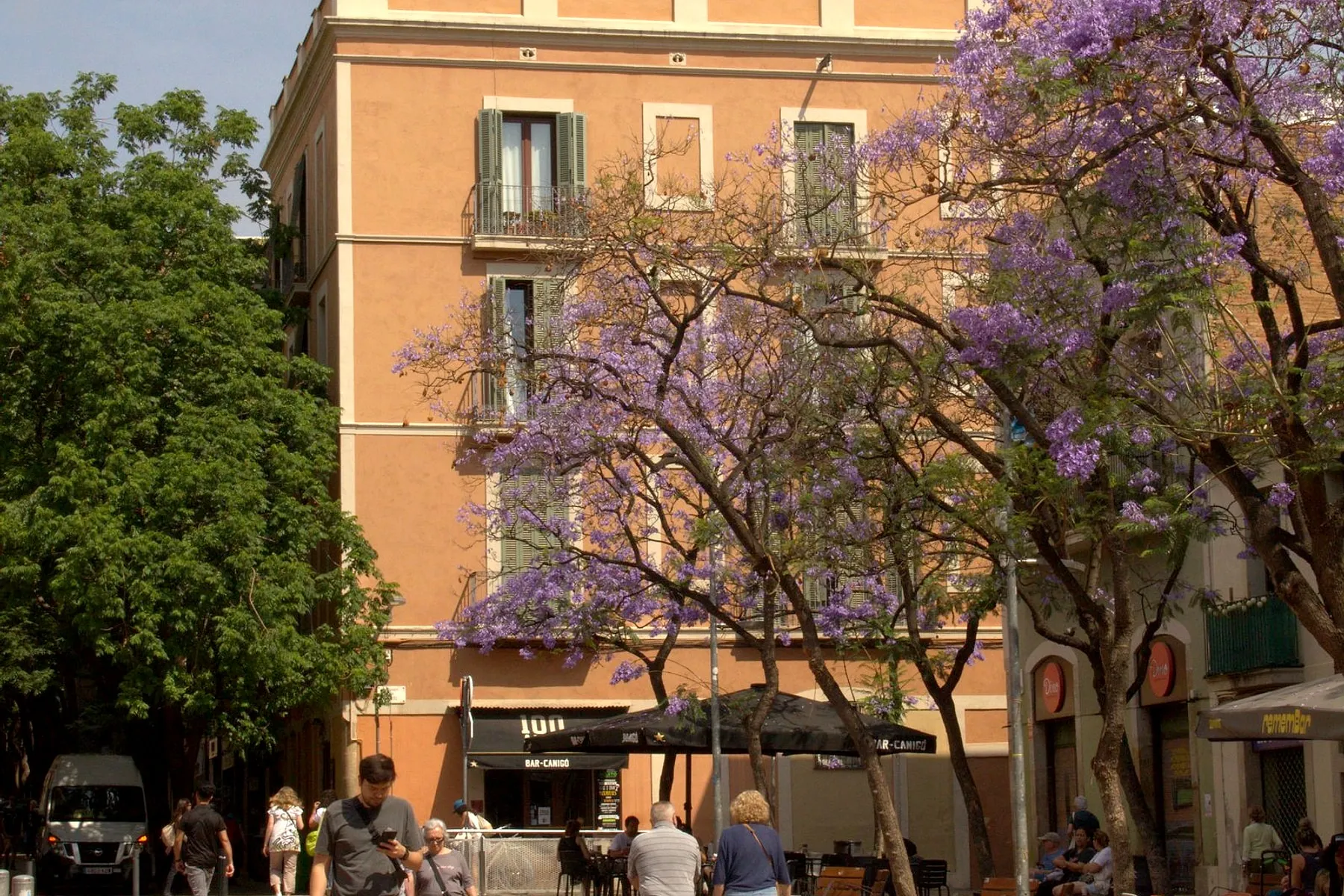
Halfway up the seaward slope of Montjuïc, at the bottom of a four-stage cascade, there is a fountain where the water comes out of a cat’s head.
It is one of the best-known objects on the hill. It has a building next to it that most people assume is part of it. It has a song attached to it in the popular memory. And when you go looking for what any institution will actually stand behind, you get four lines.
Here they are, in full, from the Ajuntament’s page for the Jardins de Laribal:
In the garden is the famous Font del Gat, very popular in the city at the end of the nineteenth century. The water flows from the head of a feline, sculpted by Joan Antoni Homs in 1918.
and, describing the gardens’ lower part:
They incorporate the popular Font del Gat and a nineteenth-century building.
That is it. A sculptor, a date, a century for the building next door, and the word famous.
What the city does not say
The municipal page does not name an architect for the building. It does not mention Puig i Cadafalch. It does not describe a restaurant or a merendero. It does not mention the song. And — the reason this page exists —
it does not explain the name.
The city tells you who carved the cat. It will not tell you why there is a cat.
That is a genuinely odd shape for a municipal heritage page to have. The Ajuntament is happy to attribute a 1918 sculpture to a named artist and to date a cascade in four sections, and then declines the one question every visitor asks.
The encyclopaedia is no help either, and the way it fails is worth knowing
If you go to the Gran Enciclopèdia Catalana and look up font del Gat, you get an entry. It reads:
Fountain of the municipality of Camarasa (Noguera).
A different fountain, a hundred and fifty kilometres inland, in a different comarca. The encyclopaedia has no entry for the Montjuïc one under that name.
⚠️ This is a trap and it has caught people working on this site. The same encyclopaedia’s entry for Montjuïc is a summit in the municipality of Pinós, in the Solsonès — not the hill above Barcelona. Two of the most searched names on this mountain resolve, in the national encyclopaedia, to somewhere else entirely. Citing either of those URLs for a fact about Barcelona is citing another place.
So when you read a confident paragraph about the origin of the name, footnoted to the encyclopaedia, check which fountain the footnote goes to.
What we are not going to reconstruct
⚠️ The building and Puig i Cadafalch. You will read that the little building beside the fountain is by Puig i Cadafalch. The Ajuntament says only a nineteenth-century building. Those two statements are not necessarily in conflict, and it would be dishonest to present them as an institutional contradiction — they are not. What they are is one sourced statement and one unsourced one. We publish the sourced one.
⚠️ The song. There is a very well-known Catalan song about a Font del Gat. The municipal pages about these gardens do not connect it to this fountain, and we are not going to make the connection on their behalf. If you have grown up with the song, you already know it; that is a different kind of knowledge from a citation, and we are not going to dress one up as the other.
⚠️ A restaurant or a merendero. Not on the page. Not from us.
This is the same discipline we applied when we could not source the height of Gaudí’s towers, and when we had to strike a Gràcia chimney claim we had published ourselves. If the sentence has no source, it does not go in.
What is genuinely worth seeing there
The cascade. A monumental cascade in four sections, separated by paths and channels, running down the slope and ending at the fountain. The whole system of terraces, ramps and steps is built to deliver you here.
The view from the fountain itself. The Ajuntament says it plainly: from the Font del Gat you can contemplate magnificent views of Barcelona. It is at the right height — high enough to see the shape of the city, low enough that the streets are still streets.
The rose garden, which is the first public one in Barcelona. The Jardins de Laribal are the first public rose garden created in Barcelona, known as the one of the Colla de l’Arròs — described by the city as a group somewhere between gastronomic and political that had a certain influence in the Barcelona of the end of the nineteenth century and the beginning of the twentieth, which met in a small building where the Ethnological Museum now stands.
A rose garden named after a dining club with opinions. That, at least, is documented.
And two pieces of sculpture. Estival, by Jaume Otero, 1929, an art déco seated female figure in marble, presiding over the roses. And near it, a glazed ceramic fountain with marine motifs by the ceramicist Llorens Artigas — the man who would later collaborate with Miró, whose foundation is five minutes up the hill.
How to get there, and why it is the right route
Come up from Plaça d’Espanya and do not ride the escalators the whole way. Cut into Laribal. You get the terraces, the pergola-viewpoints, the water staircase, the Font del Gat, and you arrive at the Greek Theatre gardens from above rather than from the road.
It takes twenty minutes longer than the escalators and it is the difference between having been to Montjuïc and having walked on it. The full set of gardens is here, and the ways up the hill are here.
Where this sits on the hill
The Laribal gardens sit between the 1929 fair buildings and the quarry the Greek Theatre was cut into. Everything on this flank is either a hole the city dug or a garden it put in the hole.
Our Montjuïc walk runs Tuesday and Thursday afternoons. We are closed on 25 December and 1 January.
Where this comes from
- Jardins de LaribalAjuntament de Barcelona · Parcs i JardinsThat the gardens are «la primera rosaleda pública que se creó en Barcelona, conocida como la de la Colla de l'Arròs»; that the Colla de l'Arròs was «un grupo entre gastronómico y político que tuvo cierta influencia en la Barcelona de finales del siglo XIX y principios del XX», meeting in a small building where the Ethnological Museum now stands; that «en el jardín se encuentra la famosa Font del Gat, muy popular en la ciudad a finales del siglo XIX. El agua mana desde la cabeza de un felino, esculpido por Joan Antoni Homs en 1918»; that the gardens «integran la popular Font del Gat y un edificio del siglo XIX»; that there is «una cascada monumental con cuatro secciones separadas por caminos y canales» ending at the fountain, «desde la que se pueden contemplar unas magníficas vistas de Barcelona»; and that the rose garden is presided over by Estival, by Jaume Otero (1929), with a glazed ceramic fountain nearby by the ceramicist Llorens Artigas. The page names no architect for the building and gives no explanation of the fountain's name.
- font del GatGran Enciclopèdia CatalanaThat the encyclopaedia's entry under this exact name is «font del municipi de Camarasa (Noguera)» — a fountain in a different comarca. There is no entry there for the Montjuïc fountain of the same name, which is why searching the encyclopaedia for it returns the wrong place.
Everything above that carries a date, a figure or a name is checked against these before it is published. Where we could not find a source, the page says so.
Quick answers
- What is the Font del Gat?
- A fountain in the Jardins de Laribal on Montjuïc, where the water comes out of a cat's head. The Ajuntament's page for the gardens says: «en el jardín se encuentra la famosa Font del Gat, muy popular en la ciudad a finales del siglo XIX. El agua mana desde la cabeza de un felino, esculpido por Joan Antoni Homs en 1918».
- Why is it called the Font del Gat?
- We do not know, and we could not find an institution that says. The municipal page names the sculptor of the cat's head and dates it, but gives no etymology at all. Nor does the Gran Enciclopèdia Catalana, whose entry for «font del Gat» is a fountain in Camarasa, in the Noguera — a different place entirely.
- Was the building designed by Puig i Cadafalch?
- The Ajuntament does not say so. What it says is that the gardens include «la popular Font del Gat y un edificio del siglo XIX». Note that a nineteenth-century building and a 1918 sculpture are not in conflict — the head was added later. But the attribution to Puig i Cadafalch is not supported by any open source we could find, and it is not a contradiction between institutions; it is a claim with nobody behind it.
- What about the song?
- There is a well-known Catalan song involving a Font del Gat, and the municipal pages about these gardens do not mention it. We are not going to reconstruct a link that the sources do not make.
- So what can you say for certain?
- That the fountain is in the Jardins de Laribal; that it was very popular in the city at the end of the nineteenth century; that the water comes from the head of a feline sculpted by Joan Antoni Homs in 1918; that there is a nineteenth-century building beside it; and that a monumental cascade in four sections runs down the slope and ends at the fountain, from which there is a considerable view over the city.
- Are the Laribal gardens worth the walk?
- They are the best route up the hill from Plaça d'Espanya, and the Ajuntament calls them «la primera rosaleda pública que se creó en Barcelona», known as the rose garden of the Colla de l'Arròs. The paths, terraces, ramps and cascades are the reason to walk instead of taking the escalators the whole way.
- Who was the Colla de l'Arròs?
- The Ajuntament describes it as «un grupo entre gastronómico y político que tuvo cierta influencia en la Barcelona de finales del siglo XIX y principios del XX», which met in a small building where the Ethnological Museum now stands. The rose garden is named after them.
The tours this piece is about
More in the journal
Montjuïc
- The gardens on Montjuïc are the reason people who live here come up the hill
- The floor of this terrace is 420 square metres of scrap, and it is not by the man everyone credits
- A good part of Barcelona is built on sand that this hill put there
- How high is Montjuïc? No institution in Barcelona will tell you
- The old city is made of the hill, and the hill has the holes to prove it
- Formula One raced through this park four times, and no institution in Barcelona records how it stopped