
Montjuïc
Barcelona built this castle to defend itself, and then spent two centuries being shelled from it
A fortress whose guns pointed the wrong way for most of its working life. The dates, the three bombardments, both sets of executions, and the things we could not verify.
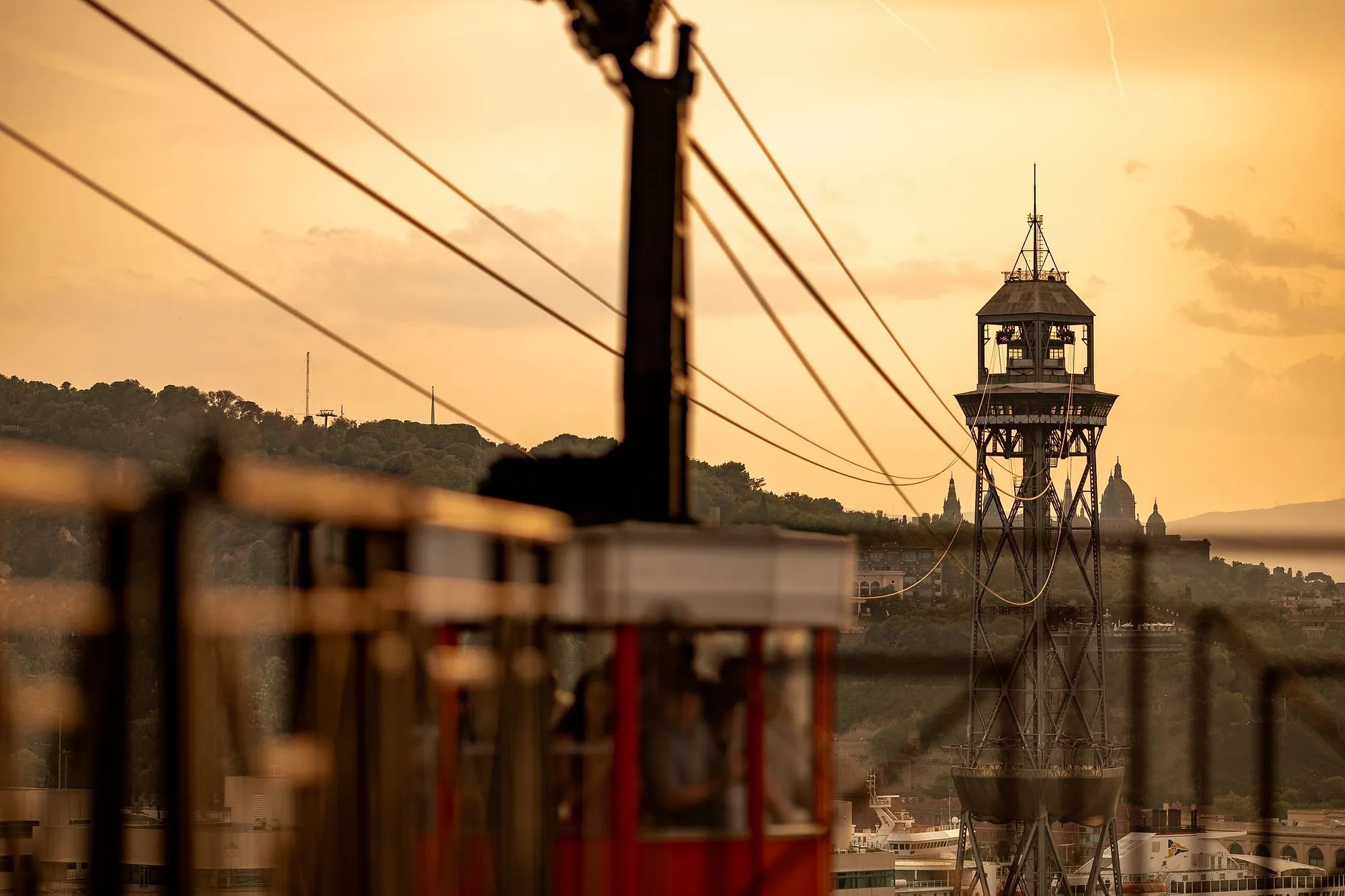
Most fortresses are built by a state to hold a coast. This one was built by a city, in a hurry, and then used against the city that built it for the better part of two centuries. Everything interesting about Montjuïc follows from that inversion.
Before the castle: a man watching for sails
There was a farell on the summit — a signal tower — documented as early as 1073. A sailor sat up there and warned Barcelona of hostile ships: with sails by day, with fires by night.
And below him, the hill was already being cut up. The Ajuntament calls the stone «one of the great riches of Montjuïc», and says most of Barcelona’s singular buildings were built from it — including the castle you are standing in.
That is what the hill was for, and in a sense it never stopped being for that. It has always been the place from which the city is watched.
Thirty days, in 1640
In 1640, with the fleet of Philip IV threatening a naval siege, the municipal government — the Consell de Cent — decided to fortify the top of Montjuïc. According to the Ajuntament’s own account, they built it in thirty days: a small quadrangular work with four half-bastions at the corners.
It worked. The Battle of Montjuïc was fought on 26 January 1641 and the city held.
Then, in 1652, Philip IV took Barcelona. The castle passed to the crown and a permanent garrison moved in.
That is the hinge, and everything after it is a consequence. The fort raised by the city in a month to keep an army out became the platform from which armies kept the city down.
The castle you actually walk around
The building on the summit today is not the 1640 work. Its outline comes from the eighteenth century.
Works were pushed forward through the 1690s, with the war against France, under the engineer Josep Chafrion. In 1706 a Bourbon and French assault left the place practically in ruins, and on 12 September 1714 — the day after the city fell — Bourbon troops entered the castle.
The rebuilding that produced the present fortress was the work of the military engineer Juan Martín Cermeño: projected in 1751 and executed between 1753 and 1779, with the glacis finished in 1779 and the works overall concluded around the middle of 1799.
A small honesty note. The city’s own pages do not entirely agree with each other about when this phase began — one says works were already under way around 1672, another dates the important push to 1694. We have given the range rather than picking whichever number reads best.
The three times it fired on the city
This is the part that gets called a legend and is not one. The Ajuntament documents all three, with figures.
3 December 1842. As punishment for a spontaneous revolt, General Espartero ordered the bombardment of Barcelona from the castle. Twelve continuous hours. Up to 1,014 shells, and at least twenty dead, with damage across the city.
10 November 1843, during the rising known as la Jamància. A systematic bombardment from Montjuïc that ran for two months: 335 dead, 354 injured, and around forty thousand people left the city.
July 1856. The bloodiest, and the one nobody has heard of. The bombardment came from Montjuïc together with the Ciutadella and the Drassanes, with military occupation and repression that caused more than four hundred deaths.
Three dates: 1842, 1843, 1856. The city’s interpretation centre lists them together in exactly that form.
What we are not going to say, because it circulates and we could not verify it: that the castle bombarded Barcelona in 1809. The municipal history goes from the Napoleonic occupation of 1808 straight to 1833 and supports nothing in between. And in 1714 the castle was the target, not the gun. In 1936–39 the Ajuntament describes its air-defence role as inoperative; it did not shell the city.
A prison, under more than one flag
This is where a walking tour has to be careful, because the moats were used by both sides and pretending otherwise would be dishonest.
1896–97, the Montjuïc trials. After a bomb was thrown at the Corpus procession in carrer dels Canvis Nous, the police made mass arrests. Detainees were imprisoned, tortured and tried inside the castle; the Gran Enciclopèdia Catalana states that the confessions were obtained by torture directed by a named Civil Guard officer. An international campaign followed and a pardon came in 1901.
The numbers here disagree between two institutional sources — the Ajuntament says around seven hundred arrested and four executed, the encyclopedia says around four hundred arrested and five executed on 3 May 1897. Both state the torture as fact. So we will tell you there was torture and there were executions, and we will not give you a count.
1909. After the Setmana Tràgica some two thousand people were arrested; five were shot in the moats. One of them was Francesc Ferrer i Guàrdia, on 13 October 1909.
1919. Around three thousand strikers from the Canadenca dispute were imprisoned in the castle.
1934. After the events of 6 October, courts martial and death sentences were carried out there.
1936–39, under the Republic. Nearly 1,500 people were imprisoned in the castle and around 250 executed — mostly military and civilians accused of treason and espionage against the Republic. On 11 August 1938 alone, sixty-two were shot in the Santa Elena moat. These were killings by the Republican side, in the same fortress, and the city’s own pages say so.
1939–60, under the Franco regime. A military prison, and again a place of execution. The city’s own pages on the castle put no number on this period. The number comes from elsewhere in the same city hall: for the memorial wall at the Camp de la Bota, Barcelona’s memory programme states that, on documentation drawn from the summary courts martial in research by the Arxiu Nacional de Catalunya, 1,706 people were executed in Barcelona between 1939 and 1952 — most at the Camp de la Bota, on the shore, “but also at Montjuïc Castle and at the Model prison”, where it was done by garrotte. The wall carries those 1,706 names.
And a second municipal source counts differently, so we are giving you both. The city’s cemetery service, describing the Fossar de la Pedrera where the remains lie, writes “the more than 1,700 people — 1,706 men and 11 women — executed by the Franco regime in Barcelona between 1939 and 1952”. That is 1,717. Same city, same years, same universe, eleven people apart, and the difference is eleven women who appear in one count and not in the other. Nobody publishes a reconciliation of the two. We are not going to pick the tidier one.
What neither source does is break the figure down by place, so how many of these people were shot in these moats is not something we can tell you.
15 October 1940
Lluís Companys, the president of the Catalan government, was arrested at La Baule on 13 August 1940, held in Paris and Madrid, and brought to Montjuïc, where he was kept isolated in cells off the parade ground.
Proceedings opened on 3 October. On 14 October 1940 a summary court martial was held; the Ajuntament records that it lasted less than an hour. At six in the morning on 15 October he was shot in the Santa Eulàlia moat.
You will very often read that he was the only president of a democratic European government executed by a fascist regime. No institution we could find states that, and it rests on definitions nobody agrees on. What the Gran Enciclopèdia Catalana does say is that his death has been claimed as a symbol of Catalonia and of a democratic government suppressed by the force of arms of a totalitarian regime. That says the same thing, and it cannot be knocked down.
He is not in the moat. He is up the hill at the Fossar de la Pedrera, and how he got there is a story of its own.
Giving it back
1960: the castle is partly ceded to the city, on the condition that a military museum go into it — a condition that reshaped the whole seaward flank of the hill. 1963: an equestrian statue of Franco is installed in the parade ground, and a Military Museum opens on 24 June.
27 April 2007: a ministerial order modifies the cession. 15 June 2008: a public festival marks its recovery for civil, social and cultural use, with tributes to Companys and to Ferrer i Guàrdia. The Military Museum closes on 24 May 2009. A master plan follows in April 2010. On 15 October 2011 — the anniversary — the Catalan flag that Companys raised in 1936 is restored there.
It has been listed as a national cultural asset since 1988 and is now run as a municipal facility. Its interpretation centre includes rooms on the castle as a place of repression and on the castle under the dictatorship, which is a more honest curatorial decision than most fortresses-turned-attractions make.
Practical, without numbers that go stale
Admission to the enclosure is charged, and the castle publishes its own free-admission windows, which change. Two things worth carrying up the hill:
- The castle states that it sells tickets only through its own website and has no arrangement with any third-party reseller. If somebody else is selling you one, that is worth a second look.
- The moats were opened to the public in the 1960s and the covered way around them became a public promenade, so a good deal of the exterior can be walked without a ticket. We are deliberately not telling you that you can reach the Santa Eulàlia moat — the execution site and its memorial — for free, because the castle’s pages do not say where today’s ticketed perimeter runs. Ask them.
How you get up there at all, including which of the three cable-car-shaped things is the one you want, is here.
Why we walk it in this order
Our Montjuïc walk climbs through the 1929 fairground before it gets here, and carries on afterwards to the quarry behind. That is not a scenic decision. A city that spent 1929 showing the world how modern it had become, and 1940 shooting its own president, did both things on this hill and within a quarter of an hour’s walk of each other.
Whether the afternoon is worth it at all is is Montjuïc worth it. And there is a smaller link back into the city: in 1870, when Gràcia rose against military conscription, the artillery that answered it came from this hill — the revolt of the quintes.
The oldest thing on this hill is not the castle and you cannot visit it: the medieval Jewish burial ground that gave Montjuïc its name, whose 529 located graves the city has deliberately left unopened.
Where this comes from
- Del farell al fortí de 1640Ajuntament de Barcelona · Castell de MontjuïcThe signal tower, the fort thrown up in 1640, the Battle of Montjuïc on 26 January 1641, and the castle passing to the crown in 1652.
- La fortalesa del segle XVIIIAjuntament de Barcelona · Castell de MontjuïcThe design of 1751, works from 1753, and the glacis finished in 1779.
- El Castell del segle XIXAjuntament de Barcelona · Castell de MontjuïcAll three bombardments of the city — 1842, 1843 and 1856 — with their figures, and the shooting of Ferrer i Guàrdia.
- El Castell durant la Segona República i la Guerra CivilAjuntament de Barcelona · Castell de MontjuïcThe nearly 1,500 imprisoned and around 250 executed between 1936 and 1939, and the sixty-two shot on 11 August 1938.
- El Castell del franquismeAjuntament de Barcelona · Castell de MontjuïcCompanys's court martial lasting under an hour, and his execution at six in the morning on 15 October 1940 in the Santa Eulàlia moat. It gives no count of people executed at the castle under the dictatorship.
- Espai Memorial Camp de la BotaAjuntament de Barcelona · Programes de MemòriaVerbatim, in Catalan: «Des de 1939 fins el 1952, segons la documentació extreta dels consells de guerra sumaríssims, en una recerca efectuada per l'Arxiu Nacional de Catalunya, a Barcelona van ser executades un total de 1.706 persones, la majoria en aquest espai del Camp de la Bota, però també al Castell de Montjuïc i a la presó Model; en aquest darrer cas l'execució es produí a garrot.» The memorial wall by Francesc Abad, 55 m long and 3.5 m high, carries the names of those 1,706 people. The page does not mention the Fossar de la Pedrera.
- El Fossar de la PedreraCementiris de Barcelona · Ajuntament de BarcelonaThe second, discrepant count. Verbatim, in Catalan: «les més de 1700 persones -1.706 homes i 11 dones- executades pel règim franquista, a Barcelona, entre 1939 i 1952», whose remains the Fossar holds — 1,717 in total, against the 1,706 of the memory programme's page. It does not break the figure down by place of execution, and no source we found reconciles the two.
- El retorn a la ciutadaniaAjuntament de Barcelona · Castell de MontjuïcThe ministerial order of 27 April 2007, the 2008 festival, the Military Museum closing in 2009 and the flag restored in 2011.
Everything above that carries a date, a figure or a name is checked against these before it is published. Where we could not find a source, the page says so.
Quick answers
- Why was Montjuïc Castle built?
- By the city, against the crown. In 1640, facing a naval siege by the fleet of Philip IV, the Consell de Cent decided to fortify the summit and did it in thirty days. Twelve years later the crown took Barcelona, the castle passed to it, and a permanent garrison moved in. From then on the fortress the city had built was the fortress that held the city.
- Did Montjuïc Castle really fire on Barcelona?
- Three times, all documented by the city: on 3 December 1842, on 10 November 1843, and in July 1856. The 1842 bombardment ran for twelve continuous hours. The 1843 one ran for two months.
- Who was executed at Montjuïc Castle?
- Among many others: Francesc Ferrer i Guàrdia on 13 October 1909, and Lluís Companys, the president of the Catalan government, on 15 October 1940. Both were shot in the moats. Executions took place there under the Republic during the Civil War and under the Franco regime after it.
- Is Montjuïc Castle worth visiting?
- Yes, and for the view second. It is a whole fortress you can walk around, with an interpretation centre that includes rooms on the castle as a place of repression — which is unusual, because most fortresses turned into attractions quietly skip that part.
- Do you have to pay to go into Montjuïc Castle?
- Yes, admission to the enclosure is charged, and the castle publishes free-admission windows on its own site. One thing worth knowing: the castle states that it sells tickets only through its own website and has no arrangement with any third-party reseller. If someone else is selling you a ticket, that is a flag.
The tours this piece is about
More in the journal
Montjuïc
- The eight-hour day was won on this avenue, and the decree that granted it does not mention it
- On the city's list of places residents avoid because of tourism, Montjuïc comes last
- There are three cable-car-shaped things on Montjuïc and most people book the wrong one
- The hill is named after a cemetery, and 529 of its graves are still down there unopened
- The quarry behind the hill, and the twenty-five columns of names
- The architect wanted to build a monument made of monuments, and the city let him