
Montjuïc
They put a lighthouse on the mountain because the old one was at sea level
A red-brick building with a silver dome on the seaward flank of the hill, which exists for a reason that is pure geometry — and a first lighthouse that is now a clock.
On the south-east flank of Montjuïc, above the container cranes, there is a two-storey building in red brick with a square tower and a silver dome. Most people photograph it by accident, in the corner of a shot of the port.
It is the landfall lighthouse of the port of Barcelona, and the reason it is up a mountain instead of down at the water is the most satisfying piece of engineering logic on this hill.
Why a lighthouse would climb
A light at sea level can only be seen as far as the curve of the earth allows, which is not very far. Raise the same lamp and the horizon retreats. Height is range, and range is the whole job of a landfall light — the one a ship looks for when it is still out in the dark trying to find the coast, as opposed to the harbour lights that take over once it is close.
The Port de Barcelona says it plainly:
It was built because of the port’s expansion southwards: built at 108 metres above sea level, the new lighthouse achieved a luminous range greater than the one the Llobregat lighthouse provided, situated at sea level.
Twenty-six nautical miles. Roughly forty-eight kilometres of visibility, bought by putting the lamp on a hill the city already had.
There is something neat in that. Barcelona’s port exists in spite of its geography — the Port’s own history says the city had no natural maritime shelter, and that the coastal dynamic brought a constant intake of sand, so there was never enough depth or safety for ships. The city had to build a harbour from nothing. But the one piece of geography it did have, the hill it was also quarrying itself out of, turned out to be exactly what the light needed.
Three dates, and they are not the same date
This is the kind of thing that gets flattened into “built in 1922” and should not be.
In the year 1906 a first lighthouse was built, which was replaced by the new building we keep today, built in 1922 and which came into operation in 1925.
A first light in 1906. A replacement building finished in 1922. Three more years before it was actually lit.
The building is by Josep Cabestany, and the Port calls it one of the most worked Catalan lighthouses from the architectural point of view — two storeys of red brick, a square-plan tower on top, and above that the cylindrical lantern finished with a silvered dome.
The light flashes twice every fifteen seconds. If you are on the hill after dark you can watch the beam go round.
And the first lighthouse of all is now a clock
The best fact here is not on the hill at all.
The Port’s history describes the slow, exhausting centuries of trying to make a harbour where the sand kept winning. The first works for a safe port began in 1477. And then:
by 1772 the mole already extended to the present moll de Pescadors, where the first lighthouse was built, today the Torre del Rellotge.
The Clock Tower at the Barceloneta end of the harbour — the one everybody walks past on the way to the beach and reads as harbour furniture — is the original lighthouse of the port of Barcelona. It stopped being a light and became a clock, and kept its shape.
Two lighthouses, a hundred and fifty years apart, and between them the whole argument of this hill: the port outgrew the sea-level solution and went up the mountain.
Around eighty maritime signals watch over the port’s waters today, and the Port Authority holds the legal competence over every lighthouse on the coast of Barcelona and Girona.
What we cannot tell you, and are not going to invent
⚠️ How tall Montjuïc is. Nobody official publishes it. The lighthouse’s 108 metres is not the summit — it is a point on the seaward flank, and the Port gives it because a light’s elevation is an operational number. We have written separately about the height nobody will state, because it is a better story than a made-up figure.
⚠️ Whether you can go in. It is a working aid to navigation on port land. If there are access arrangements, the Port publishes them; we are not going to send you up a hill on a guess.
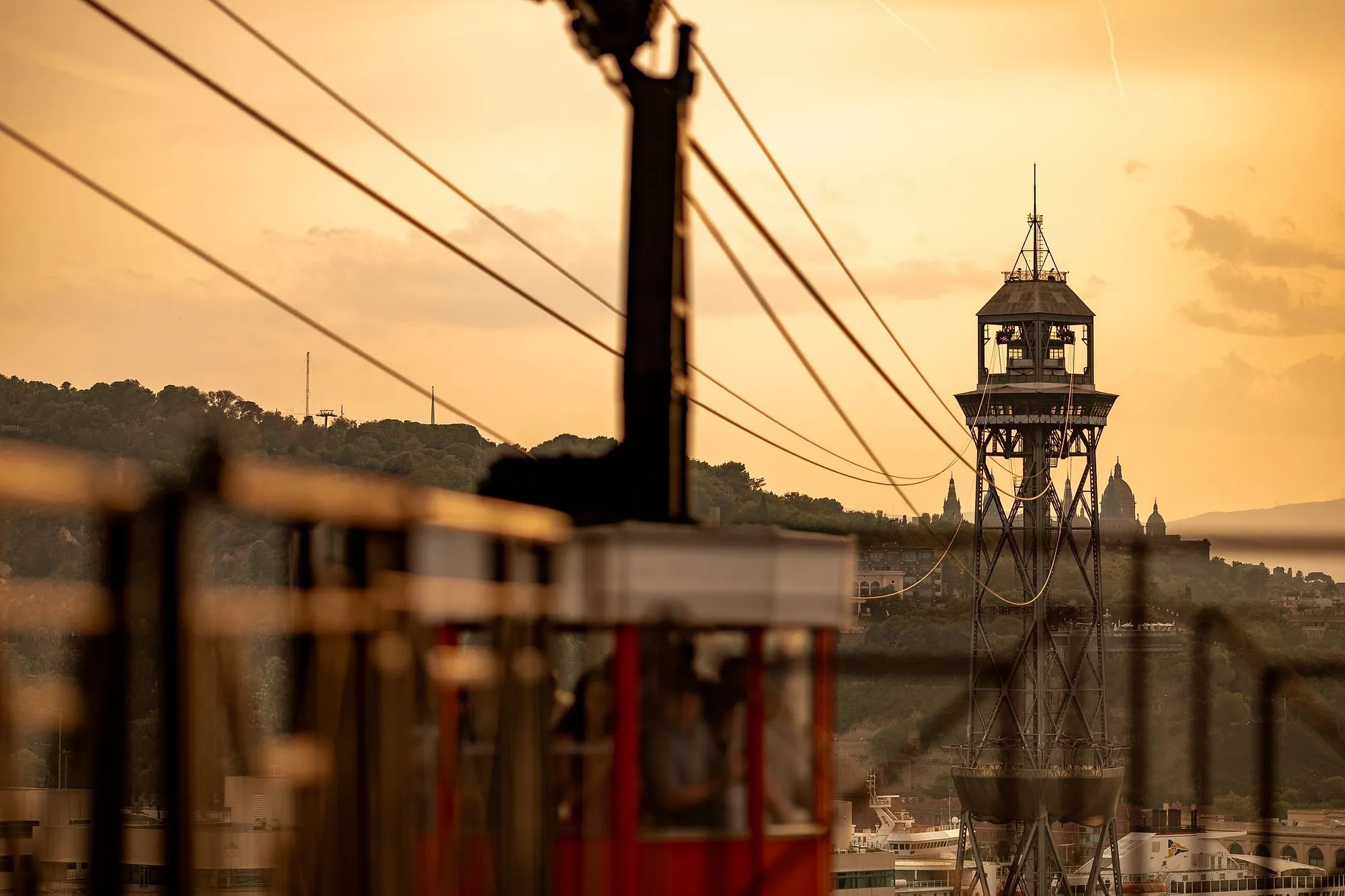
⚠️ The port cable car. The Transbordador Aeri is the other conspicuous structure on this flank and we have found no institutional material on it at all — no dates, no tower heights, not even a citable statement of which of the two towers is taller. So we say nothing. There are three cable-car-shaped things on this hill and most people book the wrong one, which is a separate problem we can help with.
How to see it
From the Costa i Llobera side. The gardens on the seaward flank, low down near the port cable-car station, look straight up at it. That is the best combination of a walk and a view of the lighthouse.
From the harbour, looking up. If you are down at the Barceloneta or on the Rambla de Mar, find the silver dome on the skyline. Then find the Clock Tower, near the fishing quay. You are looking at the first and the current lighthouse of the same port in one sweep of the eye.
At night, from anywhere on the hill. Two flashes, then a pause. It is still doing the job it was built for in 1925.
Where this sits on the hill
The lighthouse belongs with the port below it, with the terrace and the mosaic floor a little further round, and with the castle above it — three ways the same mountain has been used to watch the sea.
Our Montjuïc walk runs Tuesday and Thursday afternoons. We are closed on 25 December and 1 January.
Where this comes from
- Senyalització marítima — Far de MontjuïcPort de BarcelonaThat it is the «far de recalada del Port de Barcelona, situat al vessant sud-est de la muntanya de Montjuïc»; that it was built because of the port's southward expansion, «edificat a 108 metres sobre el nivell del mar, el nou far aconseguia un abast lluminós superior al que proporcionava el far del Llobregat, situat al nivell del mar»; the range of 26 nautical miles and the height of 108 m; that «l'any 1906 es va construir un primer far, que va ser reemplaçat per l'obra de nova planta que conservem avui, edificada el 1922 i que va entrar en funcionament el 1925»; and that it is the work of Josep Cabestany, «un dels fars catalans més treballats des del punt de vista arquitectònic», a two-storey red-brick building «coronat amb una torre de planta quadrada. A sobre hi ha instal·lada la llanterna cilíndrica, rematada amb una cúpula platejada».
- Coneix el Port — HistòriaPort de BarcelonaThat Barcelona «no tenia resguards marítims naturals»; that the Iberians and other pre-Roman peoples used «la badia natural al sud de Montjuïc» for maritime exchange; that the first works for a safe port began in 1477; and that «el 1772 el dic ja s'estenia fins a l'actual moll de Pescadors, on es va edificar el primer far, avui la Torre del Rellotge».
Everything above that carries a date, a figure or a name is checked against these before it is published. Where we could not find a source, the page says so.
Quick answers
- Why is there a lighthouse on top of Montjuïc?
- Height. The Port de Barcelona explains it as a consequence of the harbour growing southwards: «edificat a 108 metres sobre el nivell del mar, el nou far aconseguia un abast lluminós superior al que proporcionava el far del Llobregat, situat al nivell del mar». A light at sea level has a short horizon; put the same lamp on a hill and it is seen from much further out.
- How far can the Montjuïc light be seen?
- The Port gives a range of 26 nautical miles, from 108 metres above sea level. It is a landfall light — «far de recalada» — which is the light a ship uses to find the coast, as opposed to the lights that guide it once it is close in.
- How old is the building?
- Three dates and they are all different. The Port says «l'any 1906 es va construir un primer far, que va ser reemplaçat per l'obra de nova planta que conservem avui, edificada el 1922 i que va entrar en funcionament el 1925». Built 1922, in service 1925, replacing a first light of 1906.
- Who designed it?
- Josep Cabestany. The Port calls it «un dels fars catalans més treballats des del punt de vista arquitectònic»: a two-storey red-brick building crowned by a square-plan tower, with a cylindrical lantern on top finished with a silvered dome.
- What was Barcelona's first lighthouse?
- It is still standing, and it is not a lighthouse any more. The Port's history says that by 1772 the mole already extended to the present moll de Pescadors, «on es va edificar el primer far, avui la Torre del Rellotge» — the Clock Tower. The first lighthouse of the port of Barcelona became a clock.
- Can you visit it?
- It is a working aid to navigation on port land, not a museum, and we are not going to tell you it is open. If access arrangements exist they are the Port's to publish. What you can do from the public paths on that flank of the hill is see it clearly, which is most of the point.
- Who is responsible for the lighthouses around Barcelona?
- The Port de Barcelona, by law, for the whole coastline of Barcelona and Girona. It also says that close to eighty maritime signals watch over the port's own waters.
The tours this piece is about
More in the journal
Montjuïc
- Formula One raced through this park four times, and no institution in Barcelona records how it stopped
- The Magic Fountain was switched off for two and a half years, and the city's own spec sheet still describes a machine that no longer exists
- The most influential building in Barcelona stood for about a year, and the one you can visit is legally a new building
- A modernista cotton mill that spent longer as a police barracks than as a factory
- Barcelona had no natural harbour, so it spent five hundred years building one
- Barcelona is knocking down three cruise terminals, and the mayor called it the first limit in history