
Montjuïc
There are three cable-car-shaped things on Montjuïc and most people book the wrong one
A funicular, a cable car to the castle, and a cable car across the water that is not the same thing at all. Sorting out which is which is most of the problem.
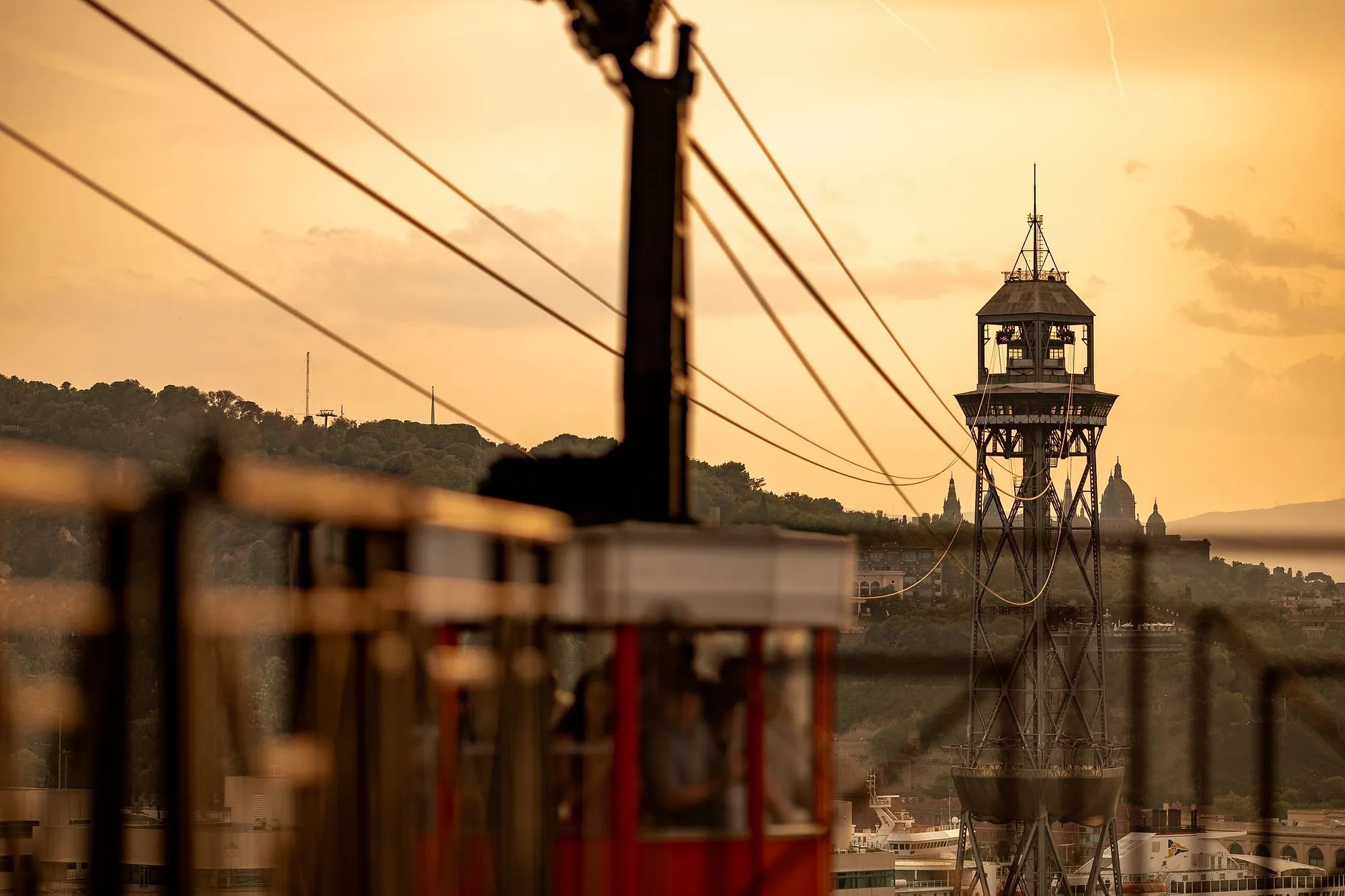
Montjuïc defeats more itineraries than any other part of Barcelona, and it is almost never the hill’s fault. It is the names.
There is a funicular. There is a cable car up to the castle. (How high you end up, incidentally, nobody official will say.) And there is a completely different cable car that crosses the harbour and does not go anywhere near the castle. All three get called the cable car in conversation, all three appear in search results for the same question, and people routinely buy the third one expecting the second.
Here they are, sorted.
1. The funicular — the one already in your ticket
From Paral·lel, where metro lines L2 and L3 stop, a funicular runs up into the park. It climbs seventy-six metres in under two minutes, and the transport operator gives it a line code like a metro line, which is essentially what it is.
It is inside the normal fare. The operator lists the single ticket as valid for metro, bus and the Montjuïc funicular, and the city says integrated tickets, season tickets and the tourist travel cards work on it as well.
This is the single most useful fact on this page. A large number of people pay for a cable car to do a job that their existing ticket already covers.
2. The Montjuïc cable car — the one that reaches the castle
From Parc Montjuïc, at the top of the funicular, the Telefèric de Montjuïc goes up to the castle. Its own description of the route is a direct ascent, with an optional stop at the Mirador de l’Alcalde on the way back down.
It needs its own ticket. The city lists the integrated services and does not include this one; the operator sells its own. So if you want to arrive at the castle gate without walking uphill, this is the one you pay for — and the funicular below it is still free with your travel card, which means you only ever pay for the top half.
We are not printing its prices or its hours, and we would gently suggest you distrust any page that does.
3. The port cable car — a lovely ride to somewhere else
The Transbordador Aeri del Port crosses the water between Miramar, on the seaward side of Montjuïc, and the Torre de Sant Sebastià in Barceloneta. Different operator, different ticket, different journey.
It does not take you to the castle. It takes you to the beach, or from the beach to the lower flank of the hill, hanging over the harbour on the way.
It is also the oldest thing in this list: it was designed in 1926 by Carles Buïgas — the engineer who built the Magic Fountain — with Ramon Calzada and Josep M. Roda, specifically to connect the 1929 Exposition to its maritime section. Which is a good reason to ride it and a bad reason to book it if what you wanted was a fortress.
4. The escalators — free, and barely signposted
From Avinguda Reina Maria Cristina, the long axis running up from Plaça d’Espanya, there are around twenty escalators taking you up and down the mountain past the museum.
They cost nothing, they are outdoors, and they do the whole first climb. If you are arriving at Plaça d’Espanya — which almost everybody does, because that is where the two brick towers are — this is the default and hardly anyone knows it exists.
5. The buses — the only thing that goes all the way up
The 150 leaves from Plaça d’Espanya and covers a good part of the mountain, up to the castle; the castle’s own page puts the ride at about twenty minutes. The 55 comes in from the city centre and climbs through Poble-sec. Several other routes serve the lower slopes.
If you have limited mobility, or you are doing this in August at three in the afternoon, the bus is not a compromise. It is the correct answer.
6. On foot
From the top of the funicular to the castle is a documented walk: twenty to twenty-five minutes, constantly uphill, steep in places, going through the Joan Brossa and Mossèn Cinto Verdaguer gardens. It is a good walk and the gardens are the reason to do it.
From Plaça d’Espanya to the castle on foot, we are not going to give you a figure. There is no marked route we could find documented and no published ascent, and inventing one is exactly how somebody ends up halfway up a hill in the sun with the wrong shoes.
How big is this thing, actually
The encyclopedia gives the hill as 192 metres. No institution we could find publishes a height of its own, so treat 192 as the encyclopedia’s rather than as settled.
On the area, a correction we owe you. This page used to say the city puts the park at 376 hectares. No institution publishes that figure. What the Ajuntament does publish, in its Pla d’Actuació del Parc de Montjuïc 2019-2029, is 316 hectares for the equipped park and 337.97 hectares for the wider 2014 planning scope.
The area is still the number that changes how you plan. Montjuïc is not a sight, it is a district: three hundred-odd hectares with a museum, a fairground, a castle, a cemetery, gardens, a stadium and an unmarked quarry in it. Nobody does it in an hour between two other things, and the attempts are what produce the reviews saying it was fine.
The combinations that actually work
- Least effort, most seen. Metro to Espanya, escalators up past the museum, bus or cable car to the castle, funicular down to Paral·lel.
- Cheapest. Metro to Paral·lel, funicular up on your normal ticket, walk the gardens to the castle. Only the castle admission costs anything.
- Best afternoon, if you have one. Come up from Plaça d’Espanya, do the 1929 fairground, then the castle, then the Fossar de la Pedrera behind it, and come down over the water on the port cable car at the end. That is a full half day and it is the sequence that makes the hill make sense.
One warning that will date this page
The lower slopes are a building site. The city has begun transforming the old exhibition grounds — some of the fairground palaces are coming down, a second phase is scheduled from 2029, and the programme runs to 2035, timed to finish for the centenary of the 1929 Exposition.
Check before you plan an afternoon around a specific palace.
Whatever you take, the gardens are the reason to walk part of it rather than ride all of it — which ones, and why several are in old quarries.
And if you would rather not work any of this out
Our Montjuïc walking tour meets at the foot of the brick towers on Plaça d’Espanya and does the climbing for you, in the order that makes the hill legible. Tell us when you book if the ascent is a problem and we route it by escalator and funicular — that is what those are for.
Whether the hill deserves the afternoon in the first place is the honest version in is Montjuïc worth it.
Where all of this starts, and what is worth ten minutes before you climb, is Plaça d’Espanya. What is at the bottom of the other side, once you come down, is Poble-sec and the Paral·lel.
The funicular being inside your metro ticket is not a quirk of this hill — it is a line of the metro network, counted in the operator’s own totals. That and the rest of the network, including the barrier at the airport, is getting around Barcelona.
The escalators, the buses and the promised metro line are all in the city’s 2025 plan for the mountain, which we have gone through with the figures attached.
Where this comes from
- Pla d'Actuació del Parc de Montjuïc (PDF, Decidim Barcelona)Ajuntament de Barcelona · Pla d'Actuació del Parc de Montjuïc 2019-2029The area of the park as the city itself plans it: «aquest àmbit de parc (316 Ha)» for the equipped park and «l'àmbit de la MPGM 2014 (337,97 Ha)» for the wider planning scope. It is the document that retired the 376 hectares this page used to carry.
- Telefèric de Montjuïc — official siteTelefèric de MontjuïcThat the cable car sells its own ticket, separate from the transport fare, and that the Mirador de l'Alcalde stop is optional.
- Història del Castell de MontjuïcAjuntament de Barcelona · Castell de MontjuïcWhat is at the top, which is where all of these ways up are going.
Everything above that carries a date, a figure or a name is checked against these before it is published. Where we could not find a source, the page says so.
Quick answers
- Is the Montjuïc funicular included in the metro ticket?
- Yes. The transport operator lists the single ticket as valid for metro, bus and the Montjuïc funicular, and the city says integrated and season tickets and the tourist travel cards work on it too. It runs from Paral·lel, where metro lines L2 and L3 stop, and climbs seventy-six metres in under two minutes.
- What is the difference between the Montjuïc cable car and the port cable car?
- They are two unrelated services. The Telefèric de Montjuïc runs up the hill from Parc Montjuïc to the castle and needs its own ticket. The Transbordador Aeri del Port crosses the harbour between Miramar and the Torre de Sant Sebastià in Barceloneta, has a different operator and a different ticket, and does not take you to the castle at all.
- Can you walk up Montjuïc?
- Yes, and the escalators do the worst of the first stretch for nothing. From the top of the funicular to the castle the walk takes twenty to twenty-five minutes, is constantly uphill and is steep in places, going through the Joan Brossa and Mossèn Cinto Verdaguer gardens. We are not going to give you an ascent figure for Plaça d'Espanya to the castle on foot, because no source publishes one.
- Which bus goes to Montjuïc Castle?
- The 150 leaves from Plaça d'Espanya and runs a good part of the mountain up to the castle; the castle's own page puts it at about twenty minutes. The 55 comes from the city centre and climbs through Poble-sec.
- How high is Montjuïc?
- The Gran Enciclopèdia Catalana gives 192 metres, and no institution we could find publishes a height of its own, so treat 192 as the encyclopedia's number rather than a settled one. On the area, the Ajuntament's own Pla d'Actuació del Parc de Montjuïc 2019-2029 gives 316 hectares for the equipped park and 337.97 for the wider planning scope. The 376 hectares in general circulation — which this page used to carry — is not published by anybody.
The tours this piece is about
More in the journal
Montjuïc
- Is Montjuïc worth it? Give it half a day or give it nothing
- The city calls this the third great transformation of Montjuïc, and it has been counting from 1929
- The bullring closed twenty-one years before bullfighting was banned, and the ban was struck down anyway
- The eight-hour day was won on this avenue, and the decree that granted it does not mention it
- On the city's list of places residents avoid because of tourism, Montjuïc comes last
- Barcelona built this castle to defend itself, and then spent two centuries being shelled from it