Gaudí
Eighteen towers, and the tallest one was only finished in 2026
Everybody counts the spires and nobody knows what they are. There are meant to be eighteen; there are fourteen; the last one went up in stages from 2018 and the top of its cross was fitted in February 2026.
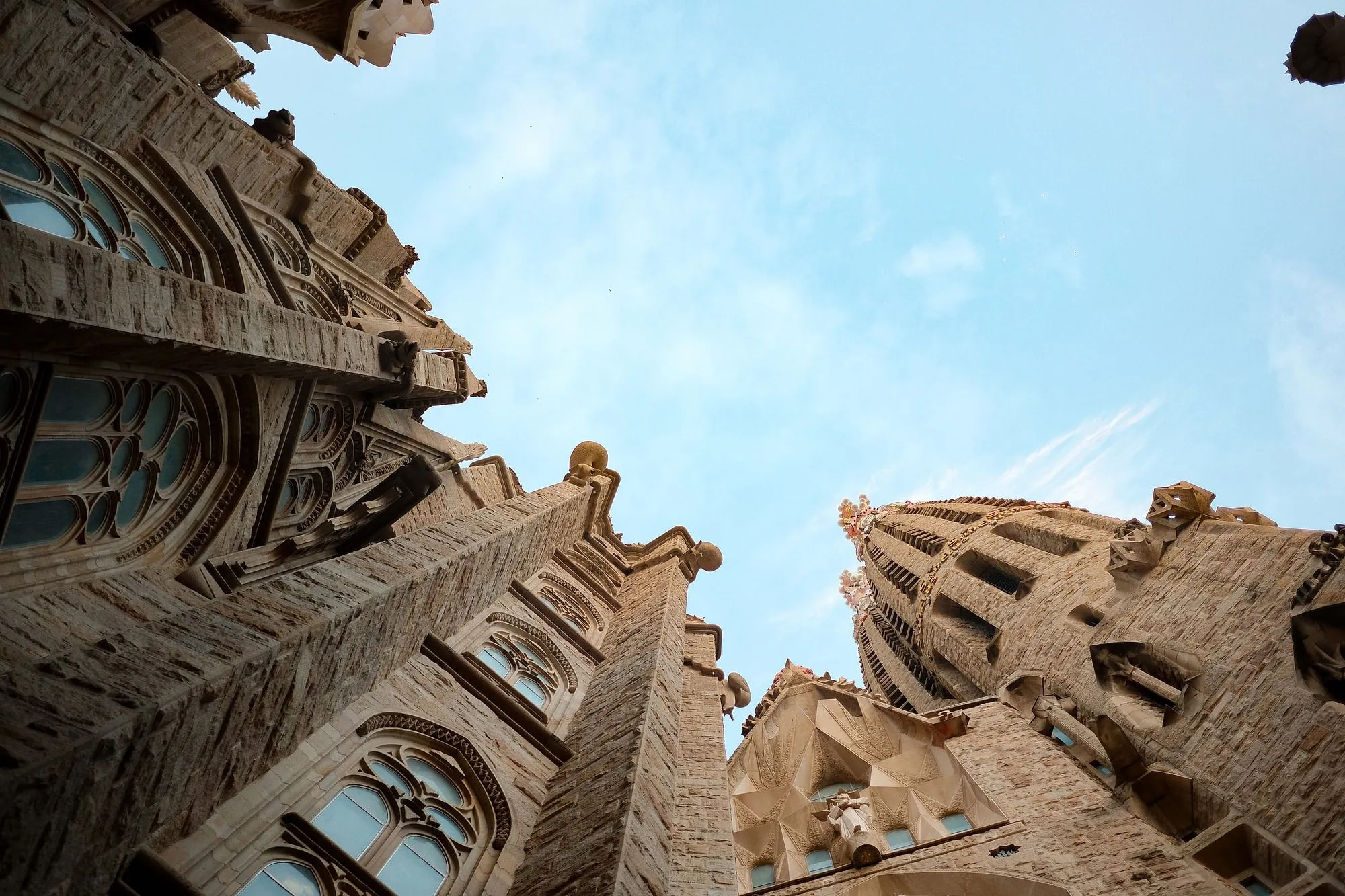
Stand on the pavement at the Sagrada Família and you will hear people counting. It is the natural response to the building and it never produces the same answer twice, because the towers are all different heights, several are hidden behind others, and four of them are not there.
Here is the whole scheme, from the basilica’s own notebooks. It is simpler than it looks and it is a hierarchy, not a decoration.
Eighteen, in three ranks
The design has eighteen towers, arranged, in the basilica’s phrase, in a pyramidal structure expressing the hierarchy of their symbolism.
Twelve bell towers — the apostles. These are the clusters of four you see on each façade. Eight are built: four on the Nativity façade, four on the Passion. The remaining four belong to the Glory façade and do not exist. Height: between 98.5 and 120 metres.
Four towers — the Evangelists. The thicker towers immediately around the centre, 135 metres each, finished in 2022 and 2023. Mark, Matthew, Luke and John.
One tower — the Virgin Mary. Over the apse, 138 metres, finished in 2021. It is the one with the star on it that people photograph at night without knowing what it is.
One tower — Jesus Christ. In the middle of the crossing, 172.5 metres, and it was finished this year.
So: fourteen standing, four to come, and the four that are missing are on the front door.
A number that does not agree with itself
Since we are quoting one publisher throughout, here is where it disagrees with itself. The notebook on the towers says the bell towers stand between 98.5 and 120 metres, and its diagram says the same. The notebook on the architecture, in the same edition, calls them each roughly 100 metres tall.
Use the range. A hundred metres is a gloss, and it is wrong by twenty metres at the top end.
172.5, and why it is that number
The height of the central tower is not a round figure and it is not a competitive one. It is twenty-three times 7.5 metres — the module the entire building is set out on, the same one that makes the side naves thirty metres, the central nave forty-five, the crossing sixty and the apse seventy-five. Everything in the interior is a multiple of it, and so is this.
You will be told, on the pavement, that Gaudí capped the tower deliberately so that his church would not rise above the hill of Montjuïc, because a work of man should not outdo a work of God. It is a lovely story. The basilica does not say it anywhere. It gives 172.5 metres, gives the arithmetic, and stops. That story and ten others are dealt with in things you will be told about Gaudí that are not true.
What the basilica does say, in its own account of the day the tower was blessed, is this:
At 172.5 metres in height, this tower becomes the highest point of the Basilica and makes the Sagrada Família the tallest church in the world.
That is a claim by an interested party, and we are giving it to you as one — attributed, quoted, and not repeated as our own.
How the last tower actually went up
The construction record is unusually legible, because it happened recently enough to be documented in press releases rather than reconstructed from archives.
- 16 October 2018 — the first panels are placed, at a height of 85 metres. The tower is built from twelve levels of panels, on a shaft with twelve faces.
- 20 February 2026 — the last piece of the cross is installed.
- 10 June 2026 — the tower is blessed.
The cross on top is its own object: three-dimensional, four-armed, clad in glass and white glazed ceramic, 17 metres tall and 13.5 metres wide. Inside it there is a sculpture of the Lamb, by the Italian artist Andrea Mastrovito, following Gaudí’s original design.
Seventeen metres. That is a five-storey building, sitting on top of a tower, as the finial.
There is also a room inside the tower — the Sala Creuer, at 80 metres, which is 65 metres above the floor of the church.
The day itself, 10 June 2026
The date was not chosen for the tower. 10 June 1926 is the day Gaudí died, and 2026 is the centenary — which is why the blessing happened on the exact hundredth anniversary of the death of the man who drew it. How he died, and what is and is not settled about it, is here.
Pope Leo XIV presided over the mass and blessed the tower. He is, on the basilica’s count, the third pontiff to visit, after John Paul II in 1982 and Benedict XVI in 2010 — the visit at which the church was dedicated and opened for worship.
More than 8,500 people took part: 4,500 inside the church and 4,000 outside it. Before the liturgy he went down into the crypt and prayed at Gaudí’s tomb, which is a hundred metres and a century away from the cross that had just been finished.
One thing worth noticing about the paperwork
The basilica’s technical notebooks carry an edition date of February 2026 and they still describe the central tower in the future tense — it will reach 172.5 metres, it will have a finished height. They were edited before the tower was topped out and were not updated afterwards.
Which is a small thing, and also a useful warning: an official document being current is not the same as an official document being right. We flag it because if you download those notebooks — and you should, they are the best free thing published about this building — you will read the future tense about something that already exists.
The four that are missing, and where they go
Walk round to carrer de Mallorca. That side faces the sea, it is the main entrance, and it is the one that is not built.
The basilica’s notebook on the Glory façade is written entirely in the future: it will show the history of humanity from Adam and Eve to the last judgement, it will have a great narthex, and it will carry four bell towers, dedicated to the apostles Andrew, Peter, Paul and James the Greater.
So the count today is fourteen of eighteen, and the four outstanding are all on the same side. That is the single most useful thing to know when you are standing on the pavement trying to work out whether the building is nearly done.
Why it takes this long — and it is a better answer than the one people expect — is set out here. What has been added since 1926 and on whose authority is part of what happened to Gaudí’s buildings.
Which tower is which, from the street
The practical version, for someone standing outside:
On the two built façades, in clusters of four: apostles. Nativity side to the north-east, Passion side to the south-west.
The one with the star, over the apse end: the Virgin Mary.
The four thicker ones close in around the middle: the Evangelists. If you can see a bull, a lion, an eagle or a winged man on them, that is how you tell them apart.
The tall one: Jesus.
And the whole thing reads better from a distance than from the railings. What to look at on the façades themselves, and the four dates that make sense of them, is the Sagrada Família from the outside, which is free and does not need a ticket.
What we are not going to tell you
Whether to buy tower access, and which one. The basilica sells it separately from entry, the arrangements change, and a page that names a tower and a condition will be wrong within the year. Check the basilica’s own site. What genuinely has to be booked in Barcelona, and what does not, is here.
The man, on the pavement
Our Gaudí walk happens outside, performed by an actor playing Gaudí, in the streets around the basilica. Ninety minutes, fifteen people, no ticket office, because there is nothing to get into.
The towers are free to look at, and now you know which is which.
Where this comes from
- Information Booklet 10 — Bell towers, domes and sacristies (PDF)Basílica de la Sagrada FamíliaThat 'the central tower, located in the middle of the crossing and with a finished height of 172.5 metres, is dedicated to Jesus Christ'; that the bell towers 'stand between 98.5 and 120 metres tall' and represent the apostles; that of the towers built today eight are bell towers, four each on the Nativity and Passion façades, and that with the four to be built on the Glory façade there will be twelve in total; and the diagram values of Jesus 172.5 m, Mary 138 m and Mark, Matthew, Luke and John 135 m each.
- Information Booklet 4 — The architecture of the Sagrada Família (PDF)Basílica de la Sagrada FamíliaThat the tallest tower is over the crossing, represents Jesus Christ and stands 172.5 metres tall, 'twenty-three times 7.5 metres, the base module for the dimensions of the naves and towers'; that it is surrounded by four thinner towers 135 metres tall representing the Evangelists, completed in 2022 and 2023; that a further 138-metre tower completed in 2021 covers the apse and represents the Virgin Mary; and that the design has eighteen towers, the shortest twelve on the façades and the six tallest in the centre, 'in a pyramidal structure expressing the hierarchy of their symbolism'. This booklet also describes the bell towers as 'each roughly 100 meters tall', which does not match the 98.5–120 metre range given in Booklet 10.
- El Papa Lleó XIV presideix la missa solemne de commemoració del centenari de la mort d'Antoni Gaudí i beneeix la torre de JesucristBasílica de la Sagrada FamíliaThat on 10 June 2026 Pope Leo XIV presided over the mass commemorating the centenary of Gaudí's death and blessed the tower of Jesus Christ; that he was the third pontiff to visit the basilica, after John Paul II in 1982 and Benedict XVI in 2010; that before the liturgy he visited the crypt and prayed at Gaudí's tomb; that more than 8,500 people took part, 4,500 inside and 4,000 outside; that 'amb 172,5 metres d'alçària, aquesta torre esdevé el punt més elevat de la Basílica i converteix la Sagrada Família en l'església més alta del món'; that the tower has twelve faces and twelve levels of panels, the first raised on 16 October 2018 at a height of 85 metres; and that it is crowned by a three-dimensional four-armed cross clad in glass and white glazed ceramic, 17 metres tall and 13.5 metres wide, with a sculpture of the Lamb by the Italian artist Andrea Mastrovito following Gaudí's original design.
- Benedicció i inauguració de la torre de JesucristBasílica de la Sagrada FamíliaThat work on the tower ran from 16 October 2018, with the first panels placed at a height of 85 metres, to the installation of the last piece of the cross on 20 February 2026; and that the Sala Creuer inside the tower of Jesus Christ sits at 80 metres, 65 metres above the level of the temple floor.
- Information Booklet 8 — The Glory façade, Baptistery and chapels (PDF)Basílica de la Sagrada FamíliaThat the Glory façade, on carrer de Mallorca, faces the sea, that work continues on the project for it, and that it 'will also have a great narthex and four bell towers', in this case dedicated to the apostles Andrew, Peter, Paul and James the Greater — all future tense, because none of it is built.
Everything above that carries a date, a figure or a name is checked against these before it is published. Where we could not find a source, the page says so.
Quick answers
- How many towers does the Sagrada Família have?
- Eighteen when it is finished. Twelve bell towers for the apostles, four for the Evangelists, one for the Virgin Mary and one for Jesus Christ. Fourteen stand today: eight of the twelve bell towers, plus the six central ones. The four missing bell towers belong to the Glory façade, which has not been built.
- How tall is the Sagrada Família?
- 172.5 metres at the central tower, which is dedicated to Jesus Christ. That is twenty-three times the 7.5-metre module the whole building is set out on. The tower was blessed on 10 June 2026, and the basilica states that it makes the Sagrada Família the tallest church in the world.
- Which tower is which?
- The four thin towers around the centre are the Evangelists, at 135 metres, finished in 2022 and 2023. The one over the apse, at 138 metres, is the Virgin Mary, finished in 2021. The tall one in the middle is Jesus Christ. The clusters of four on each of the two built façades are apostles.
- How tall are the bell towers?
- Between 98.5 and 120 metres, according to the basilica's notebook on the towers and the diagram in it. Another of its notebooks describes them loosely as roughly a hundred metres each. The range is the better figure.
- Can you go up a tower?
- The basilica sells access to towers on the built façades, and it is a separate thing from entry to the building. We are not printing which ones, or the conditions, because that is exactly the sort of detail that changes — the basilica's own site is the place to check it.
The tours this piece is about
More in the journal
Gaudí and Modernisme
- UNESCO listed three Gaudí buildings in 1984 and four more in 2005, and its own pages cannot agree on that
- Gaudí worked on the Ciutadella park, and the encyclopaedia cannot agree on whether he was still a student
- Things you will be told about Gaudí that are not true
- How to look at the Sagrada Família from the street
- Inside the Sagrada Família: a forest, on purpose, and the basilica says so itself
- George Orwell thought the anarchists should have blown it up