
Gaudí
George Orwell thought the anarchists should have blown it up
Not everybody likes it, and the most quotable person who did not like it wrote his verdict down in 1938. Here is the passage, with the parts he was wrong about marked.
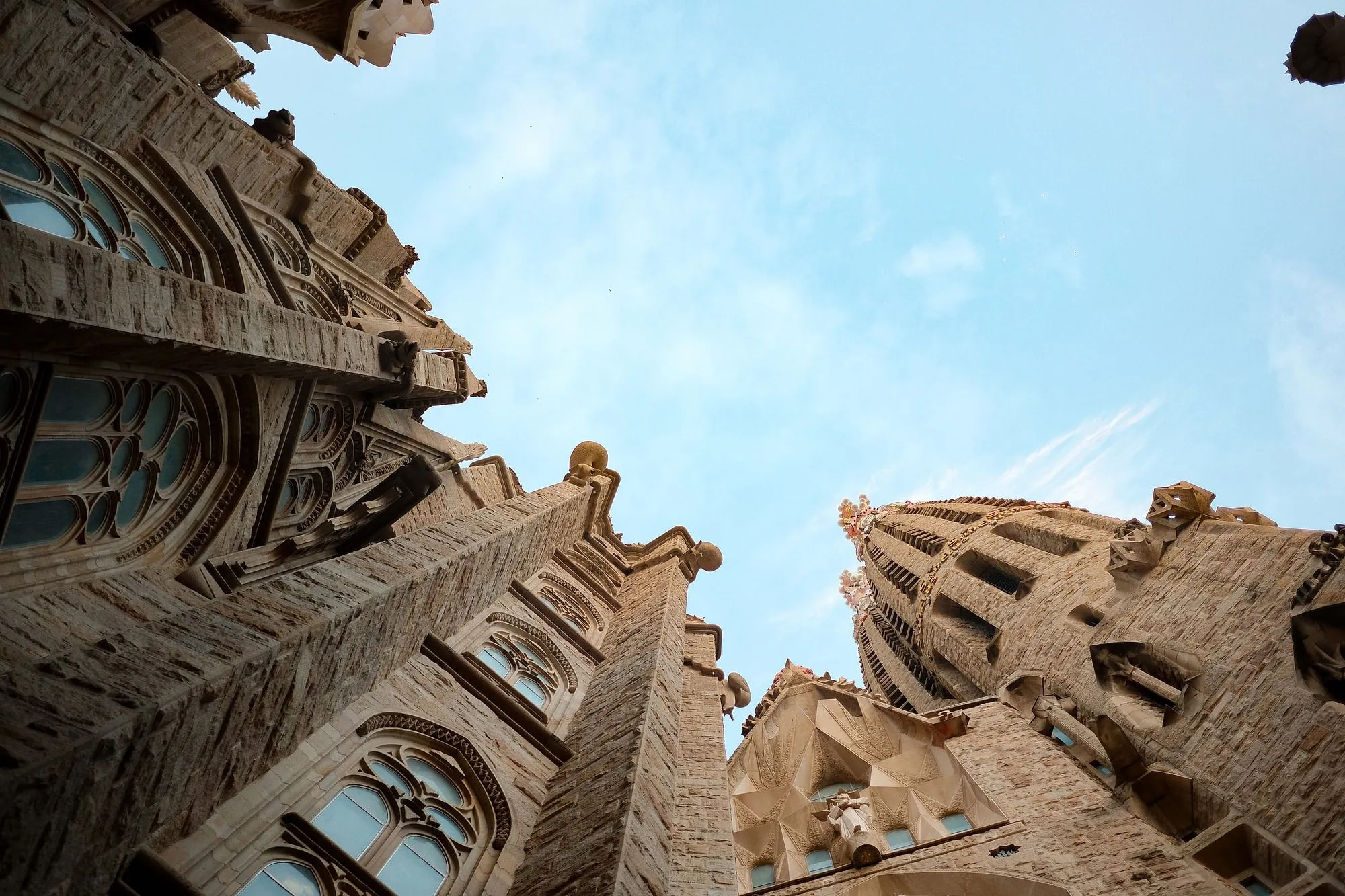
Somebody has already written the best case against this building and it is worth reading before you decide you have to be impressed.
George Orwell was in Barcelona in June 1937, in trouble. His hotel room had just been searched by police; he had spent the night sleeping in long grass on a derelict building lot; he was waiting to get out of Spain. In Homage to Catalonia he fills a few lines of that morning with this:
For the first time since I had been in Barcelona I went to have a look at the cathedral — a modern cathedral, and one of the most hideous buildings in the world. It has four crenellated spires exactly the shape of hock bottles. Unlike most of the churches in Barcelona it was not damaged during the revolution — it was spared because of its ‘artistic value’, people said. I think the Anarchists showed bad taste in not blowing it up when they had the chance, though they did hang a red and black banner between its spires.
That is a man who has been shot through the neck at the front — “In the throat, they said”, he writes, a few chapters earlier — who is being hunted by the political police of his own side, and who still has enough left over to be annoyed by a church.
What he gets wrong
It is not the cathedral. This is the single most repeated error about the Sagrada Família and Orwell makes it in the first six words. It was not a cathedral in 1937 and it is not one now: Benedict XVI consecrated it on 7 November 2010 and designated it a minor basilica. Barcelona’s cathedral is a medieval building down in the Gothic Quarter, and the two are not in the same part of the city, the same century or the same argument.
“It was not damaged” is half the story. The walls stood, which is what he could see. But the basilica’s own timeline of 1936 says: “plans and photographs are burnt and the plaster models, smashed.” The building survived and its instructions did not. Everything that has gone up since has had to be worked out from fragments — which is the real reason the argument about the building has never ended, and Orwell, walking past it once on his way out of the country, had no way of knowing it.
That is worth holding next to what he wrote about the rest of the city when he first arrived, the previous winter: “almost every church had been gutted and its images burnt. Churches here and there were being systematically demolished.” Against that, this one standing is not a small fact.
What he gets right, and it is more than people admit
The hock bottles. Go and stand on carrer de la Marina and look at the four Nativity towers. They swell out at the shoulder and taper to a neck, and once somebody has said hock bottle you cannot unsee it. It is the most accurate description of those towers anybody has written and it is in a book about a war.
Four. He counted right. In 1937 the only bell towers standing were the four over the Nativity façade, finished in 1930 — and Gaudí himself had only lived to see one of them, Saint Barnabas, completed in 1925. Everything that has appeared on that skyline since, up to and including the central tower of Jesus Christ topped out in February 2026, went up after he was dead.
The banner. A red and black flag — “the red and black flag of the Anarchists”, as he describes it in the opening pages — strung between the spires of a church. It is the single most Barcelona image in the whole book.
The part that is actually interesting
Orwell’s complaint was not really aesthetic. It was that a monument to piety survived while the city around it was doing something else, and that the survival was justified with the phrase “artistic value” — a phrase he clearly heard used, and clearly did not believe.
That argument did not end in 1937. It is still what people are arguing about when they argue about the Sagrada Família: whether continuing to build a dead man’s church for a hundred and forty-four years is devotion, tourism, or a very slow act of denial. You cannot settle it, and neither could he.
What you can do is look at the two finished façades and notice that one of them is not trying to be beautiful either. The Passion side is angular, stripped and deliberately hard to stand in front of. Disliking it is not a failure of taste. It is closer to a correct reading.
So: is it ugly?
Some people walk away flat, and they are not doing tourism wrong. If that turns out to be you, the exterior costs nothing and you will have lost forty minutes rather than a morning and a ticket — the walk round the block, street by street, is in how to look at the Sagrada Família from the street.
Orwell’s other complaint — that it was taking forever — has a real answer, and it is four constraints rather than one excuse: why it takes this long.
If you already suspect it is not for you, there is a whole Barcelona trip built the other way in Barcelona without the Sagrada Família, and a companion argument about the other Gaudí place people feel obliged to like in is Park Güell overrated.
And if you want the version where the building argues back, our Gaudí walk is ninety minutes on the pavement with an actor playing Gaudí, who is not a neutral party and does not pretend to be.
If the argument about whether it is ugly leaves you cold, there is one it cannot touch: whether it stands up, and why it is shaped the way it is. The basilica publishes its own definitions of the catenary arch and the ruled surface, and they turn a taste question into an engineering one — how Gaudí’s buildings stand up.
Whatever you conclude about the outside, the argument is settled indoors for most people. What the interior is and why.
Where this comes from
- Homage to Catalonia — full textGeorge Orwell, «Homage to Catalonia» (1938) · Project Gutenberg AustraliaOrwell's paragraph in full: «one of the most hideous buildings in the world», the spires «exactly the shape of hock bottles», and the line about the Anarchists showing bad taste in not blowing it up.
- History of the TempleBasílica de la Sagrada FamíliaThe 1936 vandalism — plans and photographs burnt, plaster models smashed — and the 2010 consecration.
Everything above that carries a date, a figure or a name is checked against these before it is published. Where we could not find a source, the page says so.
Quick answers
- What did George Orwell say about the Sagrada Família?
- In Homage to Catalonia he called it "a modern cathedral, and one of the most hideous buildings in the world", said its spires were "exactly the shape of hock bottles", and wrote that he thought "the Anarchists showed bad taste in not blowing it up when they had the chance".
- Was Orwell right that it survived the Civil War untouched?
- The building itself stood, which is what he saw. The workshop did not: the basilica's own timeline records that in 1936 its plans and photographs were burnt and its plaster models smashed. Both things are true and people usually only tell you one of them.
- Is it acceptable to dislike the Sagrada Família?
- It is a normal reaction and it has a long pedigree. One of its two finished façades was designed to be uncomfortable to look at, so a portion of the discomfort is doing exactly what it was built to do.
- Was Orwell right to call it a cathedral?
- No, and it is the most common mistake made about the building. It was consecrated as a minor basilica by Benedict XVI on 7 November 2010. Barcelona's cathedral is a medieval building in the Gothic Quarter.
- How many towers did Orwell see?
- Four. At the time of his visit the only bell towers standing were the four on the Nativity façade, completed in 1930. Gaudí himself had lived to see just one of them finished. Everything else on that skyline has gone up since, including the 172.5-metre central tower, topped out in February 2026.
The tours this piece is about
More in the journal
Gaudí and Modernisme
- How to look at the Sagrada Família from the street
- Inside the Sagrada Família: a forest, on purpose, and the basilica says so itself
- Eighteen towers, and the tallest one was only finished in 2026
- 7 June 1926, Gran Via at Bailèn, a little after six in the evening
- Gaudí and the Church: an expiatory temple, a decree from Rome, and the word the decree does not use
- The things people walk past, standing right in front of them