
Gaudí
Why it takes this long, written as constraints rather than excuses
Four things decide the pace, and none of them is the one people assume. Money, a fire, a licence and a street the basilica does not own.
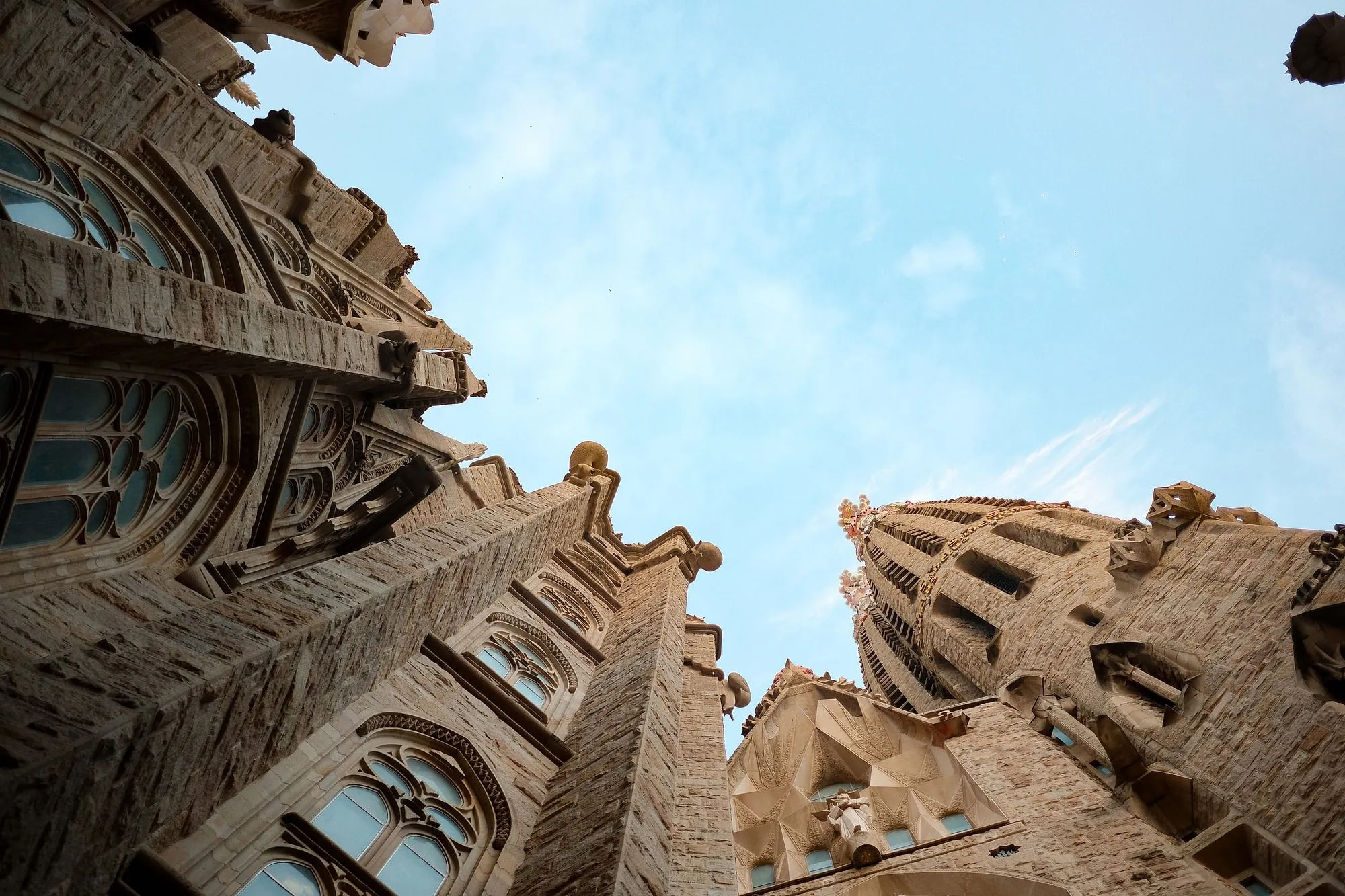
The question is usually asked as a joke and answered with one. Here it is answered as a specification: four constraints, each with a number attached, in the order in which they actually bind.
Constraint 1 — it builds at the speed of its own turnstile
The Sagrada Família was founded as an expiatory temple, which in the phrasing of its own booklet means it would be “funded exclusively with alms from the faithful”. No state money was ever part of the design.
That has not changed, only the source of the alms. From the Foundation’s audited accounts for 2025:
- Income 134.5 million euros
- From visitors 96.9 %, private contributions 0.4 %, other 2.7 %
- “100 % of the Basilica’s income is private”
- Auditors: KPMG
- Of 113.5 million in expenditure, 51.7 % went on construction and works
Read that as an engineering constraint rather than a fact about tourism. The build rate is a function of the visitor rate. A cathedral financed by a monarch goes as fast as the monarch’s patience; this one goes as fast as the queue.
Constraint 2 — the drawings do not exist
In 1936 the workshop burned. The Foundation’s own timeline is four words long about it: “Plans and photographs are burnt and the plaster models, smashed.”
What that means in practice is set out in its entry for 1939, when Francesc de Paula Quintana took over and work “was able to go on thanks to the material that could be saved from Gaudí’s workshop and that was reconstructed from published plans and photographs”. From 1940 the site was searching for fragments of the models.
The detail that makes this concrete: the basilica’s archive of plans is described as a closed collection made up solely of hard copies created between 1940 and 2009. There is nothing in it from before the war.
So every element that goes up has to be worked out first — from broken plaster, from photographs printed elsewhere, from the geometry of what survives. Some parts Gaudí left nearly complete; the naves were fully designed three years before he died. For others, such as the Virgin Mary lantern, he had settled little more than the height and the basic shape. Those two situations do not build at the same speed.
Constraint 3 — for 137 years it had no permit
The temple applied for a building licence in 1885, to the town council of Sant Martí de Provençals — a municipality that Barcelona later absorbed. Nobody ever resolved the application.
It was resolved on 6 June 2019, when Barcelona’s government commission granted the licence; the paperwork was handed over on 24 July. The council’s own headline: Barcelona grants the Sagrada Família its building permit and regularises it after more than 130 years.
The numbers, from the council’s release: 4,627,074.03 euros in total, being 4,385,341.94 of construction tax and 241,732.09 of licence fee. Ahead of it, an agreement signed on 18 October 2018 under which the temple contributes 36 million euros over ten years to the transport, metro access, street works and public-space upkeep around it.
That is a long time to build without a piece of paper, and it is also the reason a lot of the recent pace looks sudden. It is much easier to schedule work when the permit exists.
Constraint 4 — the last piece needs a street it does not own
Eighteen towers were designed. Twelve are bell towers for the apostles, between 98.5 and 120 metres. Four are for the Evangelists, 135 metres, finished in 2022 and 2023. One is the Virgin Mary’s, 138 metres, finished in 2021. The last is the tower of Jesus Christ, 172.5 metres, whose exterior was completed on 20 February 2026 and which the basilica states makes this the tallest church in the world.
Everything is on a module of 7.5 metres. The central tower is 23 modules; the Evangelists are 18.
Which leaves the four bell towers of the Glory façade, planned at 120 metres — the crane came down in height in July 2026 and was re-tasked to exactly those.
And then the part with no date at all. There is a four-metre drop between carrer de Provença and carrer de Mallorca. Gaudí resolved it with a monumental stair running from the floor of the temple out to Mallorca, carried, in the Foundation’s own description, on an elevated bridge with the traffic passing underneath.
Barcelona’s position on this is on the record and it is careful. The 2019 licence, the special plan and the plan modification behind it cover the block bounded by Provença, Sardenya, Marina and Mallorca — the land the temple stands on — and the council stated, twice, that the stair up to the Glory façade is not the subject of the agreement and is not addressed by the plans. What it did instead was undertake to convene a working group, with the temple, residents and city bodies, to open the debate.
So the honest answer to “will they knock down the flats” is that nobody has approved anything, nobody has scheduled anything, and the question was handed to a committee.
What actually slips
The tower of Jesus Christ was expected in 2025. Its exterior was finished in February 2026 and it was blessed in June. As of May 2026 the internal cladding and the lift were still being installed. The Chapel of the Assumption reached 8 metres in 2025, of an eventual 30.
None of that is scandalous. It is what a project looks like when the design is being recovered rather than followed, the funding arrives by the day, and the last item on the schedule is a planning question rather than a building one.
For a visitor, the practical consequence
Nothing you can see from the pavement is finished, including the parts that look finished. Which is a better reason to look at it carefully than most buildings offer: how to look at the Sagrada Família from the street is the lap, street by street, and the things people walk past is what to stop at.
The other stories attached to this building, and which of them survive checking, are in things you will be told about Gaudí that are not true. The place where the structural ideas behind it were tested full size, twenty kilometres out, is the Colònia Güell crypt; and the four days in June 1926 that ended the architect are in 7 June 1926. And if you would rather hear the case made by the man who took the job knowing he would not see it done, that is the Gaudí walk — ninety minutes outside, no ticket, performed by an actor.
One constraint we did not have when this page was written, and it is the largest of them. The plaster models were smashed in 1936; from 1944 the architect Francesc de Paula Quintana reorganised the temple board and recomposed them, and the basilica’s own booklet says the method made it possible to reconstruct some of what was damaged. Everything built since stands on that reassembly. The chain of people who did it is in who worked with Gaudí, and the century that nearly lost the rest of his work is what happened to Gaudí’s buildings after he died.
One part of it did finish. The central tower was topped out in February 2026 and blessed in June: the towers of the Sagrada Família.
Where this comes from
- Annual report 2025 (PDF, audited by KPMG)Junta Constructora del Temple Expiatori de la Sagrada FamíliaIncome of 134.5 M€, of which 96.9 % from visitors and 0.4 % private contributions; 113.5 M€ spent, 51.7 % of it on construction; and the statement that 100 % of the basilica's income is private.
- Barcelona concedeix la llicència d'obres a la Sagrada Família (7-6-2019)Ajuntament de Barcelona · Servei de PremsaThe licence of 7 June 2019 and its total of 4,627,074.03 €.
- Acord històric entre l'Ajuntament i la Sagrada Família (18-10-2018)Ajuntament de Barcelona · Servei de PremsaThe 2018 agreement behind that licence, and the 36 M€ the foundation undertook to contribute.
- Heritage assets — Documentation CentreBasílica de la Sagrada FamíliaThat the plan archive is a closed collection of hard copies made between 1940 and 2009.
- Booklet 4 — Architecture of the Sagrada Família (PDF)Basílica de la Sagrada FamíliaThe 7.5 m module the whole building is dimensioned from.
Everything above that carries a date, a figure or a name is checked against these before it is published. Where we could not find a source, the page says so.
Quick answers
- Why is the Sagrada Família taking so long to build?
- Four reasons, in order of weight: it is funded entirely from its own income rather than by any government, so it builds at the rate the money arrives; its original drawings and models were destroyed in 1936 and had to be reconstructed; it had no municipal building permit at all until 2019; and its final piece requires building over a public street, which is not covered by any approved plan.
- Who pays for the Sagrada Família?
- Visitors, mostly. The Foundation's audited 2025 accounts report income of 134.5 million euros, of which 96.9 % came from visitors and 0.4 % from private contributions, and state that 100 % of the basilica's income is private. Just over half of expenditure went on construction.
- When will the Sagrada Família be finished?
- No completion date for the whole building has ever been announced by the Foundation. What happened in 2026 was the completion of the exterior of the central tower and the centenary of Gaudí's death. Of eighteen towers, the four on the Glory façade are still to be built, and the monumental stair Gaudí designed has no planning approval of any kind.
- How many towers will it have?
- Eighteen. Twelve bell towers for the apostles, between 98.5 and 120 metres; four for the Evangelists at 135 metres, finished in 2022 and 2023; one for the Virgin Mary at 138 metres, finished in 2021; and the central tower of Jesus Christ at 172.5 metres, whose exterior was completed in February 2026.
- Is it true they have to knock down flats to finish it?
- It is not approved, not scheduled and not covered by any planning instrument. Gaudí's design bridges the four-metre drop to carrer de Mallorca with a stair carried on a bridge over the street. Barcelona's 2019 licence and the plans behind it cover only the block the temple stands on, and the city referred the rest to a working group including residents.
The tours this piece is about
More in the journal
Gaudí and Modernisme
- The Colònia Güell crypt, and the day Gaudí's money stopped
- He did not copy nature. He copied what nature does with a load
- Barcelona did not have one great architect. It had a generation
- The house Gaudí lived in was designed by somebody else, and Gaudí signed it
- Who paid for each Gaudí building, and what they did for a living
- In 1971 a piece of La Pedrera fell into the street