
Gaudí
How to look at the Sagrada Família from the street
Instructions, not an argument. Three streets, in this order, about forty minutes. No ticket involved at any point.
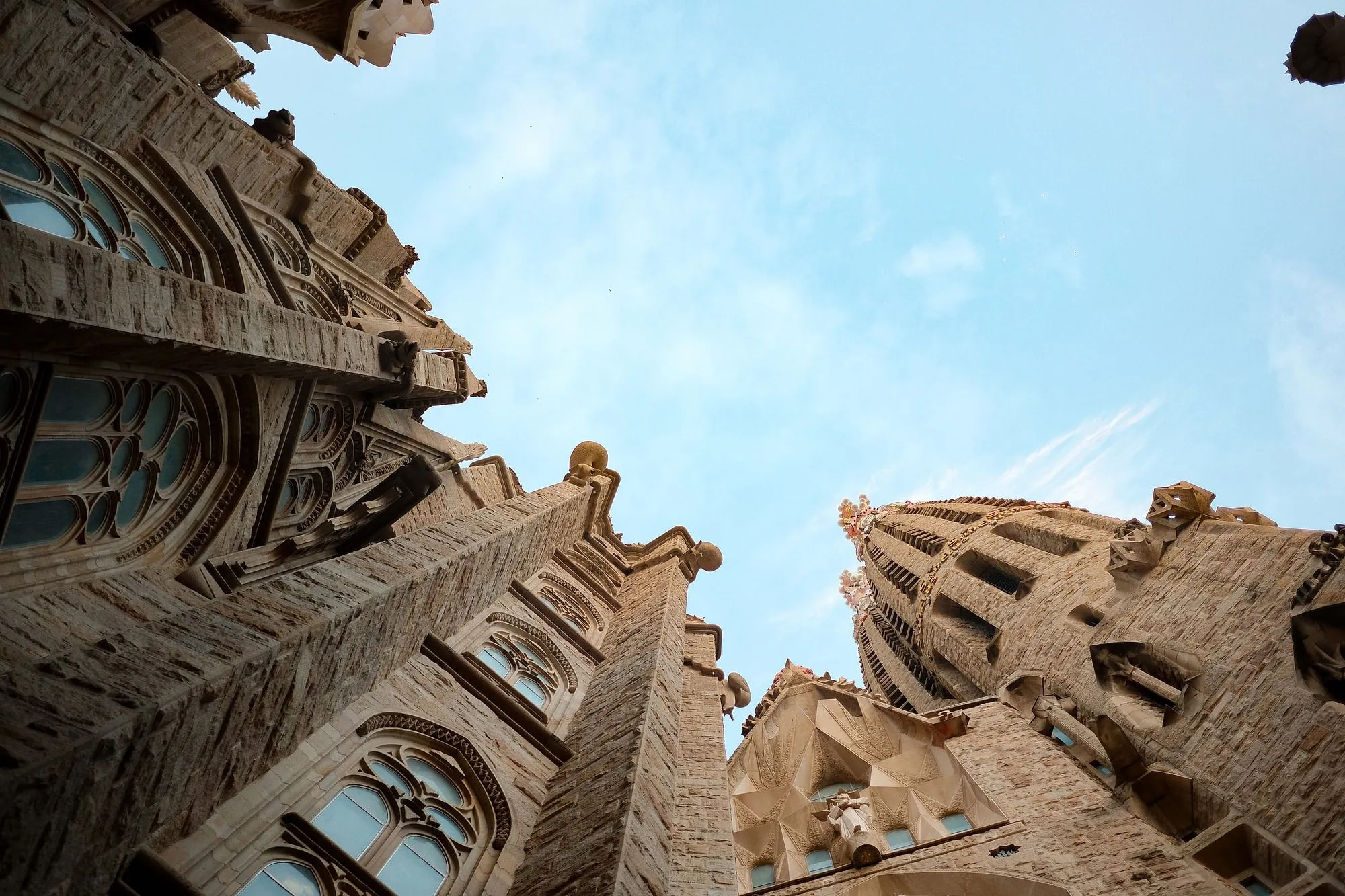
Start on carrer de la Marina, on the pavement opposite. Do not go round the front first.
This is the Nativity façade, the one Gaudí directed himself and left strict instructions for. He did not see it finished — of its four bell towers he lived to see exactly one, Saint Barnabas, completed in 1925; the other three went up in 1930. Read the façade from the bottom upwards, the way you would read a page. It is a sequence, not decoration, and people who scan it top-down miss that it has an order.
Give it ten minutes. You will not see the half of it in ten minutes; that is the point.
Now walk round to carrer de Sardenya.
This is the Passion façade and it is the same building by a different century. Angular where the other was dense, empty where the other was crowded, deliberately unpleasant to stand in front of. Gaudí left it drawn and warned that it would frighten people. It was carved decades after his death, it does not look like his work, and it was not meant to.
The useful thing to do here is not to decide which one you prefer. It is to notice that both of them are the same church, that a hundred years passed between them, and that somebody had to decide whether to imitate a dead man or not. That decision is the most interesting thing on the site and it is entirely free to look at.
Then go round to carrer de Mallorca.
This is the Glory façade, the main entrance, and it is the one still being built: its four bell towers are what the great central crane was re-tasked to in July 2026, at a planned 120 metres.
Stand back and look at the ground rather than the building. There is a four-metre drop between carrer de Provença and carrer de Mallorca, and Gaudí’s design bridges it with a monumental stair that reaches out across this street, with the traffic passing underneath. The building permit Barcelona granted in 2019 stops at the edge of the block. The city said so explicitly at the time: the stair is not covered by the agreement, not covered by the licence, not covered by the approved plans, and was handed instead to a working group with residents on it, to open the debate.
So the last thing this building has to do is the one thing it cannot do on its own land. You are standing on the undecided part.
Now look up at the middle rather than at the towers.
The tallest thing on the site is the tower of Jesus Christ, at 172.5 metres, which the basilica states makes this the tallest church in the world. Its exterior was finished on 20 February 2026, when the upper arm of the cross went on — a cross seventeen metres tall and thirteen and a half wide, in glass and white enamelled ceramic. Pope Leo XIV blessed it on 10 June 2026, the centenary of Gaudí’s death, and it was lit for the first time that night.
Of the eighteen towers Gaudí designed, only the four on the Glory façade are still to be built.
The four dates that make sense of what you are looking at
19 March 1882. Bishop Urquinaona lays the first stone. The project on the table at that point is not Gaudí’s: it is a neo-Gothic church by Francisco de Paula del Villar.
1883. Gaudí takes it over. He is thirty-one. He does not give up his other work for another three decades — from 1914 he works on nothing else, and he keeps at it until he dies in 1926.
1936. The building is vandalised during the Civil War. In the basilica’s own words, “plans and photographs are burnt and the plaster models, smashed.” This is the single fact that explains most arguments about the building: what is going up now is a reconstruction worked out from broken models, not a set of drawings being followed.
7 November 2010. Benedict XVI consecrates it and designates it a minor basilica. Not a cathedral. Barcelona already has one of those, it is medieval, and it is down in the Gothic Quarter.
Practical, and boring
The queue and the ticket office are on the Nativity side. The quiet corner is the bottom of Avinguda Gaudí, which is also where you get the whole building in one frame without lying on the ground.
If the slots are gone for your dates, nothing above changes. The outside was always the free half, and a trip built without the interior is set out in Barcelona without the Sagrada Família.
The obvious question this lap raises — why a hundred and forty-four years — has a four-part answer in why it takes this long, and none of the four is the one people guess. The man who started it was run over by a tram a few streets from here, which is 7 June 1926.
If you want the rest of his work, the inventory with the free-from-the-pavement ones marked is every Gaudí building in Barcelona. If you want the buildings that are not his, standing at the far end of the same avenue, that is modernisme beyond Gaudí.
Or have it told to you
Our Gaudí walk does this lap in ninety minutes with an actor playing Gaudí, which changes what the three façades are for: instead of three things to photograph they become one man’s argument with the people who would finish his work. It does not go inside and it is not a ticket. Everything on this page you can also do alone, for nothing, and we would rather say so.
Two things that make this lap read better. The geometry — catenary arches, ruled surfaces, columns that lean on purpose — is defined in the basilica’s own glossary and explained in how Gaudí’s buildings stand up. And the day this hour belongs in, without a second timed ticket wrecking it, is Gaudí in one day.
When you do go in — and the inside is the part that changes people’s minds — what you are actually looking at is a forest the basilica says it built on purpose. And the spires above you, which is which and which four are missing, are here.
Where this comes from
- Booklet 6 — Nativity façade, cloister and portal of the Rosary (PDF)Basílica de la Sagrada FamíliaThat Gaudí lived to see only the bell tower of Saint Barnabas finished, in 1925, and that the other three were completed in 1930.
- History of the TempleBasílica de la Sagrada FamíliaThe tower of Jesus Christ topped out on 20 February 2026, and blessed and lit for the first time on 10 June 2026.
- Booklet 4 — Architecture of the Sagrada Família (PDF)Basílica de la Sagrada FamíliaThe heights: 172.5 m over the crossing, 135 m for the Evangelists, and the module they come from.
Everything above that carries a date, a figure or a name is checked against these before it is published. Where we could not find a source, the page says so.
Quick answers
- Can you see the Sagrada Família without a ticket?
- All of the outside, from three streets, at any hour, for nothing. The two finished façades are carved a century apart in styles that contradict each other, and comparing them is most of what people end up talking about. What a ticket buys is the interior, which is a light effect and does not photograph.
- How long does it take to walk round the outside?
- One lap of the block is about a kilometre. Forty minutes at a normal pace with stops; longer if you start comparing the two façades, which you will.
- Which side should I start on?
- Carrer de la Marina, in front of the Nativity façade. It is the part Gaudí directed himself, so everything you look at afterwards is somebody else's decision about how to continue it. The only façade he actually completed is the apse, round on carrer de Provença, and almost nobody walks along it.
- Is the Sagrada Família a cathedral?
- No. Benedict XVI consecrated it on 7 November 2010 and designated it a minor basilica. Barcelona's cathedral is a different, much older building in the Gothic Quarter — officially the Santa Església Catedral Basílica Metropolitana de Barcelona.
- Is it worth going inside as well?
- If you can get a slot, yes, and buy it from the basilica's own site rather than a reseller. But the outside is not a consolation prize: it is where the building explains itself, and it is the half that is free.
The tours this piece is about
More in the journal
Gaudí and Modernisme
- UNESCO listed three Gaudí buildings in 1984 and four more in 2005, and its own pages cannot agree on that
- Gaudí worked on the Ciutadella park, and the encyclopaedia cannot agree on whether he was still a student
- Things you will be told about Gaudí that are not true
- Inside the Sagrada Família: a forest, on purpose, and the basilica says so itself
- Eighteen towers, and the tallest one was only finished in 2026
- George Orwell thought the anarchists should have blown it up