Gaudí
UNESCO listed three Gaudí buildings in 1984 and four more in 2005, and its own pages cannot agree on that
The phrase «Gaudí is a World Heritage Site» hides an extension, a lost criterion, a misspelling in an official decision, and two versions of the same page that disagree about the year.
“Gaudí is a World Heritage Site” is one of those sentences everybody says and nobody has checked. It is doing a lot of compression.
What exists is a serial property called Works of Antoni Gaudí, dossier 320bis, made of seven things, inscribed on two separate occasions twenty-one years apart — and the second occasion was not an inscription at all.
What went in, and when
1984, decision 8 COM IX.A. Three properties, and note the names UNESCO used:
Inscription: Parque Guell, Palacio Guell and Casa Mila, in Barcelona (Spain)
Spanish forms, no accents. Criteria recorded as C(i)(ii)(vi).
2005, decision 29 COM 8B.47. The Committee
Approves the extension of Parque Güell, Palacio Güell and Casa Mila in Barcelona (Spain) to include the Works of Antoni Gaudí, notably the following buildings: the Nativity façade and Crypt of Sagrada Familia, Casa Vicens, Casa Battlo, and the Crypt in Colonia Güell
Four more. And the word is extension — the 1984 property grew, and was renamed. Nothing was inscribed afresh in 2005; the boundaries of an existing listing were significantly modified. The property page records exactly that: Date of Inscription: 1984 / Significant modifications to the boundaries: 2005.
“Casa Battlo”, with a double t and no accent, is how the official decision spells it. We are quoting, not typing badly.
The seven, and the thing about the Sagrada Família
Park Güell · Palau Güell · Casa Milà, La Pedrera · Casa Vicens · the Nativity façade and the crypt of the Sagrada Família · Casa Batlló · the crypt of the Colònia Güell.
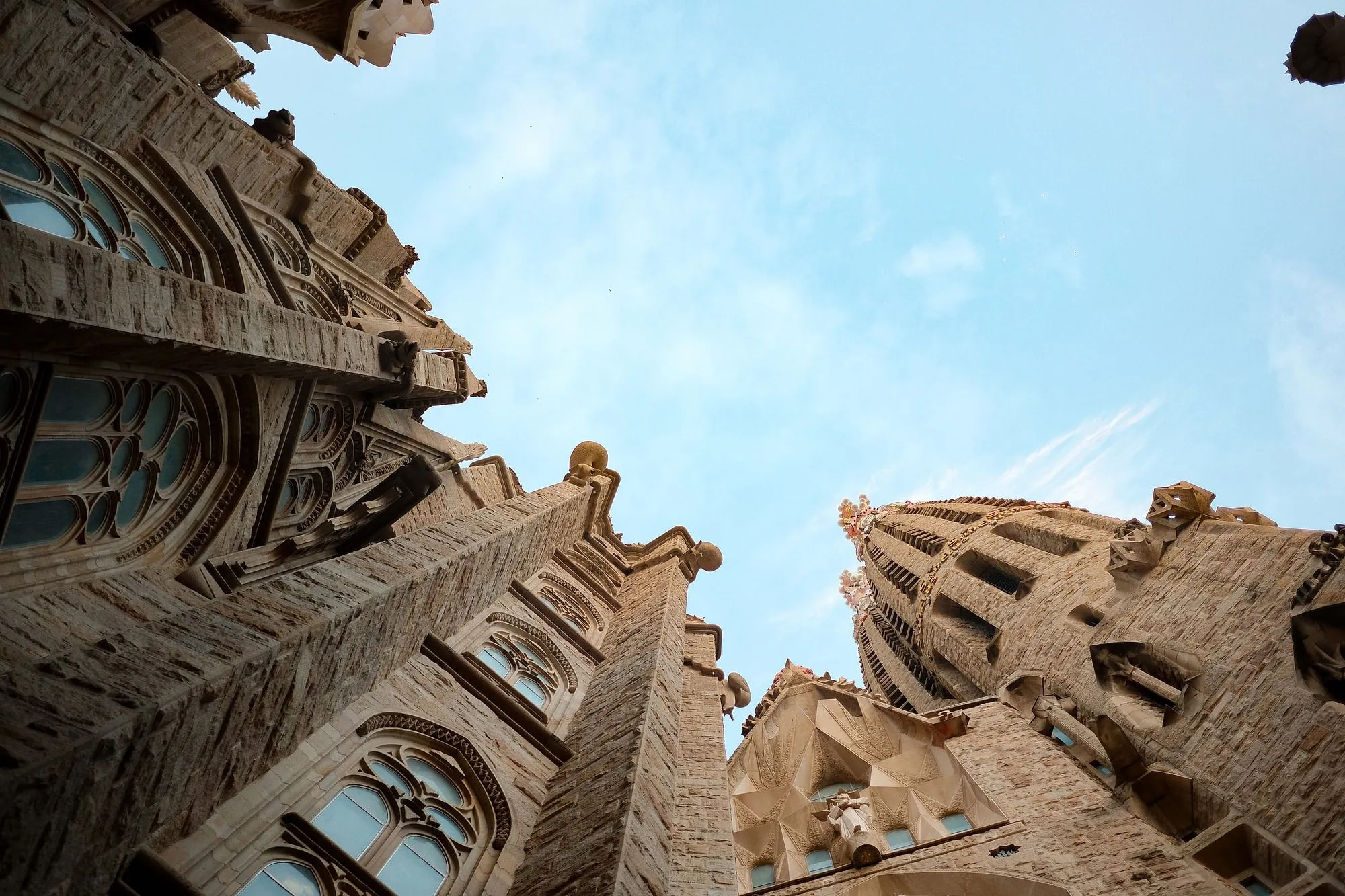
Read the fifth one again. What is listed at the Sagrada Família is the Nativity façade and the crypt. Not the basilica. Not the Passion façade, not the Glory façade, not the eighteen towers, not the interior forest.
That is not UNESCO being stingy. It is UNESCO being precise: those are the parts Gaudí built. Everything since is a continuation by other people, working from what survived of his models, and the listing does not extend to it.
Same logic elsewhere: the Colònia Güell listing is the crypt, not the church that was never finished above it.
Five places where UNESCO disagrees with UNESCO
We are not scoring points. Each of these changes what you can honestly say.
1. The criteria changed and nobody explains it. 1984 records (i)(ii)(vi). The property page and the 2005 decision give (i)(ii)(iv). Criterion (vi) — association with events, traditions, ideas or beliefs — is simply not there any more, replaced by (iv). We could not establish whether that is a database artefact or a real reclassification, so we say so and stop.
2. The French version of the page dates all seven to 1984. The Spanish version of the same page says 1984 and 2005. Same URL, same organisation, two incompatible answers depending on the language button you pressed.
3. “Built” against “remodelled”. The description says seven properties built by the architect. The integrity section says Casa Batlló is a pre-existing building remodelled by Gaudí.
Both are on the property’s own page. And the second one is right, which matters if you are choosing between Casa Batlló and La Pedrera: one is a refit of somebody else’s house and the other is a building Gaudí made from the ground.
4. The page describes the buildings’ use as family homes. In the present tense, in live text. Casa Vicens has not been a family home for years.
5. The Chinese version lists six, not seven, because it merges Casa Vicens and the Sagrada Família into one phrase.
There is even a typo in the 2005 decision — of he building typology — which the property page silently corrects to the. We checked both.
The most useful fact on the page, which nobody quotes
Seven buildings, seven different owners:
Park Güell is owned by the Barcelona City Council, Palau Güell by the Barcelona Provincial Council, Casa Milà-La Pedrera by the Fundació Catalunya - La Pedrera, and Casa Vicens is private property. Casa Batlló is owned by Inmobiliaria Casa Batlló SL, Sagrada Família by the Board of the Sagrada Família, and the Crypt of the Colònia Güell by Colònia Güell Consortium.
A city council, a provincial council, a savings-bank foundation, a private owner, a limited company, a religious board and a consortium.
That single sentence explains more about visiting Gaudí than any guidebook paragraph: why the ticket prices are so different, why the opening arrangements are so different, why some of them upsell and some of them do not, and why nobody can give you a combined ticket. There is no Gaudí institution. There are seven landlords who happen to share a listing.
It also explains why some Gaudí is free and some is not, and why one of the seven — Park Güell — has a line you cannot see.
What is not on the list
⚠️ Bellesguard and Casa Calvet are not World Heritage. They were proposed in the 2005 extension and left out. We have written about the eight that did not make it, and it is on our internal list of retracted claims, because we published the error ourselves once.
⚠️ Neither is anything else. The Finca Güell pavilions, the Teresianes, the works the city lists that no tour goes to — none of them is covered.
And while we were in the encyclopaedia: where Gaudí was born
Not a UNESCO matter, but it belongs with everything else on this page about what a source actually says.
The Gran Enciclopèdia Catalana devotes a paragraph to it and settles it with documents:
Historically the condition of “native of Reus” appears in all of Antoni Gaudí’s official documentation (baptismal certificate, inscription on the tomb, etc.), and also in that signed by the family […] or by himself. However, from the 1950s onwards, some architects who had collaborated with Gaudí spoke of Riudoms as his birthplace because Gaudí often said he “was from Riudoms”.
So both are true and they are not the same claim. The documents say Reus. The Riudoms story is a real thing Gaudí said about himself, reported by people who knew him, decades after he died. It is the family’s farm, and an identity, not a birth certificate.
That is a better answer than either side of the argument, and it is the kind of distinction we have had to learn the hard way on this site.
How to use any of this
Stop treating the seven as a route. They have seven owners, seven ticketing systems and no coordination, and they are scattered from Gràcia to Santa Coloma de Cervelló. Planning a day of Gaudí is a scheduling problem, not a map problem.
At the Sagrada Família, know which wall is listed. The Nativity façade, on the carrer de la Marina side. It is also the one worth standing in front of.
And do not use the label as a quality filter. Some of the best Gaudí in Barcelona is not on the list, including the street lamps you can look at for nothing.
Where this sits on a walk
Our Gaudí walk runs every day, morning and evening, with an actor playing Gaudí throughout — including the parts where the sources disagree with each other, which is most of the interesting ones. We are closed on 25 December and 1 January.
Where this comes from
- Works of Antoni GaudíUNESCO · World Heritage CentreThat the property is «Works of Antoni Gaudí», Spain, «Date of Inscription: 1984 / Significant modifications to the boundaries : 2005 / Criteria: (i)(ii)(iv) / Dossier: 320bis / Serial: yes»; that the description speaks of «seven properties built by the architect» while the integrity section describes Casa Batlló as «a pre-existing building remodelled by Gaudí»; that the ownership of each element is «Park Güell is owned by the Barcelona City Council, Palau Güell by the Barcelona Provincial Council, Casa Milà-La Pedrera by the Fundació Catalunya - La Pedrera, and Casa Vicens is private property. Casa Batlló is owned by Inmobiliaria Casa Batlló SL, Sagrada Família by the Board of the Sagrada Família, and the Crypt of the Colònia Güell by Colònia Güell Consortium»; that the same page speaks of the buildings' «use as family homes»; and that the French version of the page dates all seven to 1984 while the Spanish version of the same page gives 1984 and 2005.
- Inscription: Parque Guell, Palacio Guell and Casa Mila, in Barcelona (Spain)UNESCO · World Heritage Committee, decision 8 COM IX.A (1984)That in 1984 the Committee inscribed «Parque Guell, Palacio Guell and Casa Mila, in Barcelona (Spain)» — three properties — under criteria «C(i)(ii)(vi)», with criterion (vi) recorded, which does not appear in the property's present criteria.
- Extension — Works of Antoni GaudíUNESCO · World Heritage Committee, decision 29 COM 8B.47 (2005)That the Committee «Approves the extension of Parque Güell, Palacio Güell and Casa Mila in Barcelona (Spain) to include the Works of Antoni Gaudí, notably the following buildings: the Nativity façade and Crypt of Sagrada Familia, Casa Vicens, Casa Battlo, and the Crypt in Colonia Güell» — with «Casa Battlo» spelled thus, with a double t and no accent, in the official text.
- Antoni Gaudí i CornetGran Enciclopèdia CatalanaThat «històricament la condició de 'natural de Reus' apareix a tota la documentació oficial d'Antoni Gaudí (partida de baptisme, inscripció al sepulcre, etc.), i també en la signada per la família […] o per ell mateix», and that «a partir de la dècada del 1950, alguns arquitectes que havien col·laborat amb Gaudí parlaren de Riudoms com a lloc de naixement perquè Gaudí deia sovint que ell 'era de Riudoms'».
Everything above that carries a date, a figure or a name is checked against these before it is published. Where we could not find a source, the page says so.
Quick answers
- Which Gaudí buildings are UNESCO World Heritage?
- Seven, under the property name «Works of Antoni Gaudí». Park Güell, Palau Güell, Casa Milà — La Pedrera, Casa Vicens, the Nativity façade and crypt of the Sagrada Família, Casa Batlló, and the crypt of the Colònia Güell. It is a serial property, dossier 320bis.
- Were they all inscribed at the same time?
- No. The 1984 decision, 8 COM IX.A, inscribed «Parque Guell, Palacio Guell and Casa Mila, in Barcelona (Spain)» — three. The 2005 decision approves «the extension» of those three «to include the Works of Antoni Gaudí, notably the following buildings: the Nativity façade and Crypt of Sagrada Familia, Casa Vicens, Casa Battlo, and the Crypt in Colonia Güell». Formally it is an extension, not a second inscription.
- Is the whole Sagrada Família a World Heritage Site?
- No, and this is the distinction most people miss. What the 2005 decision lists is «the Nativity façade and Crypt» — the parts Gaudí built. Everything raised since is not covered by that wording.
- Is Casa Batlló a Gaudí building?
- UNESCO says both things on the same page. The description calls them «seven properties built by the architect»; the integrity section describes Casa Batlló as «a pre-existing building remodelled by Gaudí». Built and remodelled are not the same word, and the property page uses both.
- Did the criteria change?
- The recorded criteria are different in 1984 and now. The 1984 decision registers C(i)(ii)(vi); the property page and the 2005 decision give (i)(ii)(iv). Criterion (vi) is gone. We could not establish whether that is a database error or a real change, so we report it as unresolved rather than picking one.
- Who owns these buildings?
- Seven different owners, which is why visiting them feels like seven different businesses. UNESCO's own page: «Park Güell is owned by the Barcelona City Council, Palau Güell by the Barcelona Provincial Council, Casa Milà-La Pedrera by the Fundació Catalunya - La Pedrera, and Casa Vicens is private property. Casa Batlló is owned by Inmobiliaria Casa Batlló SL, Sagrada Família by the Board of the Sagrada Família, and the Crypt of the Colònia Güell by Colònia Güell Consortium.»
- Are Bellesguard and Casa Calvet on the list?
- No. They are not among the seven, and no amount of repetition makes them so. We have had to correct that on this site already.
The tours this piece is about
More in the journal
Gaudí and Modernisme
- The city's own Gaudí list has things on it that no tour goes to
- The city that made him has nothing he built, and says so on its own website
- Casa Calvet and Bellesguard: the two Gaudís that UNESCO turned down
- Gaudí designed street lamps for the whole old city, and the city took delivery of four
- Gaudí worked on the Ciutadella park, and the encyclopaedia cannot agree on whether he was still a student
- Things you will be told about Gaudí that are not true