
Gràcia
Eating in Gràcia: the hours, the formats, and why there is no list of restaurants on this page
Gràcia is the neighbourhood people ask us about restaurants in, more than any other. This page answers a different question — how eating here works — because that is the part you can still use next year, and a list of names is not.
More people ask us where to eat in Gràcia than ask us anything else about Gràcia. This page does not answer that. It answers the question underneath it, which is how does eating here work, and it is deliberately built out of the parts that will still be true in three years.
The reason is at the bottom, and it is not modesty.
The clock, first, because it defeats most people
Lunch starts at two. Not at noon. A kitchen that opens at one is opening early. By four it is winding down.
Dinner starts at nine, and at half past ten a dining room can still be filling. If you arrive somewhere at seven expecting dinner, one of three things is happening: the place is shut, the place is serving drinks only, or the place is serving dinner at seven because it is aimed at people like you.
That last one is not automatically bad. It is, however, a reliable signal about who the room is for.
And in between there is a gap. Between roughly four and eight, food is snacks. This catches out anybody arriving mid-afternoon hungry, which is why the hour-by-hour version of the whole neighbourhood is worth reading before you plan the day: a day in Gràcia.
The single most useful thing on this page
The fixed-price weekday lunch. A set price, a choice of several starters, a choice of several mains, bread, a drink, and a dessert or a coffee. Served Monday to Friday, at lunchtime, in an enormous number of ordinary places.
It exists because people work nearby and have to eat. It is not a tourist product, it is rarely translated, and it is routinely the best food-to-money ratio you will find in Barcelona. Look for a board outside with a handwritten list and one price at the bottom.
Two things about it that nobody mentions:
- It is a weekday thing. Saturday and Sunday, most places serve the full menu at full price.
- It is not a tasting menu. It is lunch. Nobody is going to explain the dishes to you and the room will be full of people reading their phones.
What to expect instead of the word you arrived with
Visitors come to Barcelona holding the word tapas, and it does not map cleanly onto what a Catalan kitchen does. You will find bars serving small plates, plenty of them, and you will also find that the good version of eating here is not a crawl at all — it is sitting down and putting dishes in the middle of the table for everybody to work through.
That is a different evening from the one people plan. It is slower, it involves one room rather than six, and it is the reason a Gràcia dinner takes three hours.
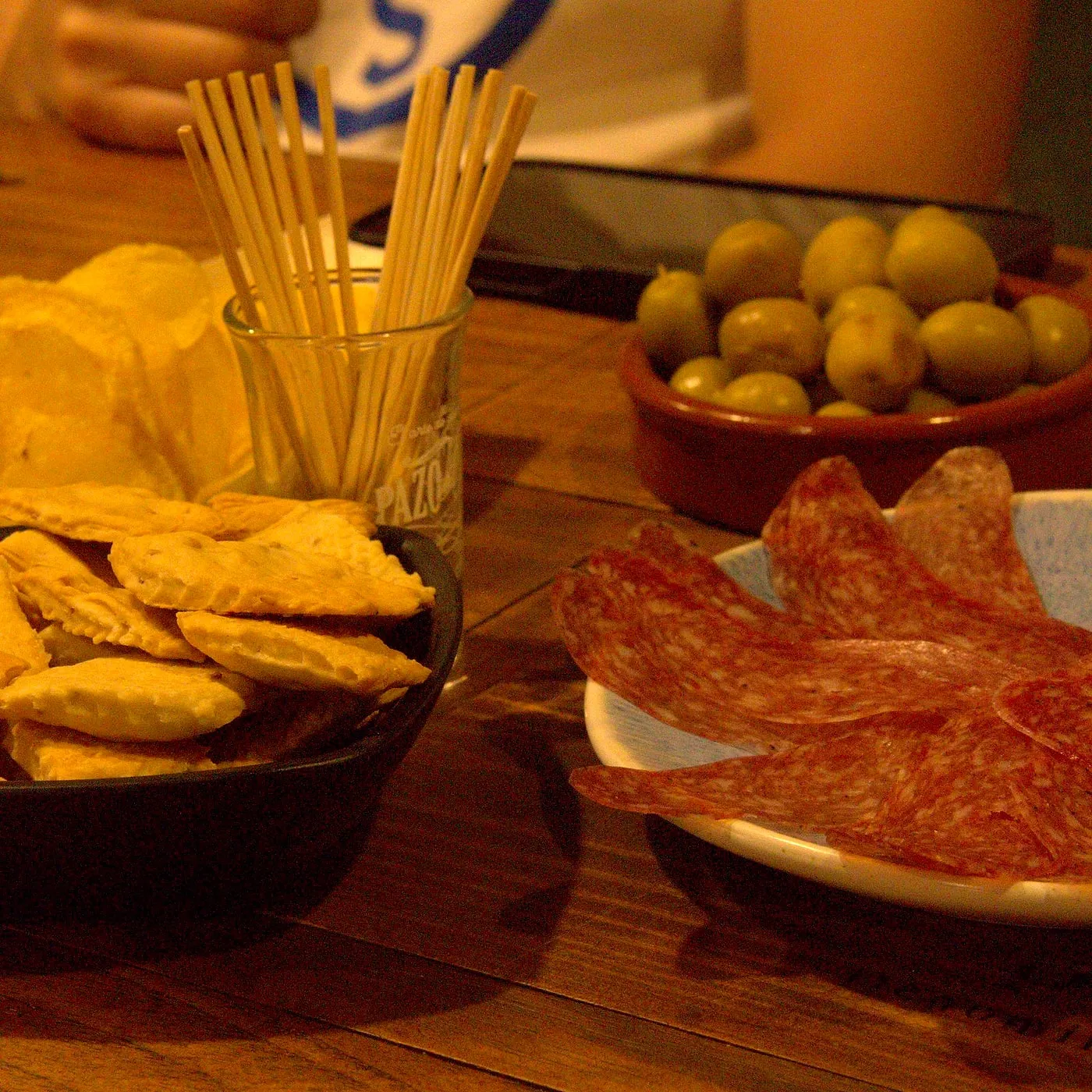
The other format worth knowing is the one that involves no kitchen at all: a plate of tinned things. Anchovies, mussels in escabeche, cockles, tuna. Tinned food here is not what a bar serves when it has run out of ideas — it is what it serves on purpose, and the good tins cost real money. That is the food that goes with the vermouth hour, which is the one appointment in the neighbourhood with a fixed time on it.
How to read a room in ten seconds
Not a formula, but these correlate:
- A handwritten board, in Catalan or Spanish only, changed today. Somebody is cooking what they bought this morning.
- Photographs of the food outside. Almost never a good sign anywhere, and here it is close to definitive.
- The room is empty at half past two on a Tuesday. Everything nearby is full and this one is not; there is a reason and it is not that you have found a secret.
- Somebody is eating alone at the bar. They live here. This is the strongest single tell in the list.
- A menu in six languages on a stand at the door. Not disqualifying — Gràcia is not a museum and places adapt — but it tells you the room’s centre of gravity has moved.
Where it is, roughly
The eating concentrates on a handful of streets rather than spreading evenly across the neighbourhood, in the same way that the shops do and for the same reason: the streets are narrow, the ground floors are small, and a business needs footfall it can reach on foot.
The squares are the other pole. Terrace dining on a Gràcia square is a genuinely lovely thing to do and it is the most expensive food in the neighbourhood, because you are paying for the square. That trade is fine as long as you know you are making it.
Now the part about lists
We are a walking-tour company. We take groups to one specific celler at the end of one specific walk, and we have a working relationship with it. Any “best restaurants in Gràcia” written by us would have that place in it, and you would have no way of telling which entries were judgement and which were arithmetic.
There is a second reason, and it is the one that actually matters:
A list in English is how a small room dies. A dining room with thirty covers, run by two people, that appears on enough English-language pages, ends up with a queue, a laminated menu in four languages and a different chef within about two years. The version you would have travelled for stops existing, and the page that killed it is still up, still ranking, still recommending it.
We would rather hand you the hours and the tells and let you find your own. That is a worse page by the usual measures. It is a better answer.
The two mistakes, stated plainly
- Eating at the hour you eat at home. It puts you in the rooms that exist for visitors, every single time, without you choosing it.
- Treating dinner as an activity between other activities. Here it is the activity. Book the evening, not the slot.
And the walk that ends with a drink in your hand
Our Gràcia walking tour finishes in a celler with vermouth from the barrel and something salty in front of you, because that is how a Gràcia Sunday finishes and because three hours of talking earns it. It is not a food tour and we do not pretend it is one — if what you want is a meal with commentary, that exists in this city and it is somebody else’s product.
What the walk does give you is the neighbourhood at a specific hour of a specific day, which turns out to be most of what you need in order to eat well here on your own for the rest of the week. The case for the half day itself is in is Gràcia worth visiting, and the practical business of getting up here is in how to get to Gràcia.
Quick answers
- What time do people eat in Gràcia?
- Lunch from about two, dinner from about nine and often later. Turning up for dinner at seven means eating alone in an empty room, and in a lot of places it means the kitchen is not open yet.
- What is the menú del dia?
- A fixed-price set lunch served on weekdays: several starters to choose from, several mains, bread, a drink and a dessert or coffee, for one price. It is aimed at people who work nearby rather than at visitors, which is exactly why it is worth having, and it is the best-value meal in the city.
- Is Gràcia good for tapas?
- Gràcia has plenty of bars serving small plates, but the word visitors arrive with does not map cleanly onto what Catalan kitchens do. Expect dishes designed to be put in the middle of the table and shared, and expect the good version of that to be a sit-down meal rather than a crawl.
- Is it expensive to eat in Gràcia?
- Less than the equivalent street in the Eixample or the Gothic Quarter, mostly because the rooms are smaller and the customers are neighbours. Weekday lunch is the cheapest good meal available; dinner on a square with a view of the square is the most expensive thing here.
- Do I need to book?
- For dinner at a weekend, in a neighbourhood where the dining rooms hold thirty people, yes. For weekday lunch, usually not, but go at two rather than at half past two.
The tours this piece is about
More in the journal
Gràcia
- Gràcia has five festes majors, and the city's page for one of them gives two different months
- Is Gràcia a good place to stay in Barcelona?
- A day in Gràcia, by the clock rather than by the map
- Gràcia at night is not nightlife, and going there expecting nightlife is the mistake
- Gràcia joined Barcelona in 1897 with almost no public buildings, so its clubs built their own
- Shopping in Gràcia: the street and the neighbourhood are not the same place