
Gràcia
The squares of Gràcia, and what each one is actually for
Five squares within fifteen minutes of each other, none of them grand, all of them in use. They are not interchangeable and they are not decorative: each one does a different job at a different hour.
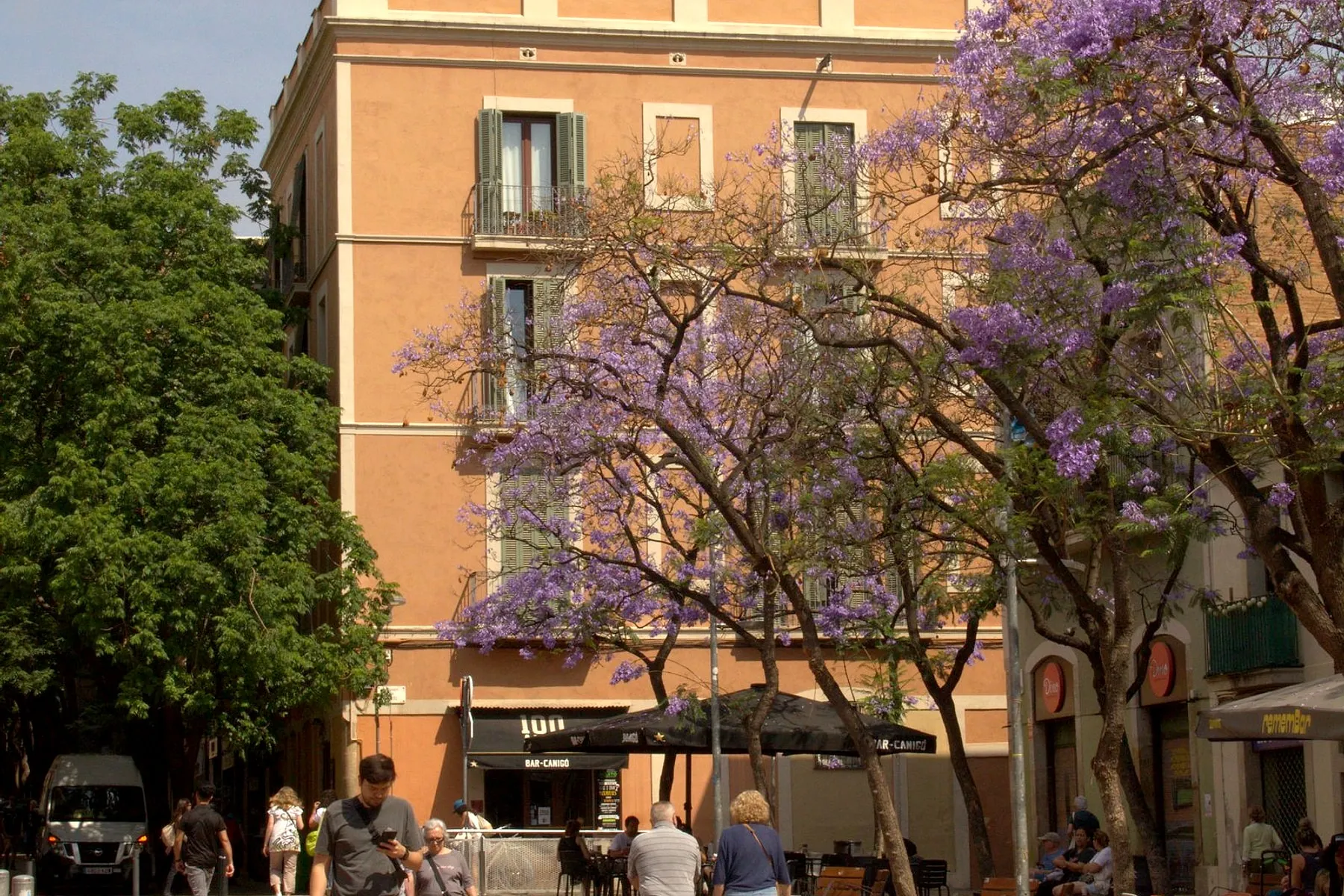
Gràcia has more squares per square kilometre than anywhere else in Barcelona and not one of them is grand. There is no cathedral square, no parade ground, nothing with a fountain at the centre and a statue of a man on a horse. They were built as places to meet, complain and organise, and they are still doing it.
What follows is what each one is doing, and roughly when.
Plaça de la Vila de Gràcia
The town hall square of the town Gràcia used to be, with the clock tower standing over it. On 4 April 1870 the bell in that tower was rung as an alarm during the draw for military conscription and the town rose; the army answered with artillery from Montjuïc, and the bell cracked and kept ringing. That afternoon has its own page.
Mornings it is a thoroughfare. Middle of the day it is a terrace. Evenings it is the square where things get announced — a stall, a stage, a banner across two lamp posts, a queue of people waiting to be told something.
If you only sit down in one square in Gràcia, this is the one that makes the rest of the neighbourhood legible.
Plaça de la Virreina
The photographed one. The church of Sant Joan closes one end with a stone façade and a rose window; terraces take up most of the rest; there are trees, and in the right weeks the light comes through them at an angle that has sold a lot of postcards.
It also demonstrates the pattern better than any of the others: nobody laid this out as a main square. It stayed a square because people kept using it as one, and eventually the paving caught up. That is how the whole street plan happened, and it is a story about two governments meeting at a line.
Plaça del Diamant
Small, square, unremarkable at first glance, and the one people come back from with something to say.
In one corner there is the Colometa sculpture — the heroine of Mercè Rodoreda’s novel, which takes its title from this square and which a great many Catalan readers regard as the novel about Barcelona. Underneath the square there is an air-raid shelter dug by the residents during the Civil War. It can be visited, but not on impulse: you have to book.
Two floors of the same square, the pavement and the tunnel under it, both belonging to the same years, and one of them is a piece of fiction.
Plaça del Sol
The neighbourhood’s living room, and the loudest room in the house.
Afternoon: children, dogs, prams, a football that keeps hitting the same wall. After dark: people sitting on the ground with something to drink, in numbers, for hours. It is a square without a single feature worth photographing that nevertheless has more life in it per square metre than anywhere in the Gothic Quarter.
The balconies around it are bedrooms. The relationship between those bedrooms and that noise is a live, decades-old argument in this neighbourhood, and if you are there at one in the morning you are in it whether you meant to be or not. The evening in full, and what it is not, is in Gràcia at night.
Plaça de la Revolució
A minute’s walk from Plaça del Sol and put to the same use, at a quieter volume. It is where you go when the Sol is full, which on a warm night it is.
The names, and why we have not explained them
Several of these squares are named after people, estates and events, and the versions of those origins that circulate online contradict each other. We have left them out rather than repeat one we cannot check. The dates in this piece — 1870, the Civil War shelter, the novel — are the ones we are prepared to stand behind.
Under this square there is a Civil War air-raid shelter: sixty-nine metres of gallery, reached down zigzag stairs dropping twelve and a half metres, dug by neighbours — one of the 1,322 the city has inventoried.
Where the squares sit in the walk
In order, on foot, they are stops 4, 6, 7 and 8 of what to see in Gràcia, which is the route that avoids repeating a street. Stop 5 is the factory chimney, which is not a square and is worth the detour anyway. Whether the neighbourhood is worth the half day at all is argued out in is Gràcia worth visiting.
Our Gràcia walking tour works through them with somebody telling you who used them and why, which is a different way of finding out what a square is for. It ends in a celler with vermouth from the barrel, which is the other way.
Twenty-one squares against three passatges is the ratio the register gives, and the passatges are almost all somewhere else: where they actually are, and who owned the ground.
Where this comes from
- Gràcia (barri de Barcelona)Gran Enciclopèdia CatalanaThe 1870 rising and the bell in the town hall tower. Note that this source dates the rising to 4–9 March; the municipal plaque in the neighbourhood says April, and the discrepancy is set out in the piece on the revolt.
Everything above that carries a date, a figure or a name is checked against these before it is published. Where we could not find a source, the page says so.
Quick answers
- How many squares does Gràcia have?
- More per square kilometre than anywhere else in the city, and the number depends on how generous you are with the word. Five of them carry the neighbourhood: Vila de Gràcia, Virreina, Diamant, Sol and Revolució, all within a fifteen-minute walk of each other.
- Which is the main square?
- Plaça de la Vila de Gràcia, with the clock tower. It was the town hall square when Gràcia was a town, and it is still where the neighbourhood assembles when it wants something.
- Which square has the air-raid shelter?
- Plaça del Diamant. The shelter under it was dug by residents during the Civil War and can be visited, but you have to book — you cannot walk in off the square.
- Which square is the loud one?
- Plaça del Sol after dark, with Plaça de la Revolució a minute away doing the same thing on a smaller scale. In the afternoon both belong to children and dogs.
- Which square is the prettiest?
- Plaça de la Virreina is the one people photograph, because the church of Sant Joan closes one end of it and the terraces fill the rest. It is also the one where you are most likely to be sitting next to somebody who lives upstairs.
The tours this piece is about
More in the journal
Gràcia
- Gràcia was its own town until 1897, and the street plan never forgave it
- April 1870: the bell of Gràcia cracked, and went on ringing
- Gràcia built a bell tower with no church attached, and put the signs of the zodiac on it to make the point
- The square is not named after the novel, and the statue of the novel spent six years in a different square
- Vermouth in Gràcia: how to find it, how it is served, and why we won't give you a list
- Festa Major de Gràcia: instructions, from someone who has to walk through it