
Gràcia
What is left of industrial Gràcia is one chimney, and we had been saying several
Half the pages written about this neighbourhood, including several of ours, describe brick chimneys in the plural, kept on purpose when the factories came down. We went to check the record. The record says one, and it does not say on purpose.
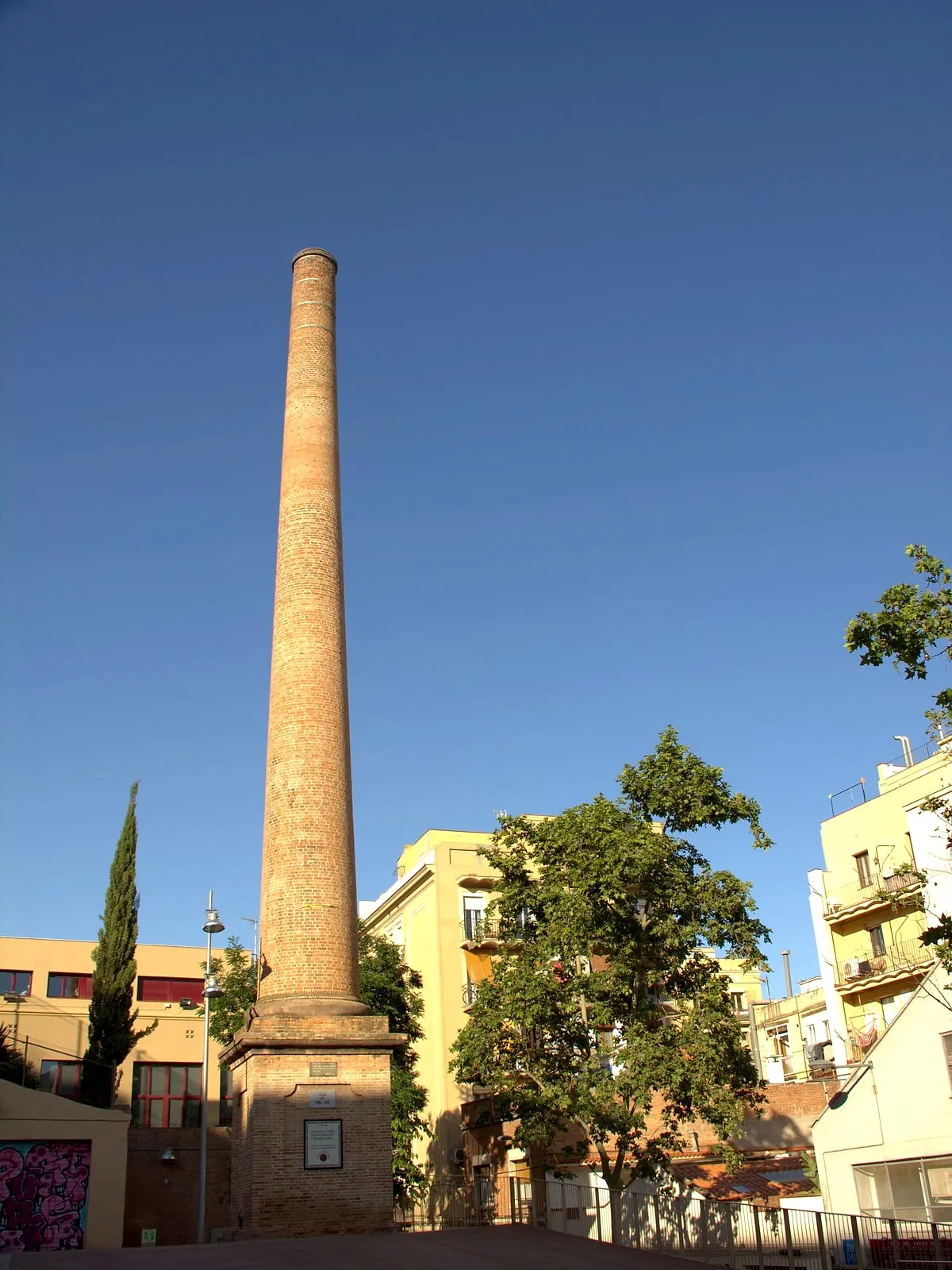
This page began as a straightforward account of the brick chimneys of Gràcia and turned into a correction of our own writing, which is the more useful thing to publish.
The claim we had made, in more than one place, was that when the factories of Gràcia were demolished for housing, several chimneys were deliberately left standing. It is a nice sentence. Every part of it that carries weight turns out to be unsupported.
What the record actually says
Barcelona keeps a catalogue of protected architectural heritage, published as an open dataset and searchable building by building. Go through the entire district of Gràcia and there is one catalogued chimney in it.
Record 2672: xemeneia de l’antiga fàbrica Puigmartí (El Vapor Nou), carrer de Siracusa, second half of the nineteenth century, protection level “assets with elements of interest”.
The description is worth reading in full, because the city writes better about this than we did. Cylindrical, exposed brick, built to traditional formulas. The chimney of the old Puigmartí factory, also called El Vapor Nou, described as an important centre which in 1861 gathered five hundred workers. And then the sentence that undoes our plural:
the only surviving indicator of the powerful industrial zone which, with “El Vapor” as its fundamental element, developed around 1860 and was tied to the laying out of Plaça Raspall, extended from 1865.
The only surviving indicator. Written by the authority that keeps the list.
It goes on: after the chimney in carrer Quevedo was lost, this one became the most conspicuous of the scarce testimonies of the industrial past of the town. So the municipal position is not that the neighbourhood is dotted with chimneys. It is that the neighbourhood lost nearly everything and this is what is left of it.
The three things we got wrong, itemised
One: the plural. There is one catalogued chimney in the district, not several. We have corrected the pages that said otherwise. Note what the count is and is not: it counts protected chimneys. There may be brickwork standing in Gràcia with no protection on it, and the catalogue would not see it. What we can say is that the city protects one, and calls it the only surviving indicator of its industrial zone.
Two: “on purpose”. The catalogue records an outcome, not a motive. It says the chimney’s moulded square base was exposed by the demolition of all the remaining factory vestiges around it in order to open the new square. Everything else went; this stayed; the square was opened. Whether anybody fought for it, and who, is not in any document we have been able to open — and we had gone as far as writing that residents insisted on it. Withdrawn.
Three: “machinery”. We had listed Gràcia’s industries as textiles, dyeing and machinery. Textiles are documented, dyeing is documented, and for machinery we could find nothing at all. Removed.
The one thing that survives the check intact is the shape of the argument: Gràcia was a factory town, the factories were inside the blocks rather than out on an estate, and the street plan you walk today is the shape that arrangement left behind. That is the street plan, and the town that owned it is here.
What the town actually made
The encyclopedia is short and specific about it. Textile factories were established in Gràcia, gradually displacing the older habit of weaving by hand at home — which is the transition that turns a village into a town. And alongside them, other kinds of factory, including a phosphorus match works, the first in the Barcelonès.
Then there is silk. The city’s own account of La Sedeta, the former Pujol i Casacuberta works, sets out that nineteenth-century Catalan silk grew around the production of black — veils, mantillas, mourning goods — and that this firm span, wove and dyed cotton, wool and silk, the silk being what distinguished it from the other textile works in Gràcia and what gave the place its nickname.
Five hundred workers in one mill in 1861. Over a thousand in La Sedeta by 1927, running almost twenty-four hours a day from Monday to Saturday.
That is what the narrow streets were carrying.
The siren
One detail from the municipal account of La Sedeta has stayed with us more than any of the numbers.
The factory had a siren that marked the beginning and the end of each shift, every day, for decades. During the war it was used to warn of the bombing.
The same sound, doing two jobs, in the same ears.
La Sedeta closed for good in 1975 — “the end of a factory in Gràcia”, as the city’s page puts it. The land was sold to a savings bank which planned flats that were never built, and a neighbourhood campaign led the city to expropriate it instead. It is now a school, a secondary school, a civic centre and a square.
One honest qualification, since this page is about being exact: La Sedeta is in the district of Gràcia but not in the old Vila de Gràcia. It stands in the Cerdà grid, on what the city itself describes as the boundary between the old Grassot neighbourhood and the former town of Sant Martí de Provençals. If you are looking for the industrial town of narrow streets, this is next door to it rather than inside it.
Standing under the one that is left
Carrer de Siracusa, in the block bounded by Puigmartí, Milà i Fontanals and the square that exists because the factory does not. Cylindrical, brick, nothing attached to it, flats all around.
There is no sign, no ticket, and nothing to do there except look up. The catalogue’s prescribed intervention for it is four words long — integral maintenance of the element — which is the driest possible way of saying: do not let this fall down.
It is stop five on the route through Gràcia, and the best hour for it is the same as for everything else up here, which is set out in a day in Gràcia.
Why publish the correction rather than quietly fix it
Because the whole argument of this site is that the things we tell you can be checked, and a page that silently improves is a page you have no reason to trust. We have done this before, with a claim about who commissioned the Pont del Bisbe and with a figure for the dead at the Fossar de la Pedrera, and the rule we ended up with is the one that applies here: take the ornament out, leave the gap visible, and say what the source does and does not support.
The gap in this case is a good one. Several chimneys kept on purpose is a sentimental story about a neighbourhood that saved its own past. One chimney left standing when everything else came down to open a square is a harder and truer story about how much was lost, and it is the one the city’s own record tells.
The walk
Our Gràcia walking tour stops under it, with an actor playing somebody who worked in the shadow of it. Three hours, ten people, ending with vermouth in a celler. The scene is called the chimney with nothing attached, and after this week it is going to be a slightly more accurate scene than it was.
The other thing the town built for itself in those decades, and which is still doing its job, is the covered market.
And the factory that chimney belonged to is still down there in plan, under a market that has been closed since 2019: the Abaceria and the Vapor Nou.
Where this comes from
- Punt d'Informació Urbanística — patrimony search (record 2672, XEMENEIA DE L'ANTIGA FÀBRICA PUIGMARTÍ (EL VAPOR NOU))Ajuntament de Barcelona · Catàleg del Patrimoni ArquitectònicRecord 2672: the chimney of the former Puigmartí factory, 'dita també El Vapor Nou', at C Siracusa 39-51, district of Gràcia, protection level 'Béns amb elements d'interès (C)', second half of the 19th century. Its text: an important centre 'que l'any 1861 aplegava 500 treballadors'; 'l'únic indicador subsistent de la potent zona industrial' that developed around 1860 and was tied to the urbanisation of Plaça Raspall, extended from 1865; that after the loss of the chimney in carrer Quevedo this is 'el més vistós dels escassos testimonis del passat industrial de la vila'; and that its moulded square base was 'posat al descobert arran de l'enderroc de tots els vestigis fabrils restants de l'entorn per tal d'obrir la nova plaça'. Prescribed intervention: 'Manteniment integral de l'element.'
- Catàleg del patrimoni arquitectònic protegit de la ciutat de BarcelonaOpen Data BCN · Ajuntament de BarcelonaThe complete published dataset of protected heritage, from which the count for the district of Gràcia is taken: one catalogued chimney, and three nineteenth-century industrial records in the district — the Puigmartí chimney, La Sedeta and the Peitx factory.
- La història de la fàbricaAjuntament de Barcelona · Institut de Cultura, Centre Cívic La SedetaThat Pujol i Casacuberta bought the site in 1900 and worked in spinning, weaving and dyeing of cotton, wool and silk; that the silk gave the works its nickname; that by 1927 the workforce was over a thousand and the factory ran almost around the clock from Monday to Saturday; that the siren that marked the shifts was used during the war to warn of bombing; that it closed for good in 1975; and that a neighbourhood campaign led the city to expropriate the site for a school, a secondary school, a civic centre and a square.
- Gràcia (barri de Barcelona)Gran Enciclopèdia CatalanaThat textile factories were established in Gràcia, displacing hand weaving at home, along with other kinds of factory including one making phosphorus matches, 'la primera del Barcelonès'.
Everything above that carries a date, a figure or a name is checked against these before it is published. Where we could not find a source, the page says so.
Quick answers
- How many factory chimneys are left in Gràcia?
- Barcelona's catalogue of protected architectural heritage lists exactly one in the whole district: the chimney of the old Puigmartí factory, also known as El Vapor Nou, on carrer de Siracusa. That is a count of what is protected, not a census of what is standing — there may be brickwork up there with no protection on it, and the catalogue would not see it.
- What was the Puigmartí factory?
- A textile works that the city's own record describes as an important centre gathering 500 workers in 1861. The catalogue calls the chimney the only surviving indicator of the powerful industrial zone that grew up around it from about 1860, tied to the laying out of Plaça Raspall.
- Where is it?
- Carrer de Siracusa, in the block between Puigmartí, Milà i Fontanals and the square that was opened when the rest of the factory came down. It is on the street and free to stand under. It is not signposted as an attraction.
- Was the chimney kept on purpose?
- That is the part we cannot source. What the city records is the outcome: everything else industrial around it was demolished in order to open the new square, and the chimney remained, with its moulded square base exposed by the demolition. The motive is not in any document we could open.
- Is there anything else left of industrial Gràcia?
- Two more nineteenth-century industrial buildings are in the catalogue for this district — La Sedeta, the former Pujol i Casacuberta textile works, and the Peitx factory. Everything else catalogued as industrial in Gràcia is twentieth century. That scarcity is the story.
The tours this piece is about
More in the journal
Gràcia
- Gràcia has thirty passatges and only three of them are in Gràcia
- The man who built modernista Gràcia was not allowed to sign it, and the city's catalogue names who did
- Gràcia has a Liberty street and a Fraternity street, and the jewels are a silversmith's sales pitch
- Mercat de la Llibertat: the iron hall a town built for itself, nine years before it stopped being a town
- The Abaceria: a market that has been in a marquee since 2019, and the cotton mill they found underneath it
- Is Gràcia safe? The city measures this, and the answer has a trap in it