
Gaudí
Gaudí and the Church: an expiatory temple, a decree from Rome, and the word the decree does not use
It is hard to write about Gaudí and religion without either sneering or gushing, so here is the third option: only the things that institutions have actually published, including the two places where the basilica and Rome do not use the same word.
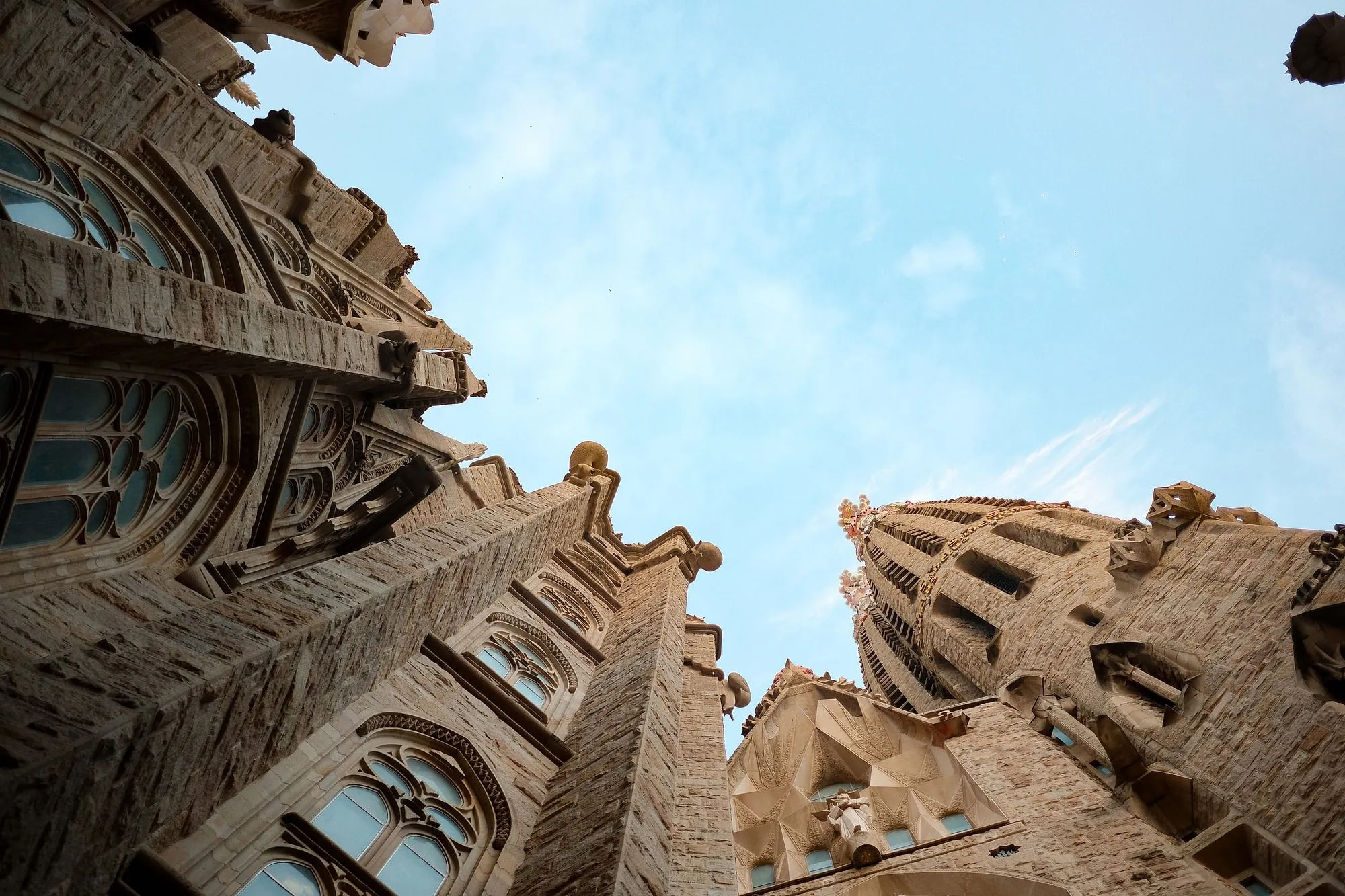
Two things make writing about Gaudí and religion difficult. One is that the people who care about it care a great deal. The other is that almost everything in circulation about it is a story somebody liked the sound of.
So this page contains only what institutions have published, with the documents linked, and it stops where they stop. There are three points where the Church’s own sources do not say the same thing, and we have left all three visible.
The building is a votive offering, not a cathedral
The first thing to get right is the object. The Sagrada Família is not the cathedral of Barcelona — that is a different building, in the old city — and it is not a parish church. It is an expiatory temple, and that is a category with consequences.
Its governing body describes itself like this:
The Junta Constructora del Temple Expiatori de la Sagrada Família is a private, non-profit, autonomous pious foundation. Its purpose is to build, preserve and restore the Expiatory Temple of the Sagrada Família, founded by Josep Maria Bocabella and designed by Antoni Gaudí.
And the practical consequence, in one sentence:
The Sagrada Família, as an expiatory temple, has always been funded through the donations and contributions of thousands of anonymous individuals over the years.
A church nobody was taxed for. Elsewhere the basilica puts it more bluntly still: the project was promoted by the people for the people.
One admission. We could not find a page on which the basilica defines what expiatory means. It uses the word constantly — it is in the foundation’s legal name — and never explains it. We are not going to supply a definition of our own and dress it as theirs. What the term does in practice, on their account, is set the funding model.
The man who started it is buried a few metres from the man who finished it
Josep Maria Bocabella was a bookseller who founded the devotional association behind the project. The first stone was laid on 19 March 1882 by Bishop Urquinaona, to a neo-Gothic design by Francisco de Paula del Villar. In 1883 Gaudí took the project over.
Both men are now in the crypt, in different chapels. The basilica’s notebook on it:
…the Chapel of Our Lady of Carmel, where Gaudí is interred, as he was devoted to her. And, on the other side is the Chapel of Our Lady of Montserrat and that of the Holy Christ, with the tomb of Josep M. Bocabella.
The founder and the architect, thirty metres apart, under the apse. The interior above them is a hundred years younger than either.
What Rome actually published, word for word
This is the part where most articles go wrong, so we are quoting rather than summarising.
On 14 April 2025 the Holy See Press Office issued bulletin B0252. Among a list of decrees promulgated that day, one item reads, in the Holy See’s own English:
the heroic virtues of the Servant of God Antonio Gaudí i Cornet, lay faithful; born on 25 June 1852, probably in Reus, Spain, and died on 10 June 1926 in Barcelona, Spain.
That is the whole entry. Three things in it are worth slowing down for.
“Servant of God” and “lay faithful”. Those are the titles the bulletin uses. It is a decree about heroic virtues.
The word “Venerable” is not in it — not applied to Gaudí. It appears in the same bulletin, but for somebody else. The basilica, on the same day, published a piece headed Antoni Gaudí, declared Venerable, saying he has been declared venerable by Pope Francis, and giving its own definition:
A venerable is a Christian who, by virtue of having lived in accordance with the Christian virtues, is a candidate to be beatified. Being considered venerable is the second step on the way to canonisation, after having been a Servant of God.
Both of those are true. Venerable is the status that results from a heroic-virtues decree. But if you want to know what Rome said, Rome said heroic virtues of the Servant of God, and if somebody quotes the Vatican as calling Gaudí Venerable, they are quoting a consequence rather than a document. The document is linked at the foot of this page. Ask for it.
And the “probably”. The Holy See declines to settle where he was born. Reus and Riudoms have been arguing about it for a century: the encyclopedia notes that natural de Reus appears in all his official documentation — baptism record, tomb inscription, school enrolments, things he signed himself — but that from the 1950s collaborators reported him saying he was from Riudoms, where his father’s family house was, and which he kept. So the decree splits it. That hedge is why this journal does not close the question either.
Where the cause stands, and the name that changed
The chronology, as published:
- 2002-2003 — the Any Gaudí. The encyclopedia records that in that year the Vatican began studying the proposal for the architect’s beatification.
- End of 2023 — the positio, the case file, is presented to the Holy See.
- 4 December 2023 — Cardinal Joan Josep Omella constitutes the Associació Canònica Pro Canonització d’Antoni Gaudí, which, in the basilica’s words, takes over from the civil association pro beatification of Antoni Gaudí. That civil body had been registered with the Generalitat in 1992. The new one is co-presided by Josep Maria Turull, rector of the basilica.
- 14 April 2025 — the decree.
Which means the association everyone still names in print, the Associació pro Beatificació, has not been the responsible body since the end of 2023. We have not found any source that gives a date for the opening of the diocesan process itself, and we are not going to invent one.
Whether he was religious, and what that meant in practice
The encyclopedia’s assessment is the most useful sentence we have found on the subject, because it neither dismisses the faith nor drowns in it:
A man of a deep and intense religiosity, this attitude should be read as a historical form of his will towards absolute perfection and as a transcendent justification of his work and his output, understood respectively as a kind of priesthood of architecture and as a sacralisation of its product.
The basilica’s own framing, in the same piece that announced the decree, is a phrase attributed to Gaudí himself — “to serve God through architecture” — and the ambition he is said to have had for the building: to make a Bible in stone, an open catechesis for everyone.
And one contemporary voice, from the year he died: Mn. Manel Trens i Ribas (1892-1976) called him the architect of God.
The single best description of what he was doing in that building is not by an architect at all. It is Benedict XVI, in the homily of the dedication, in 2010:
In this place, Gaudí desired to unify that inspiration which came to him from the three books which nourished him as a man, as a believer and as an architect: the book of nature, the book of sacred Scripture and the book of the liturgy.
And, a few lines later: Antoni Gaudí did this not with words but with stones, lines, planes, and points.
The number of years nobody can agree on
Here is the second place where the sources part company, and it is a striking one, because they are all the same institution.
| Source | When he gave himself entirely to the temple |
|---|---|
| Basilica, timeline of the temple | from 1914 until his death |
| Basilica, page on Gaudí | twelve years |
| Basilica, article announcing the decree | the last fourteen, entirely |
| Gran Enciclopèdia Catalana | from 1918 he shut himself away there |
1914 and twelve years are the same statement. Fourteen and 1918 are two different ones. Since two of the basilica’s three pages agree on 1914, that is what we would use, and we are telling you the other two figures exist.
What all four agree on is the end of it: he lived on the site in the final months of his life. He was walking away from it when he was hit by a tram — how Gaudí died, and what is genuinely unsettled about that evening.
His other religious clients
The Sagrada Família is not the only one, and the range is wider than people expect. From the UNESCO evaluation’s own grouping of his religious buildings:
The Colònia Güell church. Commissioned in 1898 for a community working in textile industry outside Barcelona. He spent a decade thinking about it, work began in 1908, and it was interrupted in 1914 with only the Crypt built — which is why the thing you can visit is a crypt with nothing on top of it. Why that unfinished basement is the most important building he made is here.
The Bishop’s Palace at Astorga, in León, for a bishop who was, as it happens, from Reus.
The Col·legi de les Teresianes, a teaching order’s school in Barcelona, still a working school.
The cathedral of Mallorca, where, in the evaluation’s words, his work represents the restoration and modernisation of a religious complex — a rare case of Gaudí working inside somebody else’s medieval building.
Four things we could not verify, and are therefore not telling you
This section exists because it is the honest end of a page like this.
That the Holy See gave permission for the burial in the crypt. It is widely repeated. We searched the basilica’s own pages for it and found nothing. Burial inside a church is not automatic, so the question is a real one — but nobody we can cite answers it.
The Catholic missions building for Tangier. An unbuilt Gaudí project that appears in a great many accounts of his religious work. It is not in the basilica’s material, not in the UNESCO documents, not in the municipal catalogue and not in the encyclopedia’s entry on him.
That he turned down commissions on religious grounds. No source we can use says it.
A definition of “expiatory”, as above.
Any of those four may well be true. They are simply not things we can hand you a document for, and this journal’s whole argument is that we will not print what we cannot.
What happened on the centenary
10 June 2026 — a hundred years to the day since he died — Pope Leo XIV presided over the commemorative mass and blessed the central tower. Before the liturgy he went down into the crypt and prayed at Gaudí’s tomb. He is the third pope to visit the building, after John Paul II in 1982 and Benedict XVI in 2010.
The tower he blessed had its last piece fitted in February of the same year. Which one it is, how tall, and what is still missing, is the towers of the Sagrada Família.
The man, told by an actor, outside
Our Gaudí walk is performed on the pavement by the basilica, by an actor playing Gaudí. Ninety minutes, fifteen people, and no ticket office, because there is nothing to get into.
It is about the man rather than the cause. The cause has its own paperwork, and it is linked below.
Where this comes from
- Bollettino B0252, 14 April 2025 — Promulgation of Decrees of the Dicastery for the Causes of SaintsSala Stampa della Santa SedeThe Holy See's own words: that on 14 April 2025 the Pope authorised the Dicastery for the Causes of Saints to promulgate a decree regarding 'the heroic virtues of the Servant of God Antonio Gaudí i Cornet, lay faithful; born on 25 June 1852, probably in Reus, Spain, and died on 10 June 1926 in Barcelona, Spain'. The bulletin calls him Servant of God and lay faithful; it does not apply the word Venerable to him, and it hedges his birthplace with 'probably'.
- Antoni Gaudí, declarat venerable (14/04/2025)Basílica de la Sagrada FamíliaThat 'Antoni Gaudí ha estat declarat venerable pel Papa Francesc'; the basilica's own definition, that 'un venerable és un cristià que, amb motiu d'haver viscut d'acord amb les virtuts cristianes, és candidat a ser beatificat' and that it is the second step on the way to canonisation, after Servant of God; that in 1926, on Gaudí's death, Mn. Manel Trens i Ribas (1892-1976) called him 'l'arquitecte de Déu'; that his maxim was 'servir Déu a través de l'arquitectura' across more than forty years given to the temple, 'els últims catorze per complet, arribant a viure els últims mesos de la seva vida en el seu recinte'; that he wanted to make a work that would be 'una Bíblia de pedra'; and that the positio was presented to the Holy See at the end of 2023, with the archdiocese creating the new Associació Canònica Pro Canonització d'Antoni Gaudí to replace the civil association registered with the Generalitat in 1992, presided by Cardinal Omella and co-presided by Josep Maria Turull, rector of the basilica.
- Es constitueix l'Associació Canònica Pro Canonització d'Antoni Gaudí (04/12/2023)Basílica de la Sagrada FamíliaThat Cardinal Joan Josep Omella constituted the canonical association which 'pren el relleu de l'associació de caràcter civil pro beatificació d'Antoni Gaudí', and that the positio had been put before the Dicastery for the Causes of Saints. It names the members: Cardinal Omella, Mn. Josep M. Turull, Mn. Armand Puig, Àlex Seoane, Antoni Soler, José Manuel Almuzara Pérez and Rosa Ribas.
- The FoundationBasílica de la Sagrada FamíliaThat the Junta Constructora del Temple Expiatori de la Sagrada Família 'is a private, non-profit, autonomous pious foundation' whose purpose is to build, preserve and restore the temple, 'founded by Josep Maria Bocabella and designed by Antoni Gaudí'; and that 'the Sagrada Família, as an expiatory temple, has always been funded through the donations and contributions of thousands of anonymous individuals over the years'.
- History of the TempleBasílica de la Sagrada FamíliaThat 'the project was promoted by the people for the people'; that in 1882 the project was designed by Francisco de Paula del Villar and that on 19 March Bishop Urquinaona laid the cornerstone; that in 1883 Antoni Gaudí took over the project while still working on other buildings; that in 1914 Gaudí began working exclusively on the temple until his death; that on 7 November 2010 Pope Benedict XVI consecrated the basilica for religious worship and designated it a minor basilica; and that on 10 June 2026 Pope Leo XIV officiated a solemn mass commemorating the hundredth anniversary of Gaudí's death and blessed the tower of Jesus Christ.
- Antoni GaudíBasílica de la Sagrada FamíliaThat 'Gaudí spent twelve years working solely on the Sagrada Família, until the day he died on 10 June 1926 after being run over by a tram'; that his funeral procession passed through most of Barcelona and ended at the Sagrada Família; and that 'Gaudí is buried in the chapel of Our Lady of Carmel, in the Temple crypt'.
- Information Booklet 5 — The crypt, the apse façade and the Assumption chapel (PDF)Basílica de la Sagrada FamíliaThat the crypt holds the Chapel of Our Lady of Carmel, 'where Gaudí is interred, as he was devoted to her', and on the other side the Chapel of Our Lady of Montserrat and that of the Holy Christ, 'with the tomb of Josep M. Bocabella'.
- Antoni Gaudí i CornetGran Enciclopèdia CatalanaThat Gaudí was 'home d'una profunda i intensa religiositat', and that this should be read as a historical form of his will to absolute perfection and as a transcendent justification of his work, understood as 'una mena de sacerdoci de l'arquitectura' and a sacralisation of its product; that from 1918 until his accidental death he shut himself away in the Sagrada Família; that in 2002-2003 the Any Gaudí was held and 'aquest any el Vaticà inicià l'estudi de la proposta per a la beatificació de l'arquitecte'; and that although he was recorded as 'natural de Reus' in all his official documentation, from the 1950s some of his collaborators spoke of Riudoms because Gaudí often said he was from there.
- Évaluation: Œuvres de Gaudí (Espagne) No 320 bis (PDF)ICOMOS · for UNESCOThat in 1898 Gaudí was commissioned to design a church for the Colònia Güell, 'a community working in textile industry outside Barcelona'; that he spent a decade reflecting on the project, that work started in 1908 and 'was interrupted in 1914 with only the Crypt built'; that his religious buildings include the Sagrada Família, the church of the Colònia Güell, the Bishop's Palace in Astorga and the college of the Teresianas; and that 'his work in the Cathedral of Mallorca represents the restoration and modernisation of a religious complex'.
- Homily, 7 November 2010 — dedication of the church of the Sagrada Familia and the altarLibreria Editrice Vaticana · Benedict XVIThat the Pope was invited 'to dedicate this Church of the Sagrada Familia, a magnificent achievement of engineering, art and faith'; that 'in this place, Gaudí desired to unify that inspiration which came to him from the three books which nourished him as a man, as a believer and as an architect: the book of nature, the book of sacred Scripture and the book of the liturgy'; and that 'Antoni Gaudí did this not with words but with stones, lines, planes, and points'.
Everything above that carries a date, a figure or a name is checked against these before it is published. Where we could not find a source, the page says so.
Quick answers
- Is Gaudí a saint?
- No. On 14 April 2025 the Holy See's bulletin recorded the promulgation of a decree on the heroic virtues of 'the Servant of God Antonio Gaudí i Cornet, lay faithful'. The basilica describes that as his being declared Venerable, which is the second step towards canonisation and not the end of it. He has not been beatified.
- What does 'expiatory temple' mean?
- We cannot tell you on anybody's authority, and that is an honest answer: the basilica uses the term constantly and we could not find a page where it defines it. What the basilica does state is the practical consequence — that as an expiatory temple it has always been funded by the donations and contributions of thousands of anonymous individuals.
- Who founded the Sagrada Família?
- Josep Maria Bocabella, whom the basilica's own foundation page names as its founder. He is buried in the crypt, in the Chapel of the Holy Christ, a few metres from Gaudí. The first stone was laid by Bishop Urquinaona on 19 March 1882, to a design by Francisco de Paula del Villar; Gaudí took the project over in 1883.
- Where is Gaudí buried?
- In the crypt of the Sagrada Família, in the Chapel of Our Lady of Carmel — 'as he was devoted to her', in the basilica's words. His funeral procession crossed most of Barcelona from the cathedral to the temple. Pope Leo XIV prayed at the tomb in June 2026, on the centenary of his death.
- How long did Gaudí work only on the Sagrada Família?
- Depends which page you read, which is why we are giving you all three. The basilica's timeline says he began working exclusively on the temple in 1914, and its page on him says twelve years. Its article announcing the Venerable declaration says the last fourteen. The Catalan encyclopedia says he shut himself away there from 1918. All agree he lived on the site in his final months.
The tours this piece is about
More in the journal
Gaudí and Modernisme
- Eighteen towers, and the tallest one was only finished in 2026
- George Orwell thought the anarchists should have blown it up
- 7 June 1926, Gran Via at Bailèn, a little after six in the evening
- The things people walk past, standing right in front of them
- One group of chimneys on La Pedrera is clad in champagne bottles
- The Colònia Güell crypt, and the day Gaudí's money stopped