
Gaudí
One group of chimneys on La Pedrera is clad in champagne bottles
Everyone knows the broken-tile surfaces. Almost nobody can tell you what the broken pieces were before they were broken, because only one of these buildings has ever published the list. It is stranger than the story people tell.
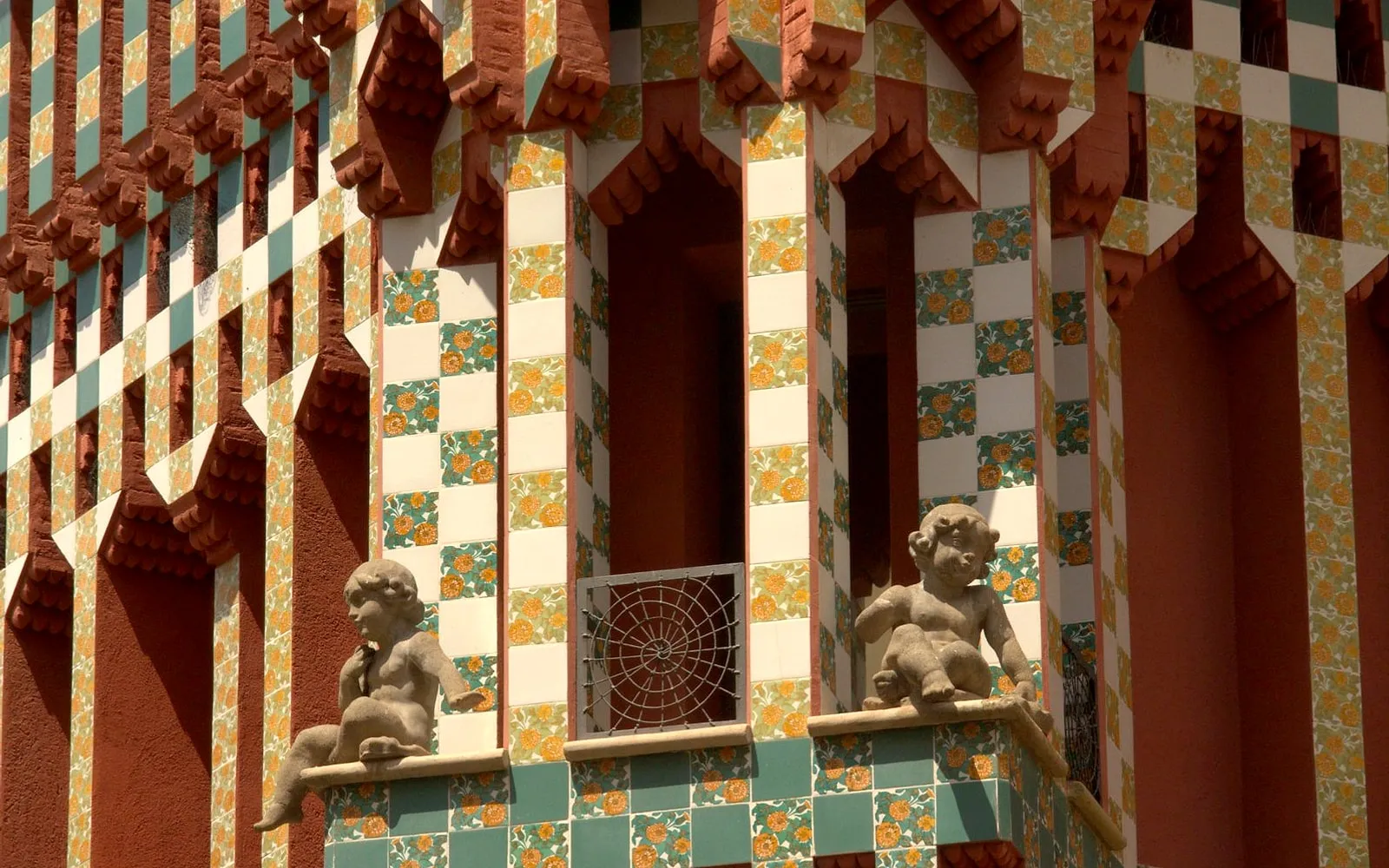
If you have seen one photograph of Barcelona you have seen trencadís: the skin of broken ceramic over the bench in Park Güell, over the chimneys, over everything that curves.
Almost nobody can tell you what the pieces were before somebody broke them. We went looking, and the honest finding is that only one building publishes its own inventory, so this page is mostly that building’s list — and the list is better than the story.
First, what it is for
La Pedrera’s description of its own roof does not begin with beauty. It begins with weather:
Trencadís (mosaic made up of irregular pieces of ceramic, marble or glass) acts as a waterproof protector for the elements, while adding an aesthetic note of colour.
Waterproofing first. Colour second, and stated second.
That reframes every surface you are about to look at. These are not decorated objects; they are clad objects, and the cladding is doing the job a lead flashing or a tiled roof would do somewhere else. The chimneys have to survive a hundred and twenty winters on top of a building, in a city with sudden violent rain.
Why break them
Because of what is underneath.
A flat rectangular tile will cover a flat wall. It will also cover a surface that curves one way, like a barrel — you can bend a grid of tiles round a cylinder. What it cannot do is follow a surface that curves in two directions at once: a dome, a twist, a chimney that swells and narrows, a bench that undulates in plan and in section at the same time.
Break the tile and the pieces conform. That is the whole technique. It is a consequence of the shapes he was already committed to, and the shapes came from how he made the buildings stand up.
The one published shopping list
Here is La Pedrera’s, verbatim in substance, for its own roof.
Four of the six stairwell exits — the big helmeted volumes, seven metres tall — are clad on the outside in:
- recycled fragments of Ulldecona stone
- white marble of the Macael, Tranco or Carrara types
- white enamelled tiles from Valencia
And then the sentence that stops people:
The only group of chimneys with trencadís mosaic is covered with fragments of dark green champagne bottles.
Twenty-nine chimneys stand on that roof, four metres tall, flues of a coal-fired central heating system that no longer exists. One group of them is faced in broken bottle glass, and the colour of that group — the deep green you cannot get from a ceramic glaze — is where it comes from.
Marble offcuts and Carrara chippings on a rental block. Recycled stone from the same quarry that supplied some of the window frames. And bottles.
Where the story usually goes instead
You will be told, on tours and in print, some version of a workman being sent round the tile factories for the rejects, or of the whole technique being invented on a particular building on a particular afternoon.
We could not source any of it. Not the factory, not the errand, not the invention. What is documented is the list above, from the building that owns the roof, plus Casa Batlló’s own more general statement that its façade uses “recycled materials, and decontextualized objects that he turned into art”.
So the truthful summary is narrow and we are going to leave it narrow: at least one Gaudí roof is demonstrably made of other things’ leftovers, and the institution that owns it says which leftovers. Everything beyond that, we cannot stand behind.
The four surfaces worth knowing about
Park Güell’s terrace. The most photographed trencadís on earth, and the park’s own pages credit it not to Gaudí but to Josep Maria Jujol, who also made the tile-shard medallions on the Hypostyle Room ceiling. Jujol has his own page in the workshop, and the argument about what you can and cannot see up there without paying is in Park Güell without a ticket.
Palau Güell’s roof. Twenty chimneys in trencadís around a sixteen-metre spire, on the oldest of these buildings and the one with fewest people on it. That is Palau Güell.
La Pedrera’s roof. The list above. Plus a small thing almost nobody is told: beside two of the staircases there are little arches faced in white trencadís, and one of them frames the Sagrada Família exactly, because Gaudí calculated the height so that it would.
Casa Batlló’s crowning. Large ceramic scales up the roof and, at the top, large spherical pieces whose colour changes from one end to the other. This one you can read from the pavement opposite, for nothing, which the other three you cannot.
The building that shows what it replaced
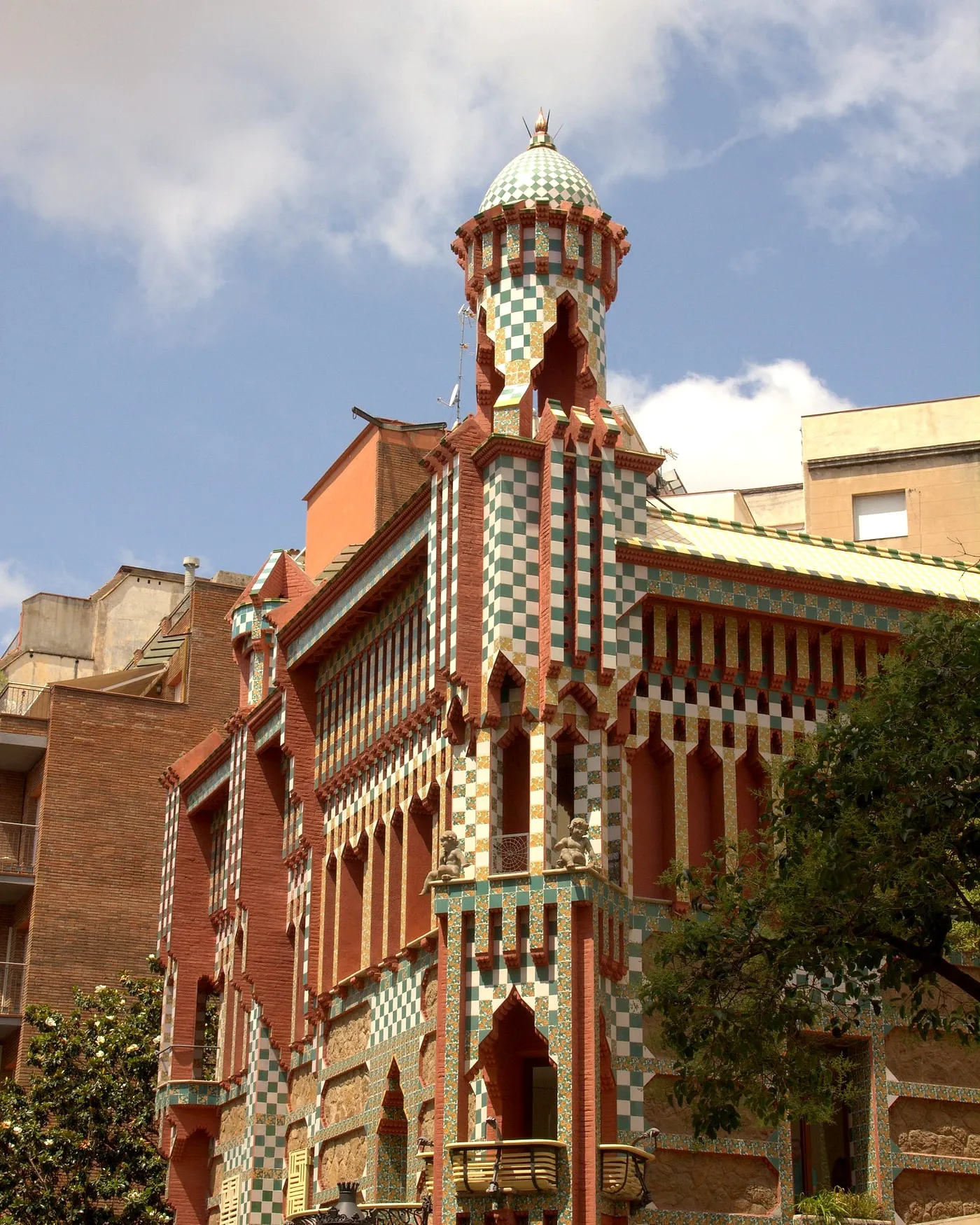
Go up to Gràcia and look at Casa Vicens, from 1883-1885. Its surfaces are ceramic too, and they are whole tiles: a green and white chequerboard, marching flat up a flat façade, with yellow ceramic flowers repeated to the eaves.
Twenty years and one problem separate that from the champagne bottles. The problem is curvature. Casa Vicens is the argument before he needed the technique, and it is the best half-hour in the city for seeing where all of it starts: is Casa Vicens worth it.
The awkward practical note
Every great trencadís surface in Barcelona is behind an admission. The roofs of La Pedrera and Palau Güell, the terrace at Park Güell. From the street you get Casa Batlló’s crowning and Casa Vicens’s chequerboard, and that is genuinely most of what there is for free.
If you are picking one interior for this specifically, the two candidates are argued out in Casa Batlló or La Pedrera, and the answer for trencadís is the roof with the bottles on it.
The version with no roof at all
Our Gaudí walk stays at street level outside the Sagrada Família — ninety minutes, fifteen people, an actor playing Antoni Gaudí. There is no trencadís on that stretch of façade and he will tell you why, which is a better answer than most of what is said about it indoors.
Where this comes from
- ArchitectureLa Pedrera · Casa Milà (Fundació Catalunya La Pedrera)That trencadís, 'mosaic made up of irregular pieces of ceramic, marble or glass', acts as a waterproof protector for the elements while adding colour; that four of the six stairwell exits are clad externally in 'recycled fragments of Ulldecona stone, white marble of the Macael, Tranco or Carrara types, or white enamelled tiles from Valencia'; that 'the only group of chimneys with trencadís mosaic is covered with fragments of dark green champagne bottles'; that the 29 chimneys are four metres high, the two ventilation towers five and the six stairwell exits seven; and that small arches covered in white trencadís flank two staircases, one of them framing a view of the Sagrada Família at a height Gaudí calculated so it would fit.
- Visitor's Guide, Easy-to-Read Version (PDF, 2024)Diputació de Barcelona · Palau GüellThat the roof terrace has twenty chimneys 'decorated with the trencadís technique of broken tiles', along with a sixteen-metre spire at the centre.
- Greek Theatre — Emblematic featuresAjuntament de Barcelona · Park GüellThat the undulating bench that bounds the terrace was planned by Josep M. Jujol.
- The façadeCasa BatllóThat Gaudí gave the façade 'involuntary sculptures, recycled materials, and decontextualized objects that he turned into art'; that the crowning is made of large scales simulating an animal's back, topped with large spherical pieces changing colour from one end to the other; and that the marine reading rests on 'the colorful glazed ceramic cladding and broken glass fragments'.
- Press kit (PDF)Casa Vicens GaudíThat Casa Vicens was built between 1883 and 1885 for Manel Vicens, a stock and currency broker — the early house whose tiled surfaces are laid as whole ceramic pieces rather than as broken fragments.
Everything above that carries a date, a figure or a name is checked against these before it is published. Where we could not find a source, the page says so.
Quick answers
- What is trencadís?
- La Pedrera's own description defines it as a mosaic made up of irregular pieces of ceramic, marble or glass, and — this is the part that gets left out — says what it is for: it 'acts as a waterproof protector for the elements, while adding an aesthetic note of colour'. It is a roofing material that happens to be beautiful, not a decoration that happens to be on a roof.
- What is trencadís made of?
- Only one building publishes its own list. La Pedrera says four of its six stairwell exits are clad in recycled fragments of Ulldecona stone, white marble of the Macael, Tranco or Carrara types, or white enamelled tiles from Valencia — and that its only group of chimneys with trencadís is covered in fragments of dark green champagne bottles.
- Why break the tiles instead of laying them flat?
- Because of the shape underneath. A flat rectangular tile can cover a flat or a singly curved surface. It cannot follow a surface that curves in two directions at once, which is what a Gaudí chimney, dome or bench does. Broken pieces conform. The technique follows from the geometry, not from a taste for fragments.
- Did Gaudí make the Park Güell bench?
- The park's own official pages say the undulating bench was planned by Josep Maria Jujol, one of his collaborators, and that the tile-shard medallions on the Hypostyle Room ceiling were made by Jujol too. It is the most photographed trencadís in the world and it is not credited to Gaudí by the institution that owns it.
- Where can I see trencadís without a ticket?
- That is the awkward answer on this page: the great trencadís surfaces are all behind an admission — the roofs of La Pedrera and Palau Güell, the terrace of Park Güell. From the street you get the crowning of Casa Batlló, which reads clearly from the pavement opposite, and the tiled surfaces of Casa Vicens in Gràcia, which are whole tiles rather than broken ones.
The tours this piece is about
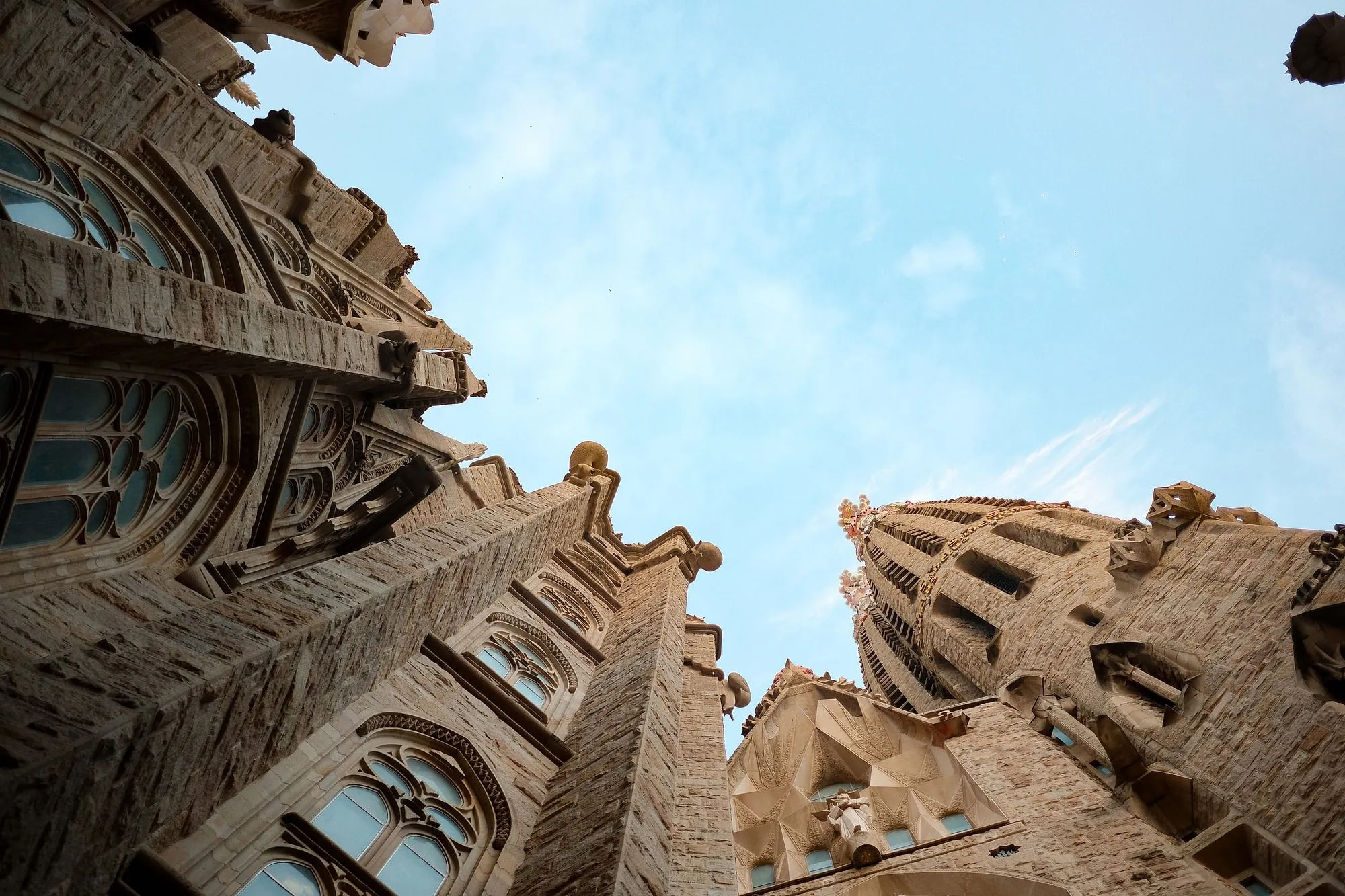
Gaudí comes alive
You will recognise the guide because he will be Antoni Gaudí.
- How long it lasts
- 1 h 30
- Runs in
- EN · ES · CA
- Price
- 30 €
Never more than 15 people
Gràcia: the town that rang the bell
A bell, a bombardment, and a vermouth at the end of it.
- How long it lasts
- 3 h
- Runs in
- EN · ES
- Price
- 36 €
Never more than 10 people
More in the journal
Gaudí and Modernisme
- 7 June 1926, Gran Via at Bailèn, a little after six in the evening
- Gaudí and the Church: an expiatory temple, a decree from Rome, and the word the decree does not use
- The things people walk past, standing right in front of them
- The Colònia Güell crypt, and the day Gaudí's money stopped
- He did not copy nature. He copied what nature does with a load
- Barcelona did not have one great architect. It had a generation