
Gràcia
April 1870: the bell of Gràcia cracked, and went on ringing
There is a fountain in Gràcia with a marble plaque on it. Halfway down, in worn capitals, it says the fountain was damaged by the uprising against conscription in April 1870. Nobody has ever taken it off the wall.
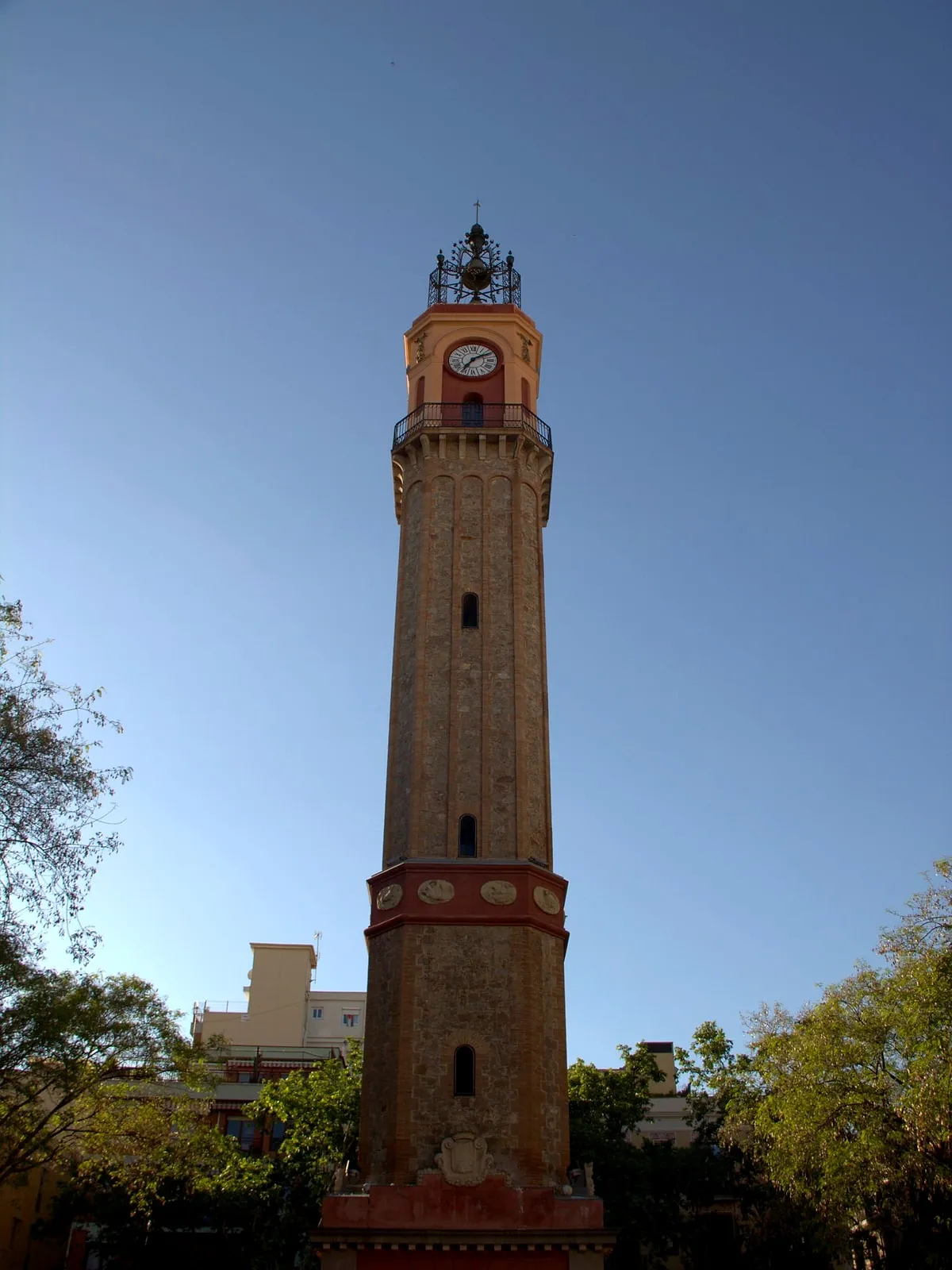
Monday, 4 April 1870. The draw is being held in Gràcia — names out of a drum, one at a time, and each name is a household finding out whether it is losing a son to the army.
Somebody goes up the tower of the town hall and rings the bell.
The bell has a name, la Marieta, and everybody in the town knows the difference between the hour and the alarm. What follows is the alarm. Gràcia rises — a separate municipality with its own mayor, not part of Barcelona and not intending to be, taking the position that it is not handing over its young men.
The answer comes from the other side of the plain. In the account the neighbourhood has kept and still repeats, artillery from Montjuïc was turned on a factory town of some tens of thousands of people, and a shell hit the tower and cracked the bell.
That hill had form. The city documents three occasions on which the guns of the castle on Montjuïc were fired on Barcelona itself — 1842, 1843, 1856 — and the history of the castle is largely a history of a fortress pointing the wrong way. What the city does not document is a fourth one in 1870, and we come back to that at the end of this page.
The bell goes on ringing.
What a quinta was
The annual levy. Each town held a lottery to decide which of its young men went into the army, and the Spanish law of the period allowed a family with money to buy the boy out in cash. A family without money did not have that option, which meant conscription was, in practice, a tax paid in sons by the people who could least afford it.
Gràcia was a factory town. It was full of exactly those families.
The plaque nobody took down
There is a public fountain in the neighbourhood with a marble plaque set into the arch above it, in Spanish, in capitals. The first line records who built the fountain — siendo alcalde D. José Balasch y Solá. The last line records who repaired it, D. Felio Martí y Urpí. Both of the dates have worn away to the point of argument.
The sentence in the middle has not:
FUÉ DETERIORADA A CONSECUENCIA DE LA SUBLEVACIÓN CONTRA LAS QUINTAS EN ABRIL DE 1870
It was damaged as a result of the uprising against conscription in April 1870.
A municipal water fountain, carrying a municipal record of the day its own town fought the army, mounted at eye level in a square where people are now drinking coffee. It has been there long enough that most people walking past have stopped reading it.
What came out of it
Six weeks after the uprising a weekly paper appeared in Barcelona called La Campana de Gràcia — the Bell of Gràcia. Satirical, and named after a cracked bell in a town that had just been shelled. It went on being published for decades, and it carried Gràcia’s reputation for insubordination to every corner of Catalonia, in print, once a week.
Which is a strange kind of afterlife for an object. The bell was rung as an alarm, hit by a shell, and ended up as a masthead.
Two things we have not been able to settle
This page would be easier to write without this section. It would also be worth less.
The month. We have followed the plaque, which says April, and 4 April 1870 was a Monday — which is when a draw is held. The Gran Enciclopèdia Catalana dates the rising to 4–9 March 1870 instead. Both are serious sources, they agree on the fourth and they disagree on the month, and we are not in a position to settle it. So you are getting both rather than the one that reads better.
The artillery, and the crack in the bell. Everybody here tells it that way and we have told it that way. But the Ajuntament’s own history of the castle sets out, with figures, every occasion on which its guns were turned on the city — 1842, 1843, 1856 — and 1870 is not one of them. That silence does not settle it either: a field battery on the hill is not the castle, and the encyclopedia’s account of the rising simply does not mention how it was put down. What it does mean is that if somebody states flatly that the castle shelled Gràcia, they are working from something we could not find.
Where to stand
Plaça de la Vila de Gràcia, under the clock tower. It costs nothing, there is no ticket office and nobody will stop you sitting there for an hour, which is the correct amount of time. The square is the old town hall square of the town Gràcia used to be — the rest of that story is in why Gràcia was its own town, and the other squares, which are also not decorative, are in the squares of Gràcia.
Our Gràcia walking tour starts here and lets the people who were in the square that afternoon do the talking, which is the difference between hearing a date and hearing an argument. Three hours, ten people, and it finishes with vermouth in a celler, because it should.
The rising was not spontaneous: the encyclopedia records that the town acted under the direction of the Centre Republicà Federal. Which is a reminder that the durable thing in this neighbourhood is its associations, not its barricades.
Where this comes from
- Gràcia (barri de Barcelona)Gran Enciclopèdia CatalanaThe 1870 rising against the quintes under the Centre Republicà Federal, the bell of the Plaça de Rius i Taulet tower that never stopped ringing, and the weekly that took its name from it. This is also the source that dates the rising to 4–9 March, against the plaque's April.
- El Castell del segle XIXAjuntament de Barcelona · Castell de MontjuïcThe three bombardments of the city from the castle — 1842, 1843, 1856 — and, by its silence, the fact that 1870 is not among the ones it documents.
Everything above that carries a date, a figure or a name is checked against these before it is published. Where we could not find a source, the page says so.
Quick answers
- What were the quintes?
- The annual military levy. Each town held a lottery to decide which of its young men were sent to the army, and under the law of the time a family with money could buy a son out of it in cash. A family without money sent the son.
- What happened in Gràcia in April 1870?
- The draw was held on 4 April, the bell of the town hall tower was rung as an alarm, and the town rose. The army answered with artillery fired from Montjuïc. A shell cracked the bell, which carried on ringing.
- Is the bell still there?
- The tower is, in Plaça de la Vila de Gràcia, and it is the square's landmark. You can stand under it any day of the week for nothing.
- What is La Campana de Gràcia?
- A satirical weekly that appeared in Barcelona six weeks after the uprising, named after that bell. The paper carried the town's reputation for insubordination across Catalonia for decades.
- Where can I see something from 1870 with my own eyes?
- On a public fountain in the neighbourhood there is a municipal plaque recording that the fountain was damaged as a result of the uprising against the quintes in April 1870. It names the mayor who built it and the mayor who repaired it. Both dates are now worn.
The tours this piece is about
More in the journal
Gràcia
- Gràcia is five neighbourhoods, and three of them used to belong to Horta
- Gràcia was its own town until 1897, and the street plan never forgave it
- Gràcia built a bell tower with no church attached, and put the signs of the zodiac on it to make the point
- The squares of Gràcia, and what each one is actually for
- The square is not named after the novel, and the statue of the novel spent six years in a different square
- Vermouth in Gràcia: how to find it, how it is served, and why we won't give you a list