
Gràcia
The square is not named after the novel, and the statue of the novel spent six years in a different square
A small square in Gràcia with a bronze woman, an air-raid shelter under it, and a name that predates the book everyone thinks it comes from by more than a hundred years.
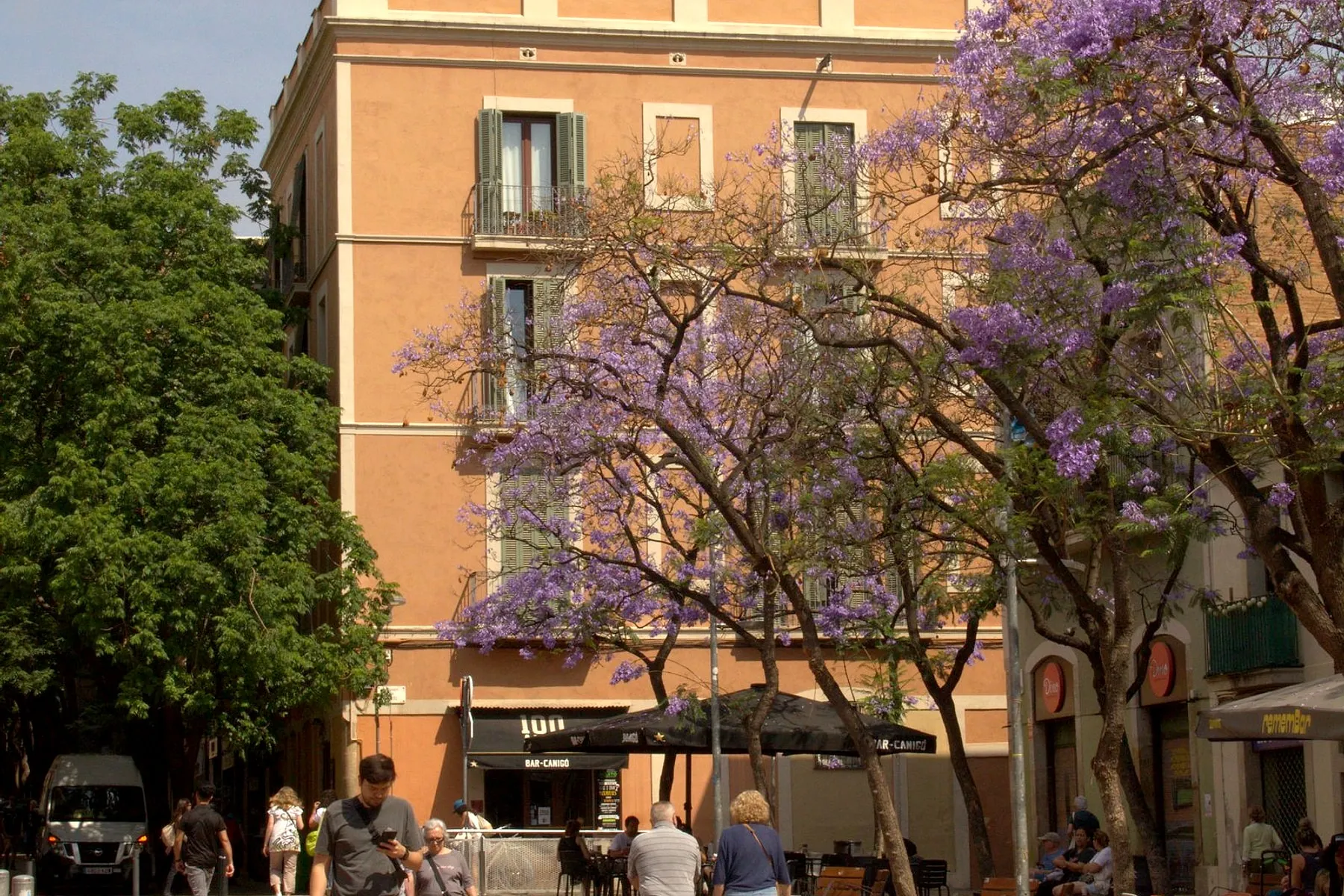
Plaça del Diamant is a small, ordinary square in Gràcia with plane trees, a couple of benches, a bronze woman with her arms up, and a set of steps going down into the ground.
It is also, for anyone who has read the novel, one of the most loaded place names in Catalan. So it is worth knowing that the square is not named after the novel, that the statue was unveiled in a different square altogether, and that Mercè Rodoreda never saw it.
The name is a jeweller’s, and it is a hundred years older than the book
The Ajuntament’s street register — which explains every street name in the city, at length, and never misses a chance to mention a writer — says this about plaça del Diamant:
It forms part of a set of street names in whose naming a jeweller intervened, when they were laid out, around 1850 (Maragda, Or, Robí, Topazi).
That is the entire explanation. Emerald, Gold, Ruby, Topaz. And no mention of Rodoreda, or of the novel, anywhere in the entry.
The register’s entry for carrer de l’Or names him: the group was named by the silversmith Josep Rossell, owner of the land.
So: a man who dealt in precious stones subdivided his plot in Gràcia around 1850 and named the streets after his stock. We wrote about this when we went through the district’s street names, and it is the least romantic origin imaginable for the most romantic place name in the city.
La plaça del Diamant, the novel, was published in 1962. The square had been called that for more than a century.
That is not a debunking of the book. It is the opposite: Rodoreda took an estate agent’s jewellery-shop name and made it mean something. The silence in the municipal register is the measure of how completely she succeeded — the city’s own naming database has no idea why anyone would care about this square.
La Colometa spent six years in the wrong square
The statue is by Xavier Medina-Campeny, in bronze and corten steel, and here is what the municipal art catalogue says about its unveiling:
The plaça del Diamant was awaiting remodelling and it was placed provisionally, on 14 April 1984, in that of Rius i Taulet. […] The inscription […] said, among other things, that “when the hour comes, la Colometa will return to her plaça del Diamant”.
And then, in the catalogue’s own dry sentence:
The hour did not come until 1990.
Six years. A monument to a novel about a specific square, standing in a different square, with a plaque promising it would move.
Rius i Taulet is the main square of Gràcia — the one with the clock tower, now called plaça de la Vila de Gràcia. So for six years the most famous literary statue in the neighbourhood was two hundred metres from where it belonged, being photographed by people who assumed it was home.
Rodoreda got a plaque, and two years
The catalogue records the moment before the monument:
they accompanied the novelist Mercè Rodoreda on 5 April 1981 at the unveiling of a plaque in the plaça del Diamant
— described as the aperitif to a monument that
Rodoreda would no longer be able to unveil, dying two years later, on 13 April 1983.
She saw the plaque. She did not see the statue, which went up a year after her death, in the wrong square, and reached the right one seven years after that.
And there is a war under it
Under the square is Refugi 232, one of Barcelona’s civil war air-raid shelters, run by the Gràcia district with visits led by the Taller d’Història de Gràcia — a neighbourhood history workshop, which is a very Gràcia arrangement and entirely in character for a place whose institutions have always been built by its own residents.
⚠️ And here is where we stop. You will be given a length, a depth, a construction date and a count of how many shelters Gràcia had. We could not open an institutional page that states any of them, so this page does not carry them. The figure we do publish for the city — 1,322 shelters, and the finding that the city says the people dug most of them themselves — is documented, and it is on its own page.
⚠️ It is not a MUHBA space. This gets repeated constantly. The city history museum publishes its own list of sites and the only air-raid shelter on it is Refugi 307, in Poble-sec, on the other side of the city.
⚠️ We are not printing the visiting arrangements. They change. Ask the organisers.
What to do when you stand in it
Do not expect a monument square. It is small, unremarkable, and surrounded by ordinary flats. That is the point of the novel and it is the point of the square.
Look at the statue from below the arms, which is the angle it was made for.
Then read the street signs around you. Or, Perla, Robí, Maragda, Topazi. You are standing in the middle of a jeweller’s window from 1850.
And go down into the shelter if the day works out. Between the bronze and the tunnel you have the twentieth century of this neighbourhood in one square: a war it dug its way through, and a novel that made its name mean something else.
Where this sits on a walk
Plaça del Diamant is three minutes from plaça de la Vila de Gràcia and inside the loop of the squares that organise the neighbourhood. It is on the way to everything and nobody arrives at it by accident.
Our Gràcia walk runs daily, morning and evening, in a group of no more than ten. We are closed on 25 December and 1 January.
Where this comes from
- Plaça del DiamantAjuntament de Barcelona · Nomenclàtor de les vies públiquesThat the name «forma part d'un conjunt de noms de carrers en la nomenclatura dels quals intervingué un joier, quan s'urbanitzaren, pels volts de 1850 (Maragda, Or, Robí, Topazi)», and that the entry makes no mention of Mercè Rodoreda or of the novel at any point.
- La Colometa, de Xavier Medina-CampenyAjuntament de Barcelona · Catàleg d'Art PúblicThat the work is by Xavier Medina-Campeny, in bronze and corten steel; that «la plaça del Diamant estava pendent de remodelació i es va posar provisionalment, el 14 d'abril de 1984, a la de Rius i Taulet», with an inscription stating that «quan sigui l'hora, la Colometa retornarà a la seva plaça del Diamant», and that «l'hora no va arribar fins al 1990»; and that the promoters «van acompanyar la novel·lista Mercè Rodoreda el 5 d'abril de 1981 en la inauguració d'una placa a la plaça del Diamant», described as the aperitif to a monument «que ja no podria inaugurar Rodoreda, que moriria dos anys després, el 13 d'abril de 1983».
- Carrer de l'OrAjuntament de Barcelona · Nomenclàtor de les vies públiquesThat carrer de l'Or «forma conjunt amb els carrers de la Perla i del Robí i la plaça del Diamant» and that the name was given «per l'argenter Josep Rossell, propietari del terreny» — the jeweller who named the group the square belongs to.
Everything above that carries a date, a figure or a name is checked against these before it is published. Where we could not find a source, the page says so.
Quick answers
- Is Plaça del Diamant named after Mercè Rodoreda's novel?
- No. The Ajuntament's street register does not mention Rodoreda or the novel at any point. It says the name «forma part d'un conjunt de noms de carrers en la nomenclatura dels quals intervingué un joier, quan s'urbanitzaren, pels volts de 1850 (Maragda, Or, Robí, Topazi)» — a set of jewel names chosen by a jeweller when the area was laid out around 1850. The name is more than a century older than the book.
- What is the statue in the square?
- La Colometa, by Xavier Medina-Campeny, in bronze and corten steel. It was unveiled on 14 April 1984 — but not here.
- Where was La Colometa unveiled, then?
- In the wrong square, on purpose and temporarily. The municipal art catalogue explains that «la plaça del Diamant estava pendent de remodelació i es va posar provisionalment, el 14 d'abril de 1984, a la de Rius i Taulet», with an inscription saying that «quan sigui l'hora, la Colometa retornarà a la seva plaça del Diamant». And then: «L'hora no va arribar fins al 1990».
- Did Rodoreda ever see anything here?
- A plaque, two years before she died. The catalogue records that she was accompanied to the square «el 5 d'abril de 1981 en la inauguració d'una placa a la plaça del Diamant», described as the aperitif to a monument she would not live to see unveiled: she died on 13 April 1983.
- Is there an air-raid shelter under the square?
- Yes — Refugi 232, run by the Gràcia district with visits led by the Taller d'Història de Gràcia. We are deliberately not printing dimensions, dates or a shelter count for it: we could not open an institutional page that states them, and this site does not attach numbers to a subject on the strength of repetition.
- Is the shelter a MUHBA site?
- It is not on the city history museum's own list of its spaces, whose only air-raid shelter is Refugi 307 in Poble-sec. Refugi 232 is run by the district with a neighbourhood history workshop guiding it, which is a different arrangement.
- How many air-raid shelters did Barcelona build?
- The figure this site publishes is the documented municipal count of 1,322, and the story of who dug them is its own page. Larger and rounder numbers circulate; we use the one we can source.
The tours this piece is about
More in the journal
Gràcia
- April 1870: the bell of Gràcia cracked, and went on ringing
- Gràcia built a bell tower with no church attached, and put the signs of the zodiac on it to make the point
- The squares of Gràcia, and what each one is actually for
- Vermouth in Gràcia: how to find it, how it is served, and why we won't give you a list
- Festa Major de Gràcia: instructions, from someone who has to walk through it
- A baker in Gràcia made a promise in 1828, and the neighbourhood has been throwing sweets at itself ever since