
Gràcia
Gràcia was its own town until 1897, and the street plan never forgave it
Before: a factory town on the plain with its own mayor and its own alarm bell. After: a district of Barcelona. The odd part is how little the second thing changed about the first.
Before: a town of about 33,000 people in 1877, on the plain above Barcelona, living off textiles, spinning and dyeing, with its own mayor, its own council and a bell on the town hall tower that was rung when something was wrong.
After: a district. Barcelona annexed Gràcia by royal decree on 20 April 1897, with nearly 62,000 people living in it, and the annexation was not popular.
Everything interesting about the neighbourhood today sits in the gap between those two paragraphs.
What being a town actually meant
Gràcia became a municipality in its own right in 1850. That is late enough to matter: it means the place was built by the nineteenth century rather than inherited from the middle ages, and it was built by industry.
It was a factory town, and the factories were inside the blocks rather than out on an estate, so the workers lived a staircase away from the noise. Textile mills above all — the encyclopedia records them displacing the older habit of weaving by hand at home — with dyeing alongside, and other trades including the first phosphorus match works in the Barcelonès. One mill on carrer de Siracusa had five hundred workers in 1861. The street grid follows from that. Short blocks, narrow streets, no ceremonial avenue anywhere, and squares that are small because nobody was commissioning a grand one. Nothing here was designed to be admired; it accumulated in order to be lived in.
The town also had a habit of governing itself loudly. The best-documented instance is April 1870, when the draw for military conscription set off an uprising and the army shelled the town from Montjuïc — that afternoon has its own page, and there is a municipal plaque in the neighbourhood that still records the damage in writing.
What annexation was
Barcelona had spent the second half of the century running out of room. The plain around it was full of towns that had the space, the factories and the people, and in 1897 the city took them: Sants, Sant Andreu, Sant Martí, Les Corts, Sant Gervasi, Gràcia. One decree, one metropolis.
From the city’s side this was administration. From Gràcia’s side it was the end of a town, and the town said so.
What Barcelona changed
The legal status, and the name on the paperwork. That is close to the whole list.
The council became a district council. The mayor stopped being a mayor. The town hall stopped being a town hall — although the building is still standing in the square it was built for, with its clock tower, and that square is still where the neighbourhood assembles when it is annoyed.
What Barcelona could not change
The grid. Two street plans drawn by two different governments, and why each looks the way it does is a page of its own. Look at a map where Gràcia meets the Eixample. The Eixample’s diagonal chamfered blocks stop dead, and behind them the streets go back to being narrow and slightly crooked. Two street plans drawn by two different governments meeting at a line. You can feel it under your feet without looking at a map at all.
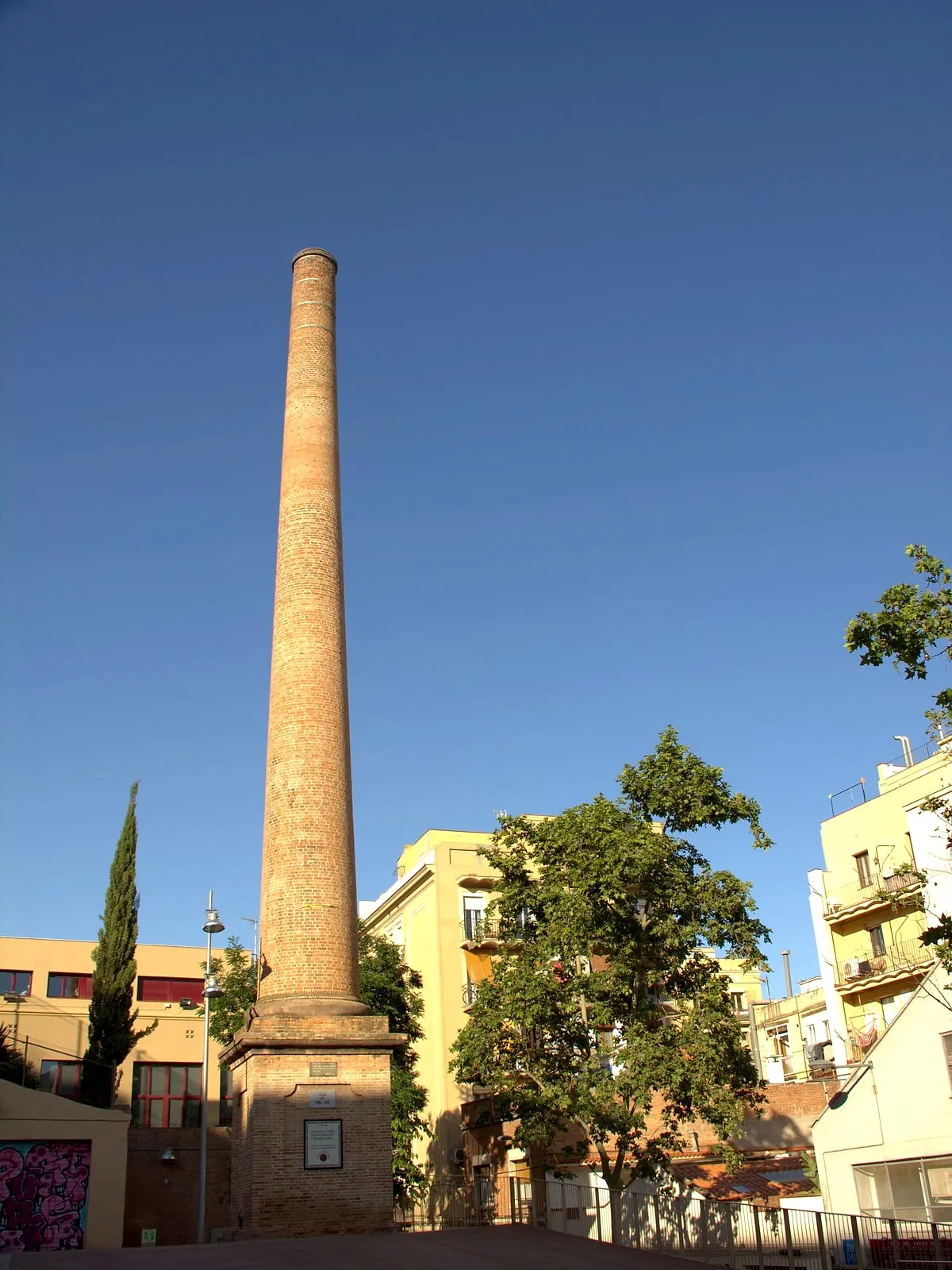
The chimney. When the factories came down for housing, one brick chimney was left standing among the flats with nothing attached to it — the city’s heritage catalogue lists exactly one in the whole district and calls it the only surviving indicator of the industrial zone around it. It is the clearest surviving evidence of what the town lived on — the inventory of what survives, and what turns out not to be documented at all, is in the chimneys of Gràcia. The other survivor from those decades is the covered market, which the town built for itself while it was still a town.
The squares. Small, frequent, and still in use for the thing they were built for. There is a square-by-square account in the squares of Gràcia.
The habit. A hundred and twenty-nine years after the decree, people here say Gràcia the way you say the name of a town, not the way you say the name of a postcode. The street festival in August, when whole streets decorate themselves by hand and compete against each other, is a town festival with a city built around it — see Festa Major de Gràcia.
One building that dates the whole thing for you
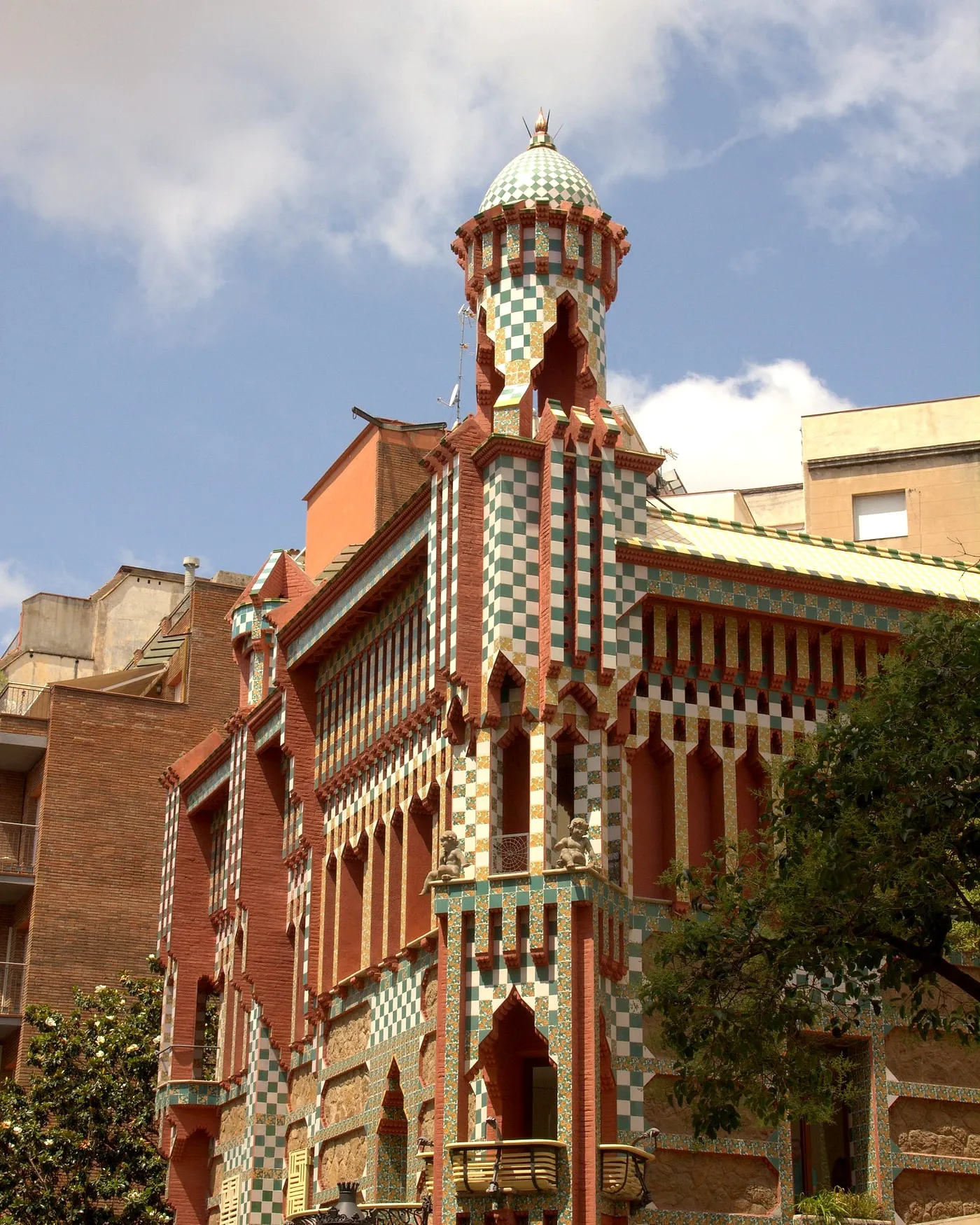
Casa Vicens went up on carrer de les Carolines between 1883 and 1885. When Gaudí built it, that address was not in Barcelona: it was in the town of Gràcia, on the edge of open ground, a summer house for a tile manufacturer, designed by a thirty-one-year-old nobody had heard of. Whether the ticket is worth buying is a different argument, dealt with in is Casa Vicens worth it.
If you want the town told out loud rather than read, our Gràcia walking tour starts at the foot of the tower and lets the people who lived through 1870 and 1897 make their own case. Ten people, three hours, and a glass of vermouth at the end of it.
The district drawn in 1984 is not the town annexed in 1897, and the difference is bigger than anybody says: the five neighbourhoods of Gràcia.
Where this comes from
- Punt d'Informació Urbanística — patrimony search (record 2672)Ajuntament de Barcelona · Catàleg del Patrimoni ArquitectònicRecord 2672, the chimney of the former Puigmartí factory (El Vapor Nou) at carrer de Siracusa: 'important centre que l'any 1861 aplegava 500 treballadors' and 'l'únic indicador subsistent de la potent zona industrial' around it. It is the only chimney catalogued in the district of Gràcia.
- Gràcia (barri de Barcelona)Gran Enciclopèdia CatalanaThe municipality formed in 1850 with 13,548 inhabitants, and the 1897 annexation to Barcelona alongside Sant Andreu, Sant Martí, Sant Gervasi and Les Corts, by which time it had reached 61,935.
- Casa VicensPatrimoni Cultural · Generalitat de CatalunyaThat Casa Vicens was built between 1883 and 1885.
Everything above that carries a date, a figure or a name is checked against these before it is published. Where we could not find a source, the page says so.
Quick answers
- When did Gràcia stop being independent?
- On 20 April 1897, by royal decree, when Barcelona annexed it along with a ring of other towns around the plain. Gràcia had nearly 62,000 inhabitants at the time and the annexation was not popular.
- How long was it a town?
- It became a municipality in its own right in 1850 and lasted forty-seven years. Before that it was a scattering of farmhouses, convents and market gardens on the road out of Barcelona.
- Why did Barcelona want it?
- Barcelona had run out of room inside its own walls and the towns on the plain had the space, the factories and the population. Absorbing them turned a walled city into a metropolis in a single decree.
- Can you still see that it was a separate town?
- Constantly. The street grid does not line up with the Eixample next to it, the blocks are short, the squares are small and the old town hall is still standing in the square it was built for, with its clock tower on top.
- Is Gràcia the only annexed town in Barcelona?
- No. Sants, Sant Andreu, Sant Martí, Les Corts and Sant Gervasi went the same way, and each of them still behaves like the town it was. Gràcia is simply the one where it shows most and which is easiest to reach on foot.
The tours this piece is about
More in the journal
Gràcia
- Is Gràcia worth visiting? Half a day, and here is the measurement
- Chillida hung fifty-four tonnes of concrete over a quarry pool, and said the water made half of it
- Gràcia is five neighbourhoods, and three of them used to belong to Horta
- April 1870: the bell of Gràcia cracked, and went on ringing
- Gràcia built a bell tower with no church attached, and put the signs of the zodiac on it to make the point
- The squares of Gràcia, and what each one is actually for