
Gràcia
Gràcia built a bell tower with no church attached, and put the signs of the zodiac on it to make the point
About thirty-three metres of tower in the middle of a square, built by a town that wanted a bell it controlled — and a plaque that finally settles the date of the revolt.
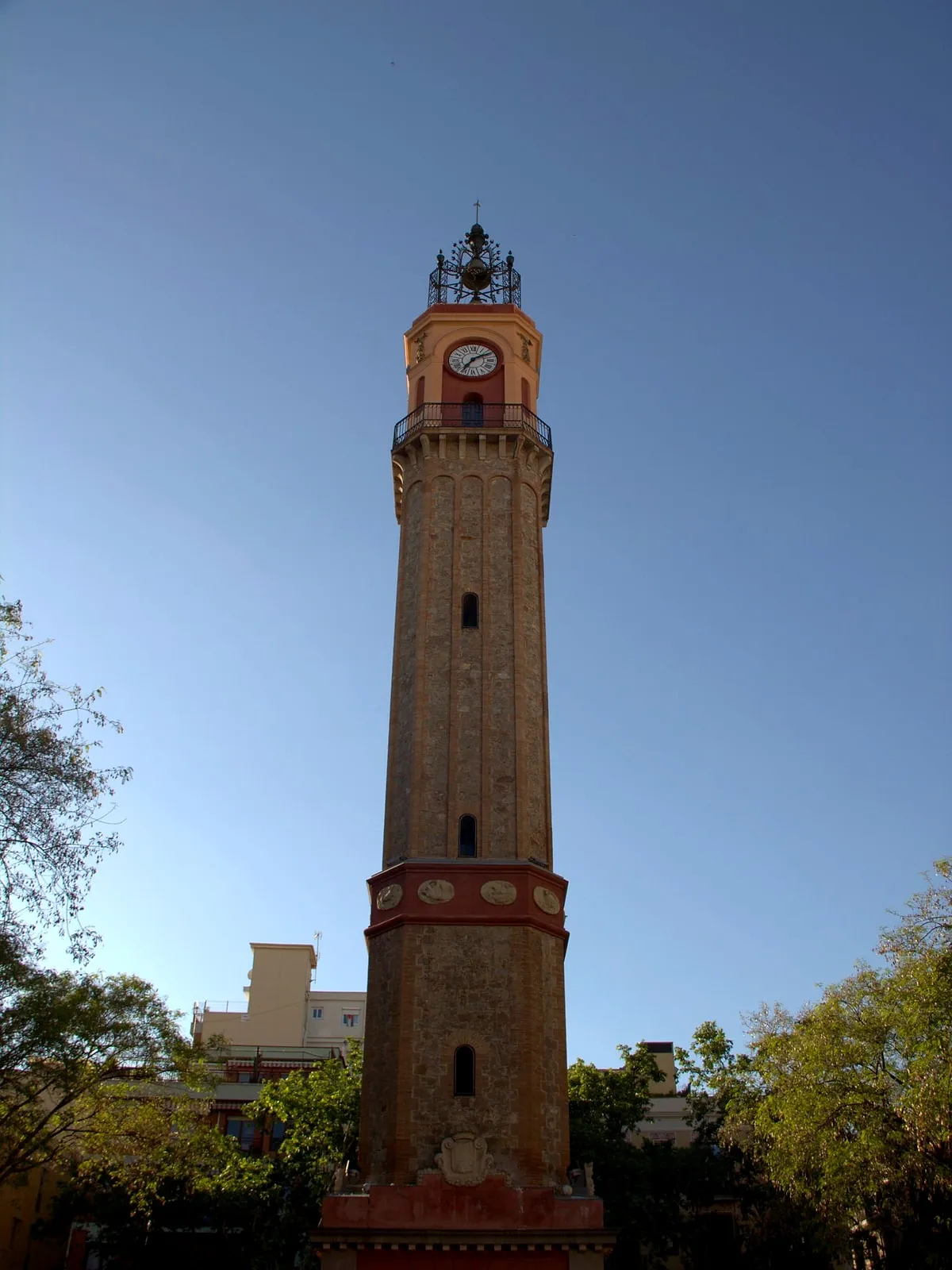
In the middle of Gràcia’s main square there is a tower with a clock on it and no church behind it.
That is the whole point of the tower, and it is stated plainly in the city’s catalogue of public art.
A bell tower for a town that did not want a priest ringing it
a lay bell tower in the middle of the square, with a clock, because the nearby churches had the common characteristic that they had no bell tower, and one was needed in order to make public calls, above all in cases of alarm.
Read what that describes. A municipality — Gràcia was still an independent town — noticing that the only bells within reach belonged to somebody else, and building its own.
Project 1862, executed 1864, by Antoni Rovira i Trías. The bell is by Isidre Pallès; the clock by the Swiss maker Albert Billeter, who lived in Gràcia between 1850 and 1880 and also made the clocks of Barcelona cathedral and of the Spanish Congress.
The record says about thirty-three metres, and that it is the tallest public tower in Gràcia. A spiral staircase of 135 steps.
And then they made sure nobody could mistake it
This is the detail that turns a municipal facility into a statement.
To accentuate the civil, not religious, character of the bell tower, twelve terracotta reliefs with the signs of the zodiac were distributed in a frieze on the lower part.
Twelve zodiac signs on a bell tower. In a Catholic country, in 1864. Not decoration — the catalogue says outright it was to accentuate that this tower is not a church.
What the bell was for
Not the hours. The catalogue is explicit about the political function:
It played an important role in the agitated period of the Sexenni Revolucionari, 1868-1874, in which the bell rang the sometent more than once to call people to mobilise against governmental abuses.
The sometent is the old Catalan call to arms: the summons that brings people out of their houses. The town’s clock tower doubled as the town’s alarm.
And it was rung until it was stopped:
When in 1874 the Bell rang the sometent for the last time to call for rebellion against general Pavia’s coup d’état […] the order was given to silence them, and in the time of the dictatorship of Primo de Rivera there was even an attempt to suppress it and take it to the towers of the International exposition, in plaça d’Espanya. But the opposition of Gràcia prevented it.
A dictatorship tried to move the bell to the fairground on the other side of the city and the neighbourhood said no.
The plaque, which settles a date
On the tower there is an inscription, and the municipal catalogue transcribes it in full:
IT WAS BUILT IN THE YEAR 1864 UNDER MAYOR / D. JOSÉ BALASCH Y SOLÁ. / IT WAS DAMAGED BY THE UPRISING / AGAINST CONSCRIPTION IN APRIL OF 1870 / AND RESTORED IN THE YEAR 1882, UNDER MAYOR / D. FÉLIX MARTÍ Y URPÍ
Two things.
First, April. The Revolta de les Quintes — the uprising against the conscription lottery — is dated to March in one major reference work and April in others, and this journal has been carrying that disagreement out loud. The tower itself, in a municipal inscription, says April of 1870.
Second, look at what the plaque is doing. It records the damage as part of the tower’s identity. Gràcia restored its bell tower in 1882 and put up a sign saying this was broken in the rising against conscription. That is not repair; that is a memorial.
The four shields, and the joke on the south face
The tower carries four coats of arms: Vila de Gràcia to the north, Barcelona to the west, the Principat to the east —
and to the south, the arms of Isabel II.
The queen who was deposed by the revolution of September 1868, four years after this tower went up. Her arms are still on it. Two hundred metres away is a square named, in full, after the coup that removed her.
Gràcia did not scrape the shield off. It just built a square opposite that says the opposite, and left both standing.
One thing the catalogue cannot keep straight
⚠️ The bell’s name. In one passage the record gives three names — Maria-Gràcia, Isidra i Assumpció. In another it gives four — Maria, Gràcia, Isidra i Assumpció. Same page.
Both agree on what everyone actually calls it: la Marieta.
We are not going to pick. It is a small thing, and it is the same pattern we keep finding — the city’s own records disagreeing with themselves in ways nobody has noticed because nobody reads two of their pages at once.
The square underneath it
The municipal record notes that the square carried the name of the Barcelona mayor Rius i Taulet from September 1907, and that for some time now the possibility of another change of name has been discussed. It has since been made: the record’s own heading calls it plaça de la Vila de Gràcia.
A square that changed its name to say that this is the town of Gràcia, under a tower built so the town could ring its own bell.
If you want one object that contains the whole argument of this neighbourhood — self-government, secularism, revolt, and a refusal to let Barcelona take its things away — it is about thirty-three metres tall and it is in the middle of the square where the district hall still is.
How to see it
Stand at the base and find the zodiac. The frieze is low down, deliberately, where people would read it. Twelve terracotta reliefs, and now you know why they are there.
Walk round it and find the shields. North, west, east, south. The deposed queen is facing the city.
Then go two streets and read the street names, which are a political programme, a jeweller’s brochure and a drainage report.
And go on 3 March if you can, when the colles come back through the square throwing sweets, or in August when the streets around it compete on decoration.
⚠️ We are not telling you it can be climbed. Access to towers like this is arranged by the district and changes; ask them, not us.
Where this sits on a walk
The tower is in plaça de la Vila de Gràcia, which is the middle of everything worth walking in the old town and two minutes from the market.
Our Gràcia walk is named after this bell. It runs daily, morning and evening, in a group of no more than ten. We are closed on 25 December and 1 January.
Where this comes from
- Torre del Campanar de la plaça de la Vila de GràciaAjuntament de Barcelona · Catàleg d'Art PúblicThat the project dates from 1862 and the execution from 1864, with restorations in 1882, 1983 and 2005; that the architect is Antoni Rovira i Trías, the bell by Isidre Pallès and the clock by the Swiss maker Albert Billeter; that it was conceived as «un campanar laic al mig de la plaça, amb rellotge, perquè a les esglésies properes s'hi donava la característica comú que no tenien campanar i en calia un per a poder fer crides públiques, sobretot en casos d'alarma»; that «per accentuar el caràcter civil, no religiós, del campanar, es van distribuir dotze relleus de terracota, amb els signes del zodíac, en un fris situat a la part baixa»; that the bell «va jugar un paper important en l'agitat període del Sexenni Revolucionari 1868-1874, en que la campana va tocar a sometent més d'un cop per cridar la gent a mobilitzar-se contra els abusos governatius»; that when in 1874 it rang «per últim cop per cridar a rebel·lar-se contra el cop d'estat del general Pavia […] es va donar l'ordre de silenciar-les i en temps de la Dictadura de Primo de Rivera fins i tot es va intentar suprimir-la i portar-la a les torres de l'exposició Internacional, a la plaça d'Espanya. Però l'oposició gracienca ho va impedir»; that it is 33 metres tall with a spiral staircase of 135 steps and four shields — Vila de Gràcia to the north, Barcelona to the west, the Principat to the east and the arms of Isabel II to the south; that Billeter lived in Gràcia between 1850 and 1880 and also made the clocks of the cathedral and of the Spanish Congress; and the full transcription of the plaque: «SE CONSTRUYÓ EN EL AÑO 1864 SIENDO ALCALDE / D. JOSÉ BALASCH Y SOLÁ. / FUE DETERIORADA A CAUSA DE LA SUBLEVACIÓN / CONTRA LAS QUINTAS EN ABRIL DE 1870 / Y RESTAURADA EN EL AÑO 1882, SIENDO ALCALDE / D. FÉLIX MARTÍ Y URPÍ». The same record gives the bell three names in one passage — «Maria-Gràcia, Isidra i Assumpció» — and four in another — «Maria, Gràcia, Isidra i Assumpció» — noting that popularly it is known as la Marieta.
- Plaça de la Revolució de Setembre de 1868Ajuntament de Barcelona · Nomenclàtor de les vies públiquesThat the September 1868 revolution was a «cop d'estat, conegut com la Gloriosa, promogut pels generals Prim, Topete i Serrano, per tal de destronar Isabel II» — the queen whose arms are on the south face of the tower, six years after it was built and two years before the revolt that damaged it.
Everything above that carries a date, a figure or a name is checked against these before it is published. Where we could not find a source, the page says so.
Quick answers
- Why does Gràcia have a clock tower in the middle of its main square?
- Because the town needed a bell and the churches did not have one. The municipal art catalogue describes it as «un campanar laic al mig de la plaça, amb rellotge, perquè a les esglésies properes s'hi donava la característica comú que no tenien campanar i en calia un per a poder fer crides públiques, sobretot en casos d'alarma».
- Who built it and when?
- The architect was Antoni Rovira i Trias, with a project of 1862 and execution in 1864. The bell is by Isidre Pallès and the clock by the Swiss maker Albert Billeter. It was restored in 1882, 1983 and 2005.
- Why are there zodiac signs on it?
- To make sure nobody mistook it for a church tower. The catalogue: «per accentuar el caràcter civil, no religiós, del campanar, es van distribuir dotze relleus de terracota, amb els signes del zodíac, en un fris situat a la part baixa».
- How tall is it?
- The municipal record says «la torre té uns 33 metres d'alçada i és la torre pública més alta de Gràcia», with an access door at the back opening onto «una escala de cargol de 135 graons».
- What did the bell actually do?
- It called people out. The catalogue says it «va jugar un paper important en l'agitat període del Sexenni Revolucionari 1868-1874, en que la campana va tocar a sometent més d'un cop per cridar la gent a mobilitzar-se contra els abusos governatius», and that when it rang for the last time in 1874 — against general Pavia's coup — the order was given to silence the bells.
- Did anyone try to remove it?
- Yes. The catalogue records that under the dictatorship of Primo de Rivera there was an attempt «suprimir-la i portar-la a les torres de l'exposició Internacional, a la plaça d'Espanya. Però l'oposició gracienca ho va impedir». The neighbourhood stopped it.
- Is the plaque on it worth reading?
- It settles an argument. The inscription transcribed in the municipal catalogue reads that the tower «SE CONSTRUYÓ EN EL AÑO 1864» under mayor José Balasch y Solá, «FUE DETERIORADA A CAUSA DE LA SUBLEVACIÓN CONTRA LAS QUINTAS EN ABRIL DE 1870 Y RESTAURADA EN EL AÑO 1882» under mayor Félix Martí y Urpí. April, in writing, on the tower itself.
The tours this piece is about
More in the journal
Gràcia
- Gràcia is five neighbourhoods, and three of them used to belong to Horta
- Gràcia was its own town until 1897, and the street plan never forgave it
- April 1870: the bell of Gràcia cracked, and went on ringing
- The squares of Gràcia, and what each one is actually for
- The square is not named after the novel, and the statue of the novel spent six years in a different square
- Vermouth in Gràcia: how to find it, how it is served, and why we won't give you a list