
Montjuïc
On the city's list of places residents avoid because of tourism, Montjuïc comes last
Two municipal surveys measure Montjuïc, and they point the same way. Fewer visitors are going up, and the people who live here have not written it off. That combination does not exist anywhere else in Barcelona.
Barcelona measures this. Not with a footfall counter — there is no official visitor count for Montjuïc and anyone quoting one made it up — but by asking its own residents, every year, whether tourism has driven them out of anywhere.
In 2025, 57.6 % said yes. Then they were asked where.
Montjuïc came last.
The table, with the hill at the bottom
Among the 999 residents who named a place:
| Place | Share |
|---|---|
| La Rambla | 27.1 % |
| Plaça de Catalunya – Passeig de Gràcia | 26.8 % |
| The seafront | 26.3 % |
| El Gòtic – El Raval – the old town | 25.5 % |
| The Sagrada Família area | 17.4 % |
| Park Güell | 14.6 % |
| El Born | 7.4 % |
| The cathedral and Santa Maria del Mar | 3.9 % |
| Gràcia | 2.9 % |
| Montjuïc and Plaça d’Espanya | 2.1 % |
Below Gràcia, which is a residential neighbourhood most visitors never reach. Below the cathedral. One thirteenth of La Rambla.
And this is not a small or obscure place being ignored by the survey. It is the entry that includes the Magic Fountain, Plaça d’Espanya, the MNAC, the Poble Espanyol, CaixaForum, the Mies pavilion, the Fundació Miró, the castle, the Olympic ring and the gardens. All of that, and 2.1 %.
The other survey, pointing the same way
The tourism observatory asks visitors which places they went to. For «Montjuïc, fonts i plaça Espanya»:
61.3 % (2021) · 65.0 % (2022) · 61.3 % (2023) · 59.2 % (2024) · 55.3 % (2025)
Down about ten points from the peak.
Two things about that, both worth saying plainly.
It is not unique to Montjuïc. The Gothic Quarter has gone from 71.1 % to 65.3 %, La Rambla from 82.6 % to 77.2 %. The Sagrada Família has held, and the Turó de la Rovira has gone up. So this is not the hill losing its appeal; it is a general drift, plus one bunker viewpoint that Instagram found.
And a survey of two thousand people moving three points is not a landslide. We are printing the whole series rather than the two ends, because the 2021 and 2023 figures are identical and any story built on a single year’s move would already have been wrong twice.
What the two datasets do agree on is the direction, and they were run by different institutions asking different people different questions. Fewer visitors are going up the hill, and residents have not stopped going.
Why, and the honest limit of what we can say
Neither survey explains anything. They count.
So here is the observable part, and you can check every word of it standing at the bottom of the escalators.
There is no bottleneck. Crowding is a geometry problem before it is a numbers problem. La Rambla is 1,200 metres of corridor with a wall of people in it; the Gothic Quarter is a network of streets three metres wide. Montjuïc is a hillside with roughly a dozen unrelated destinations scattered across it at different altitudes, most of them outdoors, connected by roads, paths, gardens and three separate cable-hauled contraptions. You cannot funnel that.
Most of it is a park. The gardens are the reason people who live here come up, and gardens absorb people in a way that a market hall or a promenade does not.
And the good things are not adjacent. The single most common complaint about Montjuïc is that everything is far from everything else. That is exactly the property that keeps it from feeling mobbed, and it is why half a day works and two hours does not.
We are not going to dress that up as a secret. It is a trade-off, and the survey is measuring the good half of it.
What the city does here, and does not
There is a municipal programme called Juguem a les places — play activities for local residents, in squares the council says tourism tends to monopolise, paid for entirely out of the tourist tax and its municipal surcharge. The commissioner’s phrasing is unusually direct: the squares tourism tends to monopolise are recovered with specific, programmed and funded neighbourhood uses.
In 2026 it ran 108 sessions between May and November, in four squares: Sagrada Família, Plaça Reial, the Gardunya and Plaça Nova.
Eixample and Ciutat Vella. Nothing on Montjuïc.
That is a negative result and negative results are worth publishing. The city deploys its crowd-recovery machinery where it thinks squares have been lost. It has not yet decided that anything on this hill has been.
What it is like to be up there, in practice
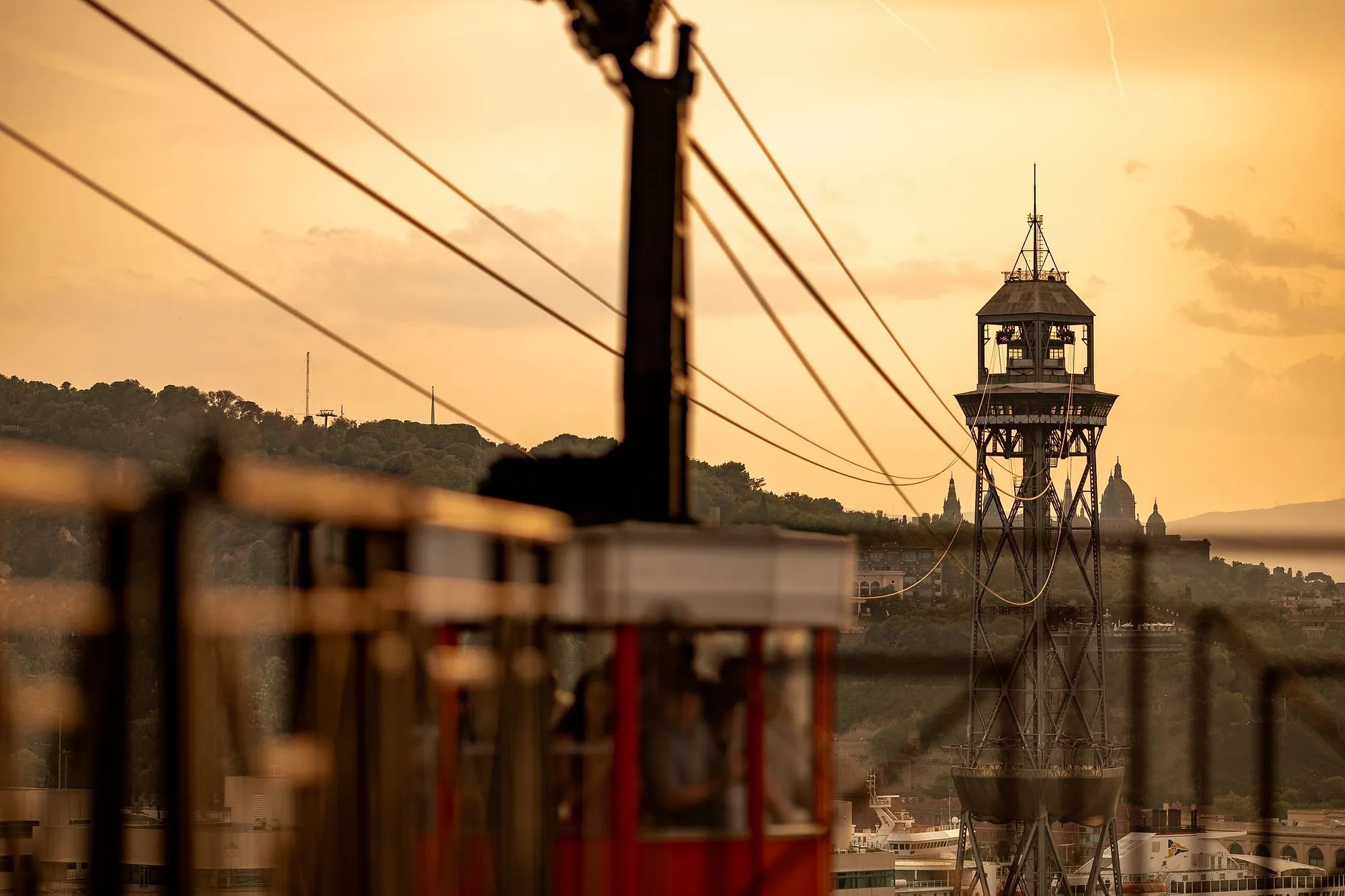
The pinch points are real and they are three. The Magic Fountain on a show night, the front steps of the MNAC at sunset, and the cable car. Everything else on the hill absorbs people.
Height sorts the crowd for you. The higher you go, the thinner it gets, and the largest share of visitors never gets past Plaça d’Espanya and the fountain. The survey category itself gives that away by lumping «Montjuïc, fountains and Plaça d’Espanya» into one line — the city’s own instrument cannot tell you whether the 55.3 % went up the hill or stood at the bottom of it and photographed a fountain.
Mornings are extraordinary and almost nobody uses them. The gardens open early, the light comes off the sea, and the castle and the cemetery are at their best before the coaches.
On safety, since the other pages here answer it
Montjuïc sits in the district of Sants-Montjuïc, fourth of ten in the city’s victimisation survey at 40.4 incidents per hundred inhabitants in 2024 — against 137.3 for Ciutat Vella. Its residents rate their own neighbourhood 6.1 out of ten, a shade under the city’s 6.3.
Neither number is about the hill specifically, and the honest caveat is the opposite of the one for the Gothic Quarter: the park is large, wooded, steeply stepped and thinly used, and coming down it on foot late at night is a different proposition from walking through a busy old town. The ways up and down are worth reading before you commit to an evening up there.
Why we go on Tuesdays and Thursdays
Because the afternoon on this hill is not the afternoon in the old city.
Our Montjuïc walk is two and a half hours on the mountain that Barcelona used as a cemetery, a quarry, a fortress and a fairground, and the reason it can be that long is the same reason the survey looks the way it does: there is room. Nobody is standing behind you waiting for you to move.
If you are choosing between hills, Park Güell scores 14.6 % on that avoidance list and Montjuïc 2.1 %, which is a fact worth having before you buy a timed ticket. And the whole avoidance table is worth ten minutes if you are planning where to spend your days at all.
We run Tuesday and Thursday afternoons, and we are closed on 25 December and 1 January.
Where this comes from
- Enquesta de percepció del turisme a Barcelona 2025 (PDF)Ajuntament de Barcelona · Oficina Municipal de Dades, Departament d'Estudis d'OpinióQuestion P12, on 1,732 residents: 57.6 % say tourism has made them stop visiting some area of the city, up from 49.5 % in 2023 and 54.0 % in 2024. Question P13, on the 999 who said yes: La Rambla 27.1 %, Plaça Catalunya–Passeig de Gràcia 26.8 %, Front Marítim 26.3 %, «el Gòtic - el Raval - el casc Antic» 25.5 %, the Sagrada Família area 17.4 %, Park Güell 14.6 %, El Born 7.4 %, «Catedral - Santa Maria del Mar» 3.9 %, Gràcia 2.9 % and «Montjuïc - Plaça Espanya» 2.1 %, the lowest named entry.
- Informe de resultats: perfil i hàbits dels turistes a Barcelona ciutat 2025 (PDF)Observatori del Turisme a BarcelonaQuestion P26, places visited, put to half the Barcelona-city sample (N = 2,023 in 2025): «Montjuïc, fonts i plaça Espanya» 61.3 % in 2021, 65.0 % in 2022, 61.3 % in 2023, 59.2 % in 2024 and 55.3 % in 2025; the Gothic Quarter 71.1 % to 65.3 % over the same period; La Rambla 82.6 % to 77.2 %; the Sagrada Família 76.8 % to 80.6 %; and the Turó de la Rovira rising from 12.2 % in 2024 to 15.7 % in 2025.
- Enquesta de Victimització de Barcelona 2025 — Presentació de resultats (PDF)Ajuntament de Barcelona · Oficina Municipal de DadesThe ràtio de localització for 2024 — incidents that happened in each district per hundred inhabitants — with Sants-Montjuïc at 40.4, fourth of ten, against Ciutat Vella at 137.3 and Gràcia at 26.0; and the 2025 safety scores out of ten, with Sants-Montjuïc residents giving their own neighbourhood 6.1 and the city 5.7, against a Barcelona average of 6.3 and 5.5.
- Barcelona amplia el programa 'Juguem a les places' als espais d'afluència turística (16/05/2026)Ajuntament de Barcelona · Servei de PremsaThat the programme runs 108 sessions between 16 May and 15 November 2026 in four squares — «plaça de la Sagrada Família, plaça Reial, plaça de la Gardunya i plaça Nova» — in the districts of the Eixample and Ciutat Vella, with a budget of 113,000 euros; that it is deployed at the Espais de Gran Afluència and «se sufraga a través de l'Impost d'Estades en Establiments Turístics (IEET) i el recàrrec municipal que s'hi aplica»; and the commissioner's formulation that «les places que el turisme tendeix a monopolitzar es recuperen amb usos veïnals concrets, programats i finançats».
Everything above that carries a date, a figure or a name is checked against these before it is published. Where we could not find a source, the page says so.
Quick answers
- Is Montjuïc crowded?
- In parts, at times, and much less than the rest of visitable Barcelona. The city does not publish footfall for the hill, so anyone giving you a number invented it. What it does publish is that among the 999 residents who said tourism had made them stop visiting somewhere in 2025, only 2.1 % named «Montjuïc - Plaça Espanya» — the lowest entry on the list, below Gràcia at 2.9 %, against La Rambla at 27.1 %.
- Are fewer people visiting Montjuïc?
- Yes, on the tourism observatory's own series. The share of surveyed tourists who visited «Montjuïc, fonts i plaça Espanya» ran 61.3 % in 2021, 65.0 % in 2022, 61.3 % in 2023, 59.2 % in 2024 and 55.3 % in 2025. Roughly ten points off the 2022 peak. The Gothic Quarter and La Rambla are doing the same thing over the same years.
- Why is Montjuïc less crowded than the rest of Barcelona?
- The survey does not explain it and we are not going to invent a reason. What is observable and checkable is the shape of the place: it is a hill of a few square kilometres with a dozen separate destinations spread across it at different heights, most of them outdoors, and no single street that everything funnels through. Crowding needs a bottleneck. The Rambla is one; a hillside is not.
- Is Montjuïc safe?
- It sits in the district of Sants-Montjuïc, which the city's victimisation survey places fourth of ten for incidents per hundred inhabitants in 2024, at 40.4 — against 137.3 for Ciutat Vella. Residents of the district score safety in their own neighbourhood at 6.1 out of ten against a city average of 6.3. Neither figure is specific to the hill, and after dark the park is large, wooded and thinly used, which is worth knowing before you plan a late walk down.
- Is Montjuïc worth it if I only have a short time?
- That is a different question and it has its own page. The short version is that half a day works and two hours does not, because everything up there is separated by gradient.
- Does the city run crowd-management measures on Montjuïc?
- Not the ones it runs elsewhere. In 2026 the Ajuntament's «Juguem a les places» programme — activities for residents in squares the council says tourism tends to monopolise, funded entirely from the tourist tax — ran in four squares: Sagrada Família, Plaça Reial, the Gardunya and Plaça Nova. All four are in the Eixample and Ciutat Vella. None is on Montjuïc.
- So is Montjuïc the non-touristy option?
- It is the least avoided major destination in the city, which is not the same as empty. The Magic Fountain, the MNAC steps and the cable car have queues and crowds like anywhere else. What the data supports is narrower and more useful: the hill has not been abandoned by the people who live here, and that is the thing that usually goes first.
The tours this piece is about
More in the journal
Montjuïc
- Is Montjuïc worth it? Give it half a day or give it nothing
- The city calls this the third great transformation of Montjuïc, and it has been counting from 1929
- The bullring closed twenty-one years before bullfighting was banned, and the ban was struck down anyway
- The eight-hour day was won on this avenue, and the decree that granted it does not mention it
- There are three cable-car-shaped things on Montjuïc and most people book the wrong one
- Barcelona built this castle to defend itself, and then spent two centuries being shelled from it