
Montjuïc
The best building of the 1929 Exposition spent fifty-six years not existing
A fair that was supposed to last eight months rebuilt an entire mountain. What survived is not what anybody expected to survive, and the hill is being rebuilt again right now for the centenary.
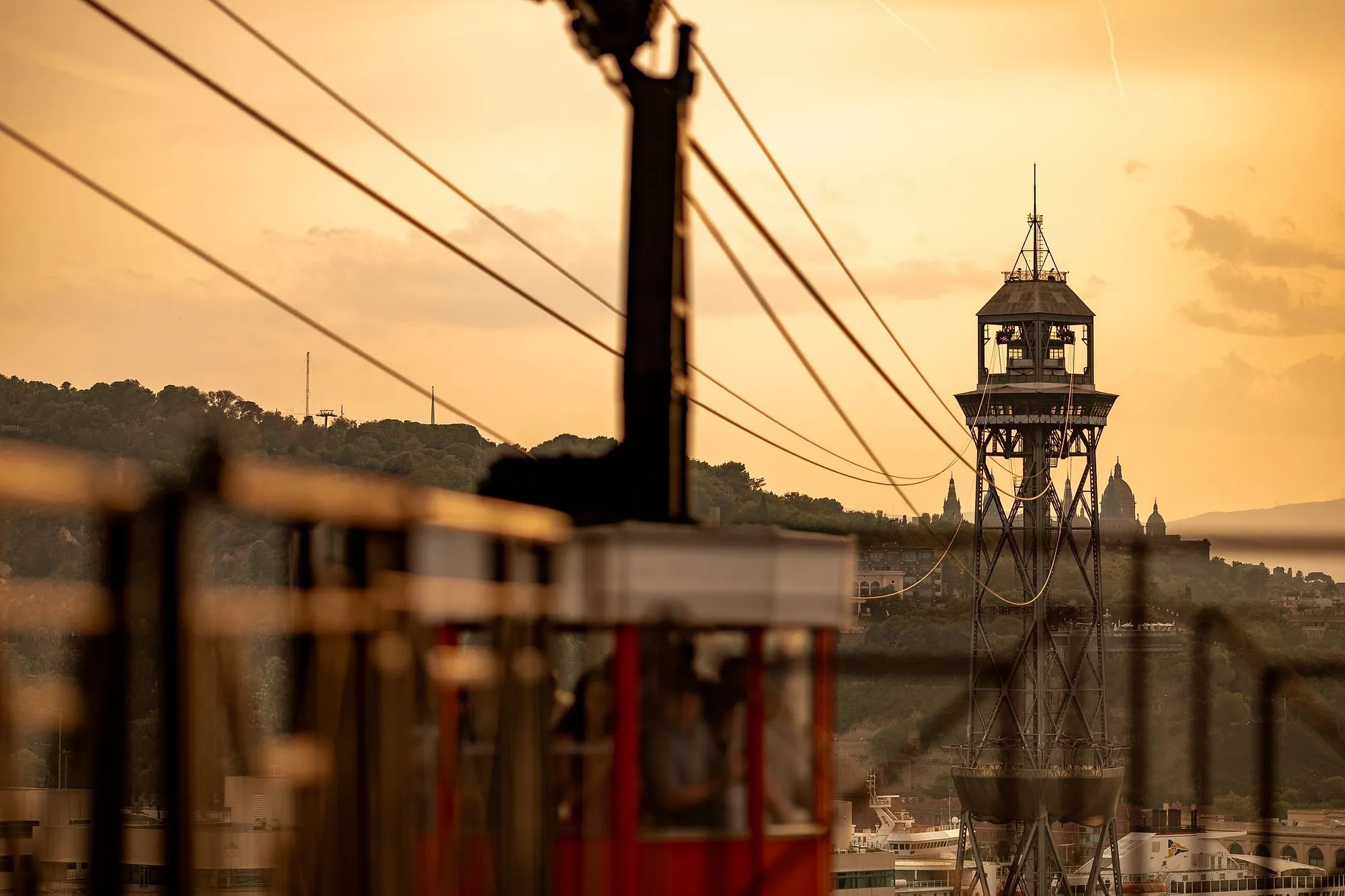
Barcelona spent the 1920s turning a hill into a fairground and the hill never went back. Almost every recognisable thing on Montjuïc below the castle — the great staircase, the fountain, the museum, the village, the theatre, the stadium — is there because of an event that lasted eight months.
What makes it worth an afternoon is not that it survived. It is which parts survived, because the fair got that spectacularly wrong.
The one that was taken apart
The German national pavilion, designed by Ludwig Mies van der Rohe, is on most short lists of the most important buildings of the twentieth century. Marble, chrome, water, and almost nothing in it.
The city puts it plainly enough: the pavilion went up for the fair and was dismantled the year after, in 1930, because that is what you do with a national pavilion. Then Barcelona rebuilt it — faithfully, and on the same spot — and the reconstruction opened on 2 June 1986.
So for fifty-six years, the building that architecture students were being taught about existed only as photographs and a plan. You can stand in it now, and what you are standing in is a 1980s reconstruction of a 1929 building, on the correct spot, at the correct size.
If the phrase real but reconstructed is starting to sound familiar, it is the same argument the old town runs on — see the buildings of the Gothic Quarter that were moved, rebuilt or finished late. Barcelona does this constantly and is completely relaxed about it.
The one that was supposed to come down and did not
The Poble Espanyol — a village assembled out of copies of buildings from all over Spain — went up fast: construction began on 19 January 1928 and it was inaugurated with the fair on 20 May 1929.
Its own history is candid about the plan. The initial idea was to demolish it at the end of the Exposition. Its creators came round to the view that it should endure, it was a success, and the demolition never happened.
A stage set that was meant to be struck, kept because the audience liked it. That is either a happy accident or the honest description of half of Barcelona, depending on the mood you are in. Whether it is worth your afternoon, and which real buildings each piece of it copies, is its own page.
The one that became the museum
The Palau Nacional was the fair’s centrepiece. Its first stone was laid on 30 June 1926 — three weeks after Gaudí was buried across the city, which is a coincidence and also a good measure of how fast the century was moving. The Barcelona he died in was already digging this hill up.
The national art collection moved in during the early thirties and the museum was inaugurated on 11 November 1934. After a long remodelling it reopened in stages, complete on 16 December 2004. The most important thing in it did not come from Barcelona at all: the Romanesque murals were removed from Pyrenean church walls between 1919 and 1923.
Not everything on the site was so lucky. The Palau d’Art Modern, from the same fair, was demolished.
The rest of it, briefly
- The Magic Fountain, built for the fair by the engineer Carles Buïgas, who also designed the harbour cable car — the one that crosses the water to Barceloneta — to link the Exposition to its maritime section.
- The two brick towers at Plaça d’Espanya, by Ramon Reventós, taking their form from the campanile in Venice. They are the gateway, and the reason everybody starts here.
- The Teatre Grec, also Reventós, 1929, built against the face of an old quarry — which is the single most Montjuïc thing on the hill: the mountain was quarried for centuries, and the holes left behind kept getting reused for something else. The most sombre of those reuses is the Fossar de la Pedrera, further up.
The stadium that was used twice
The stadium was built for 1929 to a design by Pere Domènech i Roura and inaugurated with the fair on 20 May 1929, with a rugby match against Italy.
Sixty years later it was reused for the Olympic Games, and the way it was reused is the point. The stadium’s own account: the work between the mid-eighties and 1989 kept the façade — as a testimony to Barcelona’s historical Olympic vocation — and rebuilt everything behind it. The level of the original track was lowered by eleven metres, and the stone dug out was used, according to the stadium, on the building site of the Sagrada Família.
Which is a very Barcelona sentence. The rock excavated from a 1929 stadium to make it fit a 1992 Olympics went into a church that had been under construction since 1882 and still is.
It was re-inaugurated on 8 September 1989, and in March 2001 it was renamed after Lluís Companys, the president of the Catalan government — who was shot in the moat of the castle at the top of the same hill. The hill does not let you keep the two halves apart, which is what the castle is for. The rest of the Olympic ring, and the arrow question, are here; where that excavated stone actually went is here.
The Palau Sant Jordi next door, by Arata Isozaki, opened in 1990. The communications tower on the ridge is Santiago Calatrava’s, from 1992.
What we are not going to tell you
- A closing date for the Exposition. It ran into January 1930. The precise day circulates widely and we could not find an institution publishing it.
- That the Palau Nacional, the fountain, the towers, the theatre or the stadium were built as temporary structures. This is repeated constantly. Only two of the fair’s buildings have an institutional statement about intended impermanence: the German pavilion, which was indeed taken down, and the Poble Espanyol, which was not. For the rest, nobody says it.
- Exact construction start years for the stadium. “1927 to 1929” is everywhere; no source we could reach gives a start year.
The hill is being rebuilt again, right now
This matters if you are planning a visit. The city has begun transforming the old exhibition grounds: demolition of some of the fairground palaces is under way, one of Puig i Cadafalch’s palaces becomes the new congress centre, a second phase is scheduled from 2029, and the whole programme runs to 2035 — timed so the new spaces open for the centenary of the 1929 Exposition.
Which means any page describing the lower slopes of Montjuïc, including this one, is a snapshot. We would rather say that than have you arrive at a hoarding.
Walking it
The order matters more than the list. Our Montjuïc walking tour takes the hill in the sequence it actually happened — the fair, then the castle above it, then the quarry behind it — which is why it lands differently from the same places visited in whatever order the map suggests.
If you are still deciding whether to give the hill an afternoon at all, that is is Montjuïc worth it, and the practical question of how you get up there is here.
One name from that year belongs in the Gaudí story and is almost never put there. The monumental fountain in Plaça d’Espanya, at the foot of this hill, is by Josep Maria Jujol — the man who planned the undulating bench in Park Güell and the tile medallions on the Hypostyle Room ceiling. If you walked up from the metro you walked round a Jujol on the way to a Gaudí-free hill. He has his own entry in who worked with Gaudí.
Four of the fair’s survivors now have pages of their own: the Magic Fountain and what happened to it between 2022 and 2025; the German pavilion, dismantled in 1930 and rebuilt in 1986; the access towers and the fountain on Plaça d’Espanya; and the Casaramona factory, which predates the fair by seventeen years and was standing there through all of it.
What happened to two of these buildings afterwards: the Palau de l’Agricultura became a theatre by accident, and the stadium ended up surrounded by an Olympic ring whose roofs and towers are worth more attention than the stadium.
Where this comes from
- 40 años del icono de la arquitectura moderna en MontjuïcAjuntament de BarcelonaThat the pavilion built for the 1929 Exposition was dismantled the following year, that Barcelona rebuilt it faithfully on the same site, and that the reconstruction opened on 2 June 1986.
- Historia del Poble EspanyolPoble Espanyol de BarcelonaBuilding started on 19 January 1928, it opened on 20 May 1929, and it survived the demolition originally planned for it.
Everything above that carries a date, a figure or a name is checked against these before it is published. Where we could not find a source, the page says so.
Quick answers
- When was the Barcelona International Exposition of 1929?
- It opened on 20 May 1929 and ran into January 1930. We do not give a closing date because we could not find one an institution publishes — several are in circulation and none of them is sourced.
- What is left from the 1929 Exposition in Barcelona?
- The Palau Nacional, now the national art museum. The Magic Fountain, by the engineer Carles Buïgas. The Poble Espanyol. The two brick towers at Plaça d'Espanya. The Greek Theatre. The stadium, rebuilt behind its own façade for 1992. And the German Pavilion, which was taken apart in 1930 and put back on its original site in 1986.
- Was the Mies van der Rohe Pavilion in Barcelona rebuilt?
- Yes. Barcelona City Council's own account is that the pavilion, built for the 1929 Exposition, was dismantled the year after, and that the city rebuilt it faithfully on the same site. The reconstruction opened on 2 June 1986, so the most influential building of the fair did not physically exist for fifty-six years.
- Why is the Poble Espanyol still there?
- Because its creators changed their minds. Poble Espanyol's own history says the initial idea was to demolish it when the Exposition ended, and that its creators came to believe it should endure. It was such a success that the demolition was called off.
- Is Montjuïc changing again?
- Yes, substantially. The city has begun transforming the old exhibition grounds — demolition of some of the fairground palaces is under way, a second phase is scheduled from 2029, and the programme runs to 2035, timed so that the new spaces open for the centenary of the 1929 Exposition. Anything you read about the palaces, including this page, will need checking.
The tours this piece is about
More in the journal
Montjuïc
- It is a copy of a hundred and seventeen buildings, and it never pretended otherwise
- The paintings in the museum were peeled off the walls of churches two hundred kilometres away
- The man who built it also built the pavilion that held Guernica, and one of its exhibits is upstairs
- Barcelona's theatre district is an agricultural palace, a quarry and a workers' cooperative from Gràcia
- The most famous thing that happened in this stadium is the one thing nobody will confirm
- They built the roof on the ground and then lifted it forty-five metres into the air