
Gràcia
Gràcia has a Liberty street and a Fraternity street, and the jewels are a silversmith's sales pitch
A political programme, a developer's brochure and a drainage report, all written on the same street signs — and the city's own register explains every one of them.
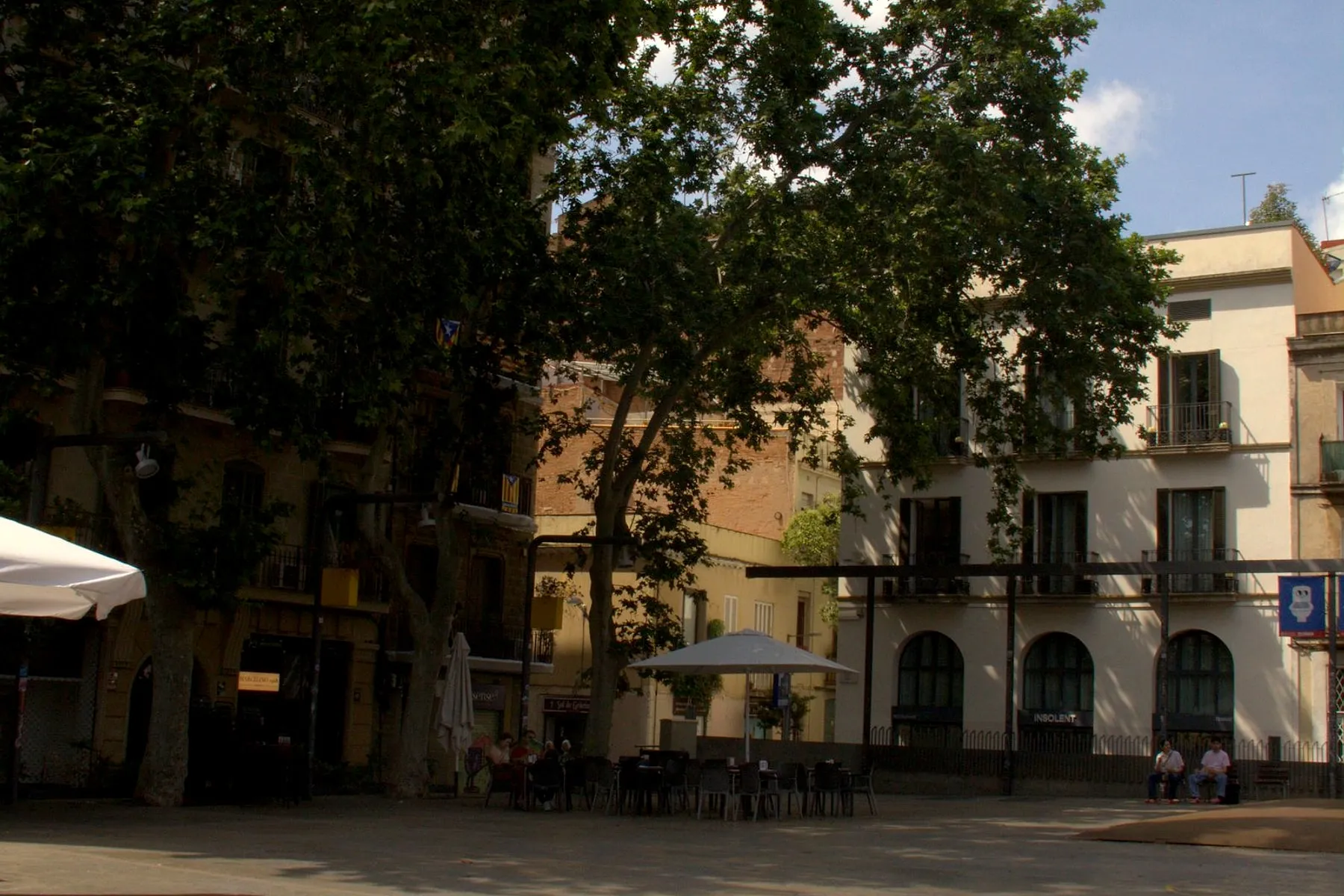
Walk five minutes in Gràcia and you cross Liberty, Fraternity, Progress, Gold, Pearl, Ruby, Diamond, Danger and Flood.
It reads like a neighbourhood that named itself in a hurry, during an argument, while it was raining. That is roughly what happened, and the Ajuntament’s street register — the Nomenclàtor — explains every one of them without being asked.
This is the Gràcia counterpart to the trade names of the old city. Down there, the names record what people made. Up here, they record what people believed, who owned the land, and where the water went.
The politics
Carrer de la Llibertat. Carrer de la Fraternitat. The register gives both the same one-line explanation:
In homage to one of the three principles adopted by the French Revolution.
Two of the three. Liberty and Fraternity have streets in Gràcia.
⚠️ We went looking for the third and did not find it. There is no page for a carrer de la Igualtat at the address the register uses for streets of that name. That is not proof one never existed — an absent page is not a source, and we have been caught by that exact mistake before on this site. So we report it as what it is: we could not find Equality, and we are not going to build a theory on a missing URL.
Carrer del Progrés, which runs between Llibertat and Siracusa, is dedicated
to all the manifestations of progress that the population of this town has rendered.
This town. Note the phrasing the register preserves. That is the language of a municipality writing about itself, before 1897 — Gràcia was its own town until then, with its own council doing its own naming.
Plaça de la Revolució de Setembre de 1868 says the quiet part in the street sign. The register:
Coup d’état, known as la Gloriosa, promoted by the generals Prim, Topete and Serrano, in order to dethrone Isabel II.
A square named, in full, after the overthrow of a queen. The present name was approved on 28 March 1983, in the first years of democratic local government — so it is a restoration, not an original, and that is part of the story too.
Two years after the Gloriosa, this town cracked its own bell and rose against military conscription. The street names are not decorative. They are the same politics, in signage.
The property developer
Now the other half, and it is a useful corrective to anybody who thinks the old names are all romance.
Carrer de l’Or — Gold. The register:
Forms a set with the carrers de la Perla and del Robí and the plaça del Diamant. Name given by the silversmith Josep Rossell, owner of the land.
Gold, Pearl, Ruby, Diamond. A jeweller subdivided his plot and named the streets after his stock.
It is a nineteenth-century estate agent’s brochure, still in place, still being photographed by people who assume it means something older. And the plaça del Diamant — one of the most emotionally loaded place names in Catalan culture — is on that list because a silversmith liked the sound of it.
That does not make it less interesting. It makes it more honest, and it is exactly the pattern we found in the square that is called Royal because of a monument nobody built.
The drainage
And then the two best names in Barcelona.
Carrer del Diluvi — Flood.
For the amount of water that piled up at the bottom of the street when the torrent de l’Olla came down full.
The torrent de l’Olla is now itself a street — the register calls it an old stream that crossed the town of Gràcia. The whole street plan of Gràcia is drawn by water and property lines: two roads, four streams and a convent. Carrer del Diluvi is what it felt like to live at the bottom of one of the streams.
Carrer del Perill — Danger.
For the dangerousness of walking along it, because of the holes and potholes in the ground and the lack of night lighting.
A municipality named a street after its own failure to maintain it.
And then the register does something we admire and try to copy: it flags its own uncertainty.
It seems that originally the street’s name was del Pelegrí (which turned into peligro) after Pelegrí Viladiu, a textile manufacturer.
It seems that. The register is telling you it has a plausible etymology and is not certain of it — a folk transformation from a surname to the Spanish word for danger, and then a Catalan translation of the wrong word. If it is right, the street is named after a misunderstanding that has been formalised twice.
We keep the hedge. Institutions that hedge deserve to be quoted with the hedge in.
The one with a cinema on it
Carrer de Verdi, which everyone in Barcelona knows as the street with the cinemas. The register identifies him:
Giuseppe Fortunino Francesco Verdi d’Uttini (Roncole, 1813 - Milan, 1901). Composer. Principal musical figure of the Risorgimento.
Not “great Italian composer”. Principal musical figure of the Risorgimento — the movement for Italian unification.
And the date the name was approved: 5 September 1907. Which is also the date carrer de la Fraternitat was approved.
A Catalan town, ten years after being absorbed by Barcelona, approving on one day a street named after a French revolutionary principle and a street named after the composer of Italian national unification. Whoever drew up that list was not choosing at random.
How to read a Gràcia street sign
Political noun? Nineteenth-century municipal self-definition. Llibertat, Fraternitat, Progrés, Revolució.
Precious stone or metal? Somebody’s building plot. Or, Perla, Robí, Diamant.
Weather or hazard? A description of the ground. Diluvi, Perill, Torrent de l’Olla.
A person? Look them up in the register before assuming. Verdi is there for his politics as much as his operas.
And a saint or a virgin? Usually older than all of the above, and usually attached to a building — which is how four of the district’s five neighbourhoods got their names.
That is a two-hour walk you can do for nothing, with your phone, and it will teach you more about how this neighbourhood thinks than any museum in it. The squares are where the same argument was held out loud.
Where this sits on a walk
The best short circuit is plaça de la Revolució → carrer del Progrés → carrer de la Llibertat → the market → carrer de l’Or → plaça del Diamant, and out onto Torrent de l’Olla. Ten minutes of walking, five centuries of decisions.
Our Gràcia walk runs daily, morning and evening, in a group of no more than ten. We are closed on 25 December and 1 January.
Where this comes from
- Carrer de la LlibertatAjuntament de Barcelona · Nomenclàtor de les vies públiquesThat the street is named «en homenatge a un dels tres principis assumits per la Revolució Francesa».
- Carrer de la FraternitatAjuntament de Barcelona · Nomenclàtor de les vies públiquesThat the street is named «en homenatge a un dels tres principis assumits per la Revolució Francesa», and that the name was approved on 05/09/1907.
- Carrer del ProgrésAjuntament de Barcelona · Nomenclàtor de les vies públiquesThat the street lies between carrer de la Llibertat and carrer de Siracusa, and is dedicated «a totes les manifestacions de progrés que ha rendit la població d'aquesta vila».
- Plaça de la Revolució de Setembre de 1868Ajuntament de Barcelona · Nomenclàtor de les vies públiquesThat the name refers to a «cop d'estat, conegut com la Gloriosa, promogut pels generals Prim, Topete i Serrano, per tal de destronar Isabel II», and that the current name was approved on 28/03/1983.
- Carrer de l'OrAjuntament de Barcelona · Nomenclàtor de les vies públiquesThat the street «forma conjunt amb els carrers de la Perla i del Robí i la plaça del Diamant» and that the name was given «per l'argenter Josep Rossell, propietari del terreny».
- Carrer del PerillAjuntament de Barcelona · Nomenclàtor de les vies públiquesThat the name comes «per la perillositat que comportava transitar-hi, pels sots i clots del terra i per la manca d'il·luminació nocturna», and that «originàriament sembla que el nom del carrer fou del Pelegrí (el qual es transformà en peligro) per Pelegrí Viladiu, fabricant tèxtil» — a hedge the register itself makes with «sembla que».
- Carrer del DiluviAjuntament de Barcelona · Nomenclàtor de les vies públiquesThat the name is «per la quantitat d'aigua que s'acumulava a la part baixa del carrer quan el torrent de l'Olla baixava ple».
- Carrer del Torrent de l'OllaAjuntament de Barcelona · Nomenclàtor de les vies públiquesThat it is named after an «antic torrent que travessava la vila de Gràcia».
- Carrer de VerdiAjuntament de Barcelona · Nomenclàtor de les vies públiquesThat it is named after «Giuseppe Fortunino Francesco Verdi d'Uttini (Roncole, 1813 - Milà, 1901). Compositor. Principal figura musical del Risorgimento», and that the name was approved on 05/09/1907 — the same date as carrer de la Fraternitat.
Everything above that carries a date, a figure or a name is checked against these before it is published. Where we could not find a source, the page says so.
Quick answers
- Why does Gràcia have streets called Llibertat and Fraternitat?
- Because of the French Revolution, and the register says so in as many words. Both entries read: «En homenatge a un dels tres principis assumits per la Revolució Francesa» — in homage to one of the three principles adopted by the French Revolution. A town that had its own revolt in 1870 named its streets after the slogans.
- Is there a carrer de la Igualtat as well?
- We looked and did not find one in the city's register at the address where it would be. That is not proof it never existed — a missing page is not a source — so we report it as what it is: two of the three principles are on Gràcia's street signs and we could not find the third.
- What about Plaça de la Revolució?
- Its full name is plaça de la Revolució de Setembre de 1868, and the register explains the reference: «cop d'estat, conegut com la Gloriosa, promogut pels generals Prim, Topete i Serrano, per tal de destronar Isabel II» — the coup known as the Glorious Revolution, which deposed the queen. The current name was approved on 28 March 1983.
- Why are there streets called Or, Perla, Robí and Diamant?
- Because a silversmith owned the land. The register's entry for carrer de l'Or says it «forma conjunt amb els carrers de la Perla i del Robí i la plaça del Diamant. Nom posat per l'argenter Josep Rossell, propietari del terreny». Gold, Pearl, Ruby and Diamond are not poetry; they are a jeweller branding his own subdivision.
- Why is one street called Perill — Danger?
- The register gives the literal reason: «per la perillositat que comportava transitar-hi, pels sots i clots del terra i per la manca d'il·luminació nocturna» — the danger of walking along it, because of the holes and potholes in the ground and the lack of night lighting. It adds that the name seems originally to have been del Pelegrí, after the textile manufacturer Pelegrí Viladiu, and that this turned into peligro.
- And carrer del Diluvi?
- Drainage. The entry: «per la quantitat d'aigua que s'acumulava a la part baixa del carrer quan el torrent de l'Olla baixava ple» — for the amount of water that piled up at the bottom of the street when the torrent de l'Olla came down full. The torrent is now the street called Torrent de l'Olla, which the register describes as «antic torrent que travessava la vila de Gràcia».
- Why is there a street named after Verdi?
- The register identifies him as the composer and «principal figura musical del Risorgimento» — the Italian unification movement. The name was approved on 5 September 1907, the same day as carrer de la Fraternitat, which tells you something about the politics of that particular batch of names.
The tours this piece is about
More in the journal
Gràcia
- Why the streets of Gràcia are like that: two roads, four streams and a convent
- Gràcia has thirty passatges and only three of them are in Gràcia
- The man who built modernista Gràcia was not allowed to sign it, and the city's catalogue names who did
- Mercat de la Llibertat: the iron hall a town built for itself, nine years before it stopped being a town
- The Abaceria: a market that has been in a marquee since 2019, and the cotton mill they found underneath it
- What is left of industrial Gràcia is one chimney, and we had been saying several