
Gothic Quarter
Neither of the Renaissance façades on this square was rescued from a bomb, and the city's own page implies they were
The quietest square in the old city, the marks on the church wall, and a piece of assembly that three institutions describe three different ways.
If you take one turning off the lane between the cathedral and El Call, you arrive in a small enclosed square with a fountain, a plane tree and a church whose lower wall is pitted and torn.
It is the quietest place in the neighbourhood. It is also, in a way almost nobody is told, an assembly — and the way the city itself describes that assembly does not match its own heritage records.
30 January 1938
The Ajuntament’s memorial page states it plainly, and we are going to quote rather than paraphrase, because this is a page where paraphrase has already done damage.
Italian fascist aviation, allied with Franco, bombed Barcelona that morning from 9.00 to 11.20, without interruption. The church of Sant Felip Neri, then in the hands of the Republican Generalitat, was serving as a shelter for children from the neighbourhood and from elsewhere in the country, who were fleeing the fascist terror. The bombs brought the church down and buried the children who had taken cover in the basement.
Una vintena van morir. Els bombardeigs no van cessar, i els esforços d’evacuació eren obstaculitzats per les bombes. Fins a quaranta-dues persones van ser assassinades aquell matí i més d’un centenar van resultar ferides.
About twenty children. Forty-two people killed that morning, more than a hundred injured. The square was devastated; only the church façade was left standing, with the shrapnel marks still visible.
You will very often hear a more dramatic version of this, in which a second bomb falls specifically on the people who came to dig the children out. The city does not say that. Its sentence is that the bombing did not cease and that the evacuation efforts were obstructed by the bombs. We have corrected that on our own pages before and we are not going to reintroduce it here.
The marks, and where the wrong explanation came from
For decades the pitting on the wall was explained as a firing squad — bullet marks from the execution of the church’s priests.
The Ajuntament’s own page names that for what it was:
Durant anys, la propaganda franquista va fer córrer el relat que els senyals de la façana corresponien a les bales disparades per afusellar els sacerdots de l’església, i encobrir, amb aquesta versió, la seva responsabilitat en la massacre.
Propaganda circulated by the regime, to cover its own responsibility. That is a heavy sentence for a municipal plaque and the city publishes it in the present tense of its own record.
The church itself is later than the square’s fame suggests: the Generalitat’s file dates work on the present building from 1721 to 1752.
Now the part that is assembled
Two of the buildings around you carry sixteenth-century Renaissance façades. Neither was built where it stands.
The shoemakers’ guild house. The COAC’s file: in 1565, in Carrer de la Corribia, opposite the cathedral steps, the shoemakers built a new guild house replacing an early Gothic one. Only the façade survives — with the guild’s arms and the lion of Saint Mark, their patron — and it had to be dismantled in 1943 to save it from the demolitions for the avinguda de la Catedral. A third storey added in a 1740 remodelling was removed when it was re-erected here, so what you see is closer to the sixteenth-century original than what stood on Corribia in 1900.
The coppersmiths’ guild house. This one has travelled much further. The Generalitat’s file puts its original site in Carrer de la Bòria, over the portal of Filateres, beside Plaça de l’Àngel — the other end of the old city. It survived the bombardment of 1714. What it did not survive was the opening of Via Laietana in 1911. It was taken down, moved to Plaça de Lesseps — where, in the file’s own words, it stood realment fora de context — and moved again, decades later, to this square.
So the two façades in front of you were displaced by two different pieces of street surgery, thirty-two years apart, from two different parts of town.
Where the city and the heritage record part company
The Ajuntament’s memorial page describes the reconstruction of the square in the fifties as done amb elements renaixentistes procedents d’altres zones bombardejades, com l’antic barri de la Catedral.
The Generalitat’s file on the shoemakers’ façade says the opposite, in as many words: en aquest emplaçament no havia estat danyada pels bombardeigs, però aquest sector es va veure afectat pels enderrocs de l’obertura de l’actual avinguda de la Catedral el 1943.
And the coppersmiths’ façade was not in a bombed zone at all — it had already been standing in Plaça de Lesseps, in Gràcia, since the 1910s.
A doctoral thesis from the Universitat de Barcelona traces the paperwork and agrees with the Generalitat: the relocation of the coppersmiths’ house to Lesseps was approved on 19 January 1911, the rebuilding finished in 1916 under the architect Ignacio María Colomer — who combined the building’s two original façades into a single one, because the original had faced two opposite streets.
Which means that when it came here, the thing being moved was already a composite. And it was recomposed again: the thesis records that at Sant Felip Neri la fachada volvió a ser modificada, colocándose una parte junto a la iglesia y la otra mitad en otro de los lados de la plaza. The shoemakers’ façade lost a storey and gained a gargoyle, and the neutral wall joining the two was built from stone salvaged from the demolitions on Corribia.
What was bombed was the destination, not the origin. The square is a memorial to an air raid, rebuilt with pieces displaced by two urban schemes, at least one of them recomposed twice before it arrived.
That is not a scandal. It is the same operation as the buildings that moved a few streets away and the same logic as what Via Laietana took — and it makes the square a better exhibit, not a worse one, because it is where the neighbourhood’s two twentieth centuries meet in one small space.
And nobody agrees when it happened
Three sources, three answers, for the same operation:
- The Generalitat: 1950 for the shoemakers, and — inside a single file — both 1959 and als anys cinquanta for the coppersmiths.
- The COAC: 1955 for both.
- The Universitat de Barcelona, quoting the city architect Adolf Florensa writing in 1958: the shoemakers’ façade was at that date still conservada en almacenes municipales, and the plot beside the arch va a edificarse. Which puts the shoemakers’ re-erection after 1958.
We are printing “the late nineteen-fifties” and telling you why nobody should give you a year.
One further error to sidestep if you go reading: the Generalitat’s own file names the coppersmiths’ original site as Plaça dels Àngels in one paragraph and Plaça de l’Àngel in the next. They are different places — the first is in the Raval, by the contemporary art museum. Plaça de l’Àngel is the correct one, and the COAC has copied the mistake across.
Being here
There is nothing to buy and nothing to queue for. There is a fountain, a tree, and a school that uses the square as a playground, which is the detail that reorganises the visit: children have been in this square continuously, including on the morning it was bombed.
Go quietly and do not make a production of it. It takes four minutes.
Go at night if you can. It is on the route in the Gothic Quarter after dark, and it is the one square in the neighbourhood where the emptiness is the point rather than a convenience.
Read the arch on your way out. The low passage of Montjuïc del Bisbe leads back towards Carrer del Bisbe — and the Generalitat notes that the module of the shoemakers’ façade over that arch comes from yet another relocated building. Three provenances in one wall.
What people dug under the city’s other squares in the same war is Barcelona’s air-raid shelters, and the walkable order through this neighbourhood is what to see in the Gothic Quarter.
Our Gothic Quarter walk passes through here and does not linger, for the reason above. It spends its two hours on what is genuinely old and what was assembled in the twentieth century, told by an actor rather than recited; the after-dark version does the same streets when they are empty. Neither of them will tell you about a second bomb.
Where this comes from
- Placa de memòria — Plaça de Sant Felip NeriAjuntament de Barcelona · Programes de Memòria DemocràticaThe city's own account of 30 January 1938: uninterrupted bombing between 9.00 and 11.20, the church serving as a shelter for children, «una vintena van morir», «els bombardeigs no van cessar, i els esforços d'evacuació eren obstaculitzats per les bombes», «fins a quaranta-dues persones van ser assassinades aquell matí i més d'un centenar van resultar ferides»; that Francoist propaganda circulated the story that the marks on the façade were bullets from executing the church's priests, to cover its own responsibility; and that in the nineteen-fifties the municipal administration rebuilt the square «amb elements renaixentistes procedents d'altres zones bombardejades».
- Casa del Gremi dels Sabaters — plaça de Sant Felip Neri, 3Generalitat de Catalunya · Inventari del Patrimoni ArquitectònicThat in 1950 a new building was raised on the plot reusing a sixteenth-century façade whose original site was in Carrer Corríbia near the cathedral; that «en aquest emplaçament no havia estat danyada pels bombardeigs», the sector being affected instead by the demolitions for the opening of the avinguda de la Catedral in 1943; and that the module of the façade corresponding to the arch over Carreró de Montjuïc del Bisbe comes from yet another relocated building.
- Casa del Gremi dels Calderers — plaça de Sant Felip Neri, 4Generalitat de Catalunya · Inventari del Patrimoni ArquitectònicThat the transferred façade originally stood in Carrer de la Bòria over the portal of Filateres, next to Plaça de l'Àngel; that it survived the bombardment of 1714 but was affected by the opening of Via Laietana in 1911; that it was first moved to Plaça Lesseps, «un lloc on es trobava realment fora de context»; and that it was moved again to Plaça de Sant Felip Neri, the file giving both 1959 and «als anys cinquanta».
- Casa del Gremi dels Sabaters — reconstrucció de la façana original a la plaça Sant Felip NeriCol·legi d'Arquitectes de Catalunya · arquitecturacatalana.catThat the guild house was built in 1565 in Carrer de la Corribia opposite the cathedral steps, replacing an earlier Gothic one; that only the Renaissance façade survives, bearing the guild arms and the lion of Saint Mark; that it had to be dismantled in 1943 to save it from the demolitions for the avinguda de la Catedral; and that a third floor added in a 1740 remodelling was removed when the façade was rebuilt on this square, partly restoring its original appearance.
- Casa del Gremi dels Calderers — tercera ubicacióCol·legi d'Arquitectes de Catalunya · arquitecturacatalana.catThe register's entry for the third siting of the coppersmiths' guild façade at Plaça de Sant Felip Neri 4, dated 1955 — against the Generalitat's 1959 for the same operation.
- Agustín Cócola Gant, «El Barrio Gótico de Barcelona. Planificación del pasado e imagen de marca» (tesi doctoral, 2010)Universitat de Barcelona · Departament d'Història de l'ArtThat the coppersmiths' guild house stood in Plaça de l'Àngel, in the path of the Via Laietana scheme, and that its relocation to Plaça de Lesseps was approved on 19 January 1911, the rebuilding finished in 1916 under the architect Ignacio María Colomer, combining the building's two façades into one; that on being rebuilt at Sant Felip Neri the façade was modified again, with one part placed beside the church and the other half on a different side of the square; that a storey was removed from the shoemakers' façade and a gargoyle added; and that the city architect Adolf Florensa wrote in 1958 that the shoemakers' façade was still «conservada en almacenes municipales» and its plot «va a edificarse».
- Església de Sant Felip NeriGeneralitat de Catalunya · Inventari del Patrimoni ArquitectònicThat work on the present church began in 1721 and was not finished until 1752.
Everything above that carries a date, a figure or a name is checked against these before it is published. Where we could not find a source, the page says so.
Quick answers
- What happened in Plaça de Sant Felip Neri?
- An air raid on the morning of 30 January 1938. The Ajuntament's memorial page says Italian fascist aviation bombed the city without pause between 9.00 and 11.20; the church, then in the hands of the Republican Generalitat, was serving as a shelter for children; the bombs brought it down and buried the children sheltering in the basement. In the city's words, «una vintena van morir. Els bombardeigs no van cessar, i els esforços d'evacuació eren obstaculitzats per les bombes. Fins a quaranta-dues persones van ser assassinades aquell matí i més d'un centenar van resultar ferides».
- Are the marks on the church wall from bullets?
- No, and the city says where that story came from. The Ajuntament writes that for years Francoist propaganda circulated the account that the marks corresponded to bullets fired to execute the church's priests, so as to cover up its own responsibility for the massacre. They are shrapnel.
- Are the buildings on the square original?
- Two of the façades are sixteenth-century and neither of them was built here. The Casa del Gremi dels Sabaters came from Carrer de la Corribia, by the cathedral, dismantled in 1943 when the avinguda de la Catedral was driven through. The Casa del Gremi dels Calderers came from Carrer de la Bòria by Plaça de l'Àngel, displaced in 1911 by the opening of Via Laietana, rebuilt in Plaça de Lesseps, and moved again to this square in the fifties.
- Were the façades rescued from the bombing?
- No, and this is where the sources disagree. The Ajuntament's memorial page says the square was rebuilt «amb elements renaixentistes procedents d'altres zones bombardejades». The Generalitat's heritage file for the shoemakers' façade says the opposite in as many words — «en aquest emplaçament no havia estat danyada pels bombardeigs» — and attributes both displacements to street-widening schemes, one in 1911 and one in 1943. What was bombed was the destination, not the origin.
- When were the façades put up here?
- Nobody agrees. The Generalitat says 1950 for one and 1959 for the other; the architects' register dates both 1955; and a doctoral thesis from the Universitat de Barcelona quotes the city architect Adolf Florensa writing in 1958 that the shoemakers' façade was still «conservada en almacenes municipales» and the plot «va a edificarse». The safe formulation is the late nineteen-fifties.
- Is it worth visiting?
- Yes, and quietly. It is thirty seconds off the standard route between the cathedral and El Call, there is nothing to buy, and it is the one place in the neighbourhood where being noisy is genuinely out of order. A school uses it as a playground.
The tours this piece is about
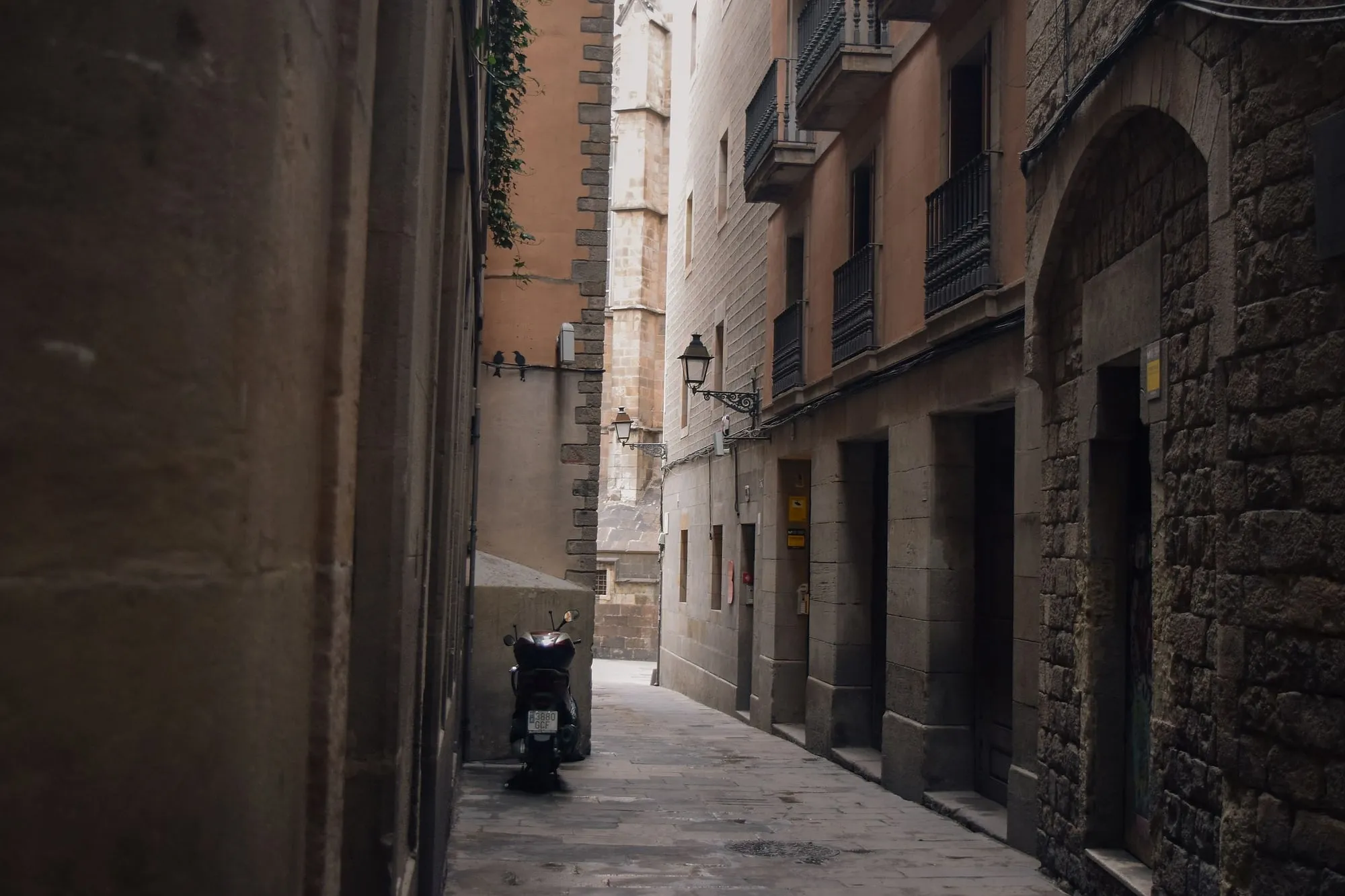
The Gothic Quarter: a neighbourhood that invented itself
Barcelona's most photographed bridge dates from 1928.
- How long it lasts
- 2 h
- Runs in
- EN · ES · CA
- Price
- 15 €
Never more than 20 people
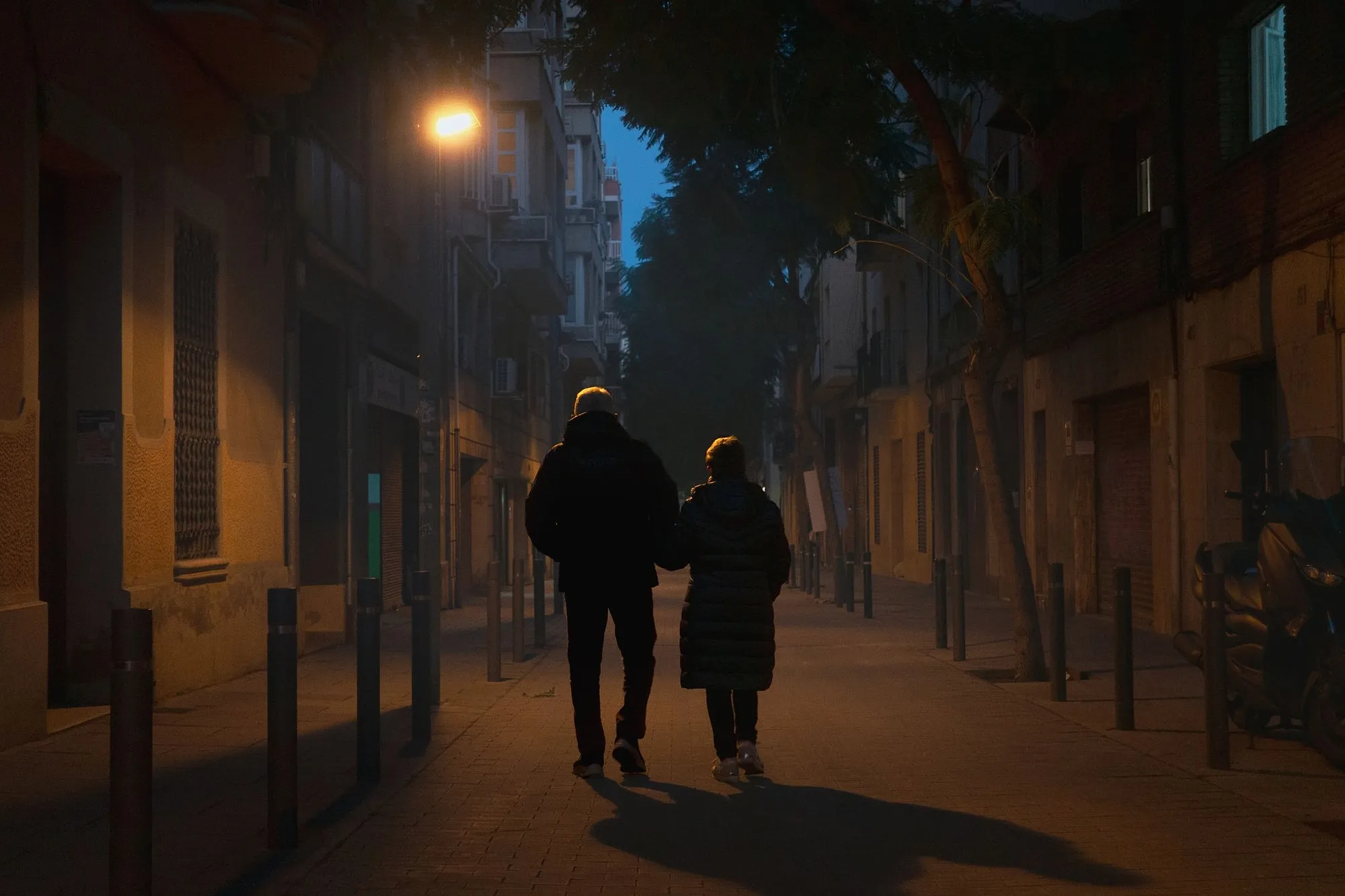
The Gothic Quarter after dark
By day it is a crowded stage set. By night it is a narrow city.
- How long it lasts
- 2 h
- Runs in
- EN · ES · CA
- Price
- 18 €
Never more than 20 people
More in the journal
The Gothic Quarter
- Europe's largest early-modern excavation is five per cent of what was demolished here, and it exists because somebody tried to build a library
- In one of these squares you can still swear a will out loud, under a procedure from the eleventh century
- The Council of a Hundred had a hundred members for about ninety years, and kept the name for another four centuries
- Nobody walks across the Pont del Bisbe, and that is what it is for
- One of these houses was taken apart and rebuilt somewhere else
- Last month the state declared one building on this street a site of democratic memory