
Gothic Quarter
What to see in the Gothic Quarter, in an order that does not double back
The whole neighbourhood is three hundred metres across. That is why people wander it for two hours and come out unable to say what they saw.
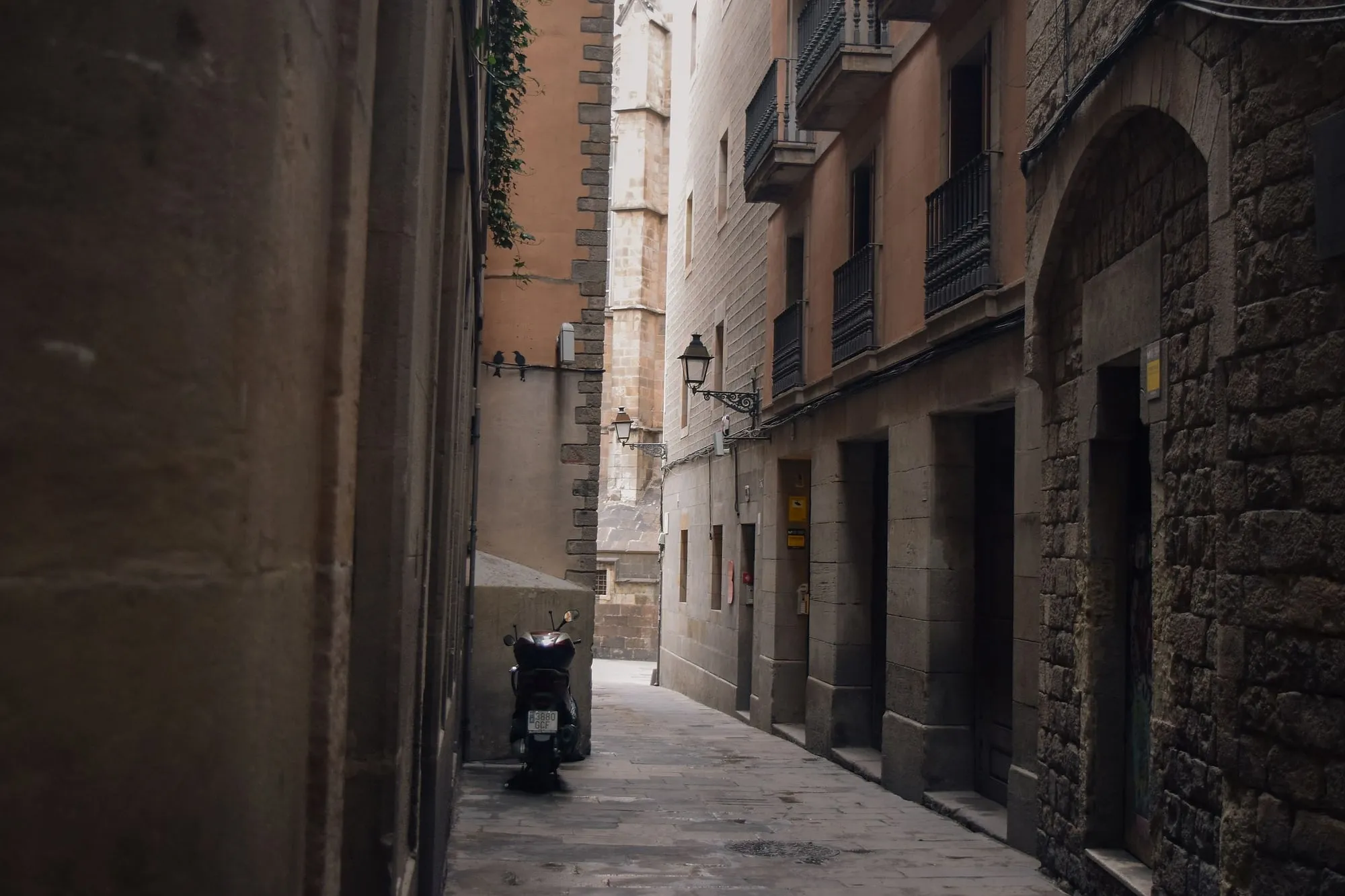
The Gothic Quarter is small in a way people do not believe until they are in it. Plaça Nova to Plaça del Rei is three hundred metres in a straight line. The whole Roman town it grew out of was about ten hectares.
That is exactly why it defeats people. There is no distance to organise the visit, so everyone drifts, and after two hours they have walked past most of it twice without stopping at any of it.
Here is an order that does not double back, takes about two hours, and costs nothing.
1. Plaça Nova — the Roman gate
Start with your back to the modern building and the cathedral on your right. Two big drum towers flank the gate where the main Roman road came into the town.
The gate itself is Augustan and so is the small pedestrian archway in it. The towers are late-Roman additions, fitted onto a gate that was already there. The curtain of wall that once joined them, with a room over the top, was demolished in 1823; the Romanesque-looking windows near the top of the towers were put in around 1909 and 1920; the houses that hid all of it came off between 1942 and 1957; and the aqueduct arch beside it is, in the city’s own words, a recreation made last century.
Every one of those sentences is true at once, and the neighbourhood is going to keep doing this to you for the next two hours, so it is a good place to start calibrating. The long version.
2. Carrer del Bisbe — the bridge
The cathedral itself deserves more than the eleven minutes most people give it: 215 painted keystones, four organs and two tombs of the same saint.
Straight down the narrow street beside the cathedral. The carved arch overhead is the most photographed object in the old city and it was finished in 1928.
Stand underneath and look up. The soffit is a star vault and its keystones are carved: an alpha and omega on the central boss, and on another a skull pierced by a sword — not a dagger, whatever you have read. Almost nobody sees it, because they take the photograph from twenty metres back. What the bridge is actually for, and why the stories about the skull are only stories: the Pont del Bisbe.
3. Plaça de Sant Jaume — the two governments
The street opens into a square with the city hall on one side and the seat of the Catalan government on the other, facing each other across it. This is where every demonstration in Barcelona ends up, and it is the only genuinely ceremonial space in the neighbourhood.
Thirty seconds. Then turn west.
4. El Call — the medieval Jewish quarter
Four narrow streets west of carrer del Bisbe: Marlet, the Arc de Sant Ramon del Call, and the one that was Sant Domènec del Call until the district renamed it Carrer de Salomó ben Adret in 2018 — the old name commemorated St Dominic’s day, which is the day the assault on the quarter began in 1391.
Stop at Marlet 1, where a slab of Hebrew inscription is set into the wall. It is a copy; the museum holds the original, and warns that the nineteenth-century plaque beside it carries an incorrect translation. The medieval text records a charitable foundation and a lamp that burns permanently.
The whole quarter takes ten to fifteen minutes to walk and there is almost nothing left above ground, which the city museum says before anybody else does. It is the quietest part of the daytime quarter and the part with the least to look at, and those are the same fact — the full version is here.
5. Plaça de Sant Felip Neri
Reached through an alley you will walk past the first time. A small enclosed square with a fountain and a church.
The pockmarks across the church façade come from an air raid on 30 January 1938, between nine and twenty past eleven in the morning. The city’s own memory programme gives the toll as forty-two people killed and over a hundred wounded, and says the bombs levelled the church, burying the children sheltering in its basement — some twenty died. It adds that the raids went on without pause and that the bombs hampered the evacuation. For decades the marks were explained as the work of a firing squad; the city calls that Francoist propaganda and corrected it publicly.
It is not a photo stop and it does not want your voice at full volume. It is also the single most affecting minute in the neighbourhood.
6. The cathedral, and the letterbox
Back out to the front of the cathedral. Works began on 1 May 1298 and the cathedral says the building was practically finished by the middle of the fifteenth century — the 1448 you will read everywhere is the year its cloister was finished, not the body. The front you are looking at is neo-Gothic, essentially finished by 1890 with its spire completed in 1912, and it was paid for from start to end by one banker with no public money in it at all. How it compares with the other great church ten minutes away is its own page.
Then, before you leave the square, look at the doorway of the Casa de l’Ardiaca on the corner. Set into the wall is a marble letterbox carved with swallows and a tortoise, designed in 1895 by Lluís Domènech i Montaner for the lawyers’ association. It is the best small object in the neighbourhood, it costs nothing, and roughly nobody stops at it — the man who made it is the other great architect of this city.
7. Carrer del Paradís — the columns
An unmarked door on a street barely wide enough for two people, into the courtyard of a hikers’ club. Inside are the columns of the Roman temple, on the high point of the ancient town.
Nine metres tall, on a three-metre podium. Three of them were found here, at the end of the nineteenth century, inside the later buildings that had grown around them. The fourth was assembled around 1879 out of temple fragments recovered from rubble, stood in Plaça del Rei for the best part of eighty years, and was moved to join the others in 1956. There is a millstone set into the pavement outside marking the summit of the low hill they stand on.
8. Plaça del Rei — and what is under it
The royal square: enclosed on all sides, with the great hall of the palace on one flank. The Saló del Tinell is genuinely fourteenth-century, and for centuries you could not see it because a convent had been built over it; the later fabric was stripped away in the 1930s and 40s. The tall arcaded tower that looks like the most medieval thing in Barcelona is sixteenth century.
The building you enter the museum through is the Casa Clariana-Padellàs, which stood on another street and was taken apart and rebuilt here around 1930 when a new avenue was driven through the old town.
Digging its foundations is how the city found what is underneath: what the museum calls a four-thousand-square-metre walk through the subsoil, including a dyeing works and laundry from the second century, a fish-salting and garum works from the third, and a winery from the end of it. The kings held court on top of an industrial estate — the whole story is here, and the list of what else was moved is here.
9. Carrer de la Tapineria — the wall
Out of the square to the north-east and the neighbourhood does the one thing nobody expects: it produces a long, tall, unmistakable run of Roman wall with its towers, standing in the open beside a public square.
It is free, it is never busy, and most people walk past it on their way to something with a queue. And it is not a survival so much as a reveal: the museum publishes photographs of this spot from 1917 and 1941, and what changed between them was Via Laietana going through and the buildings coming off the wall.
10. Plaça de la Vila de Madrid — the dead
Five minutes further, towards La Rambla, there is a sunken rectangle visible through railings: a Roman burial road, first to third century, silted over by a stream and rediscovered in the late 1940s during the post-war remodelling of the square.
Outside the wall, because Roman law forbade burial inside the city. The monuments are cupae — stone forms copying a wooden vat — which the museum describes as belonging to people of middle and humble station. Not the ones with the marble. The enclosure has its own admission, but the square is sunken and you can look straight down into it from the street. It is the only place on this walk where you are looking at Roman people rather than Roman masonry, and it is the right place to finish.
Practical
- Two hours, about two kilometres with the doubling back, flat throughout.
- Worn stone, cobbles, occasional narrow steps. Shoes matter here more than anywhere else in the city.
- Before half past nine or after ten at night. In between it is shoulder to shoulder. The night version is genuinely a different walk — why, and where to go.
- Nothing on this route needs a ticket. The indoor sites all have their own admission arrangements and none of them is required.
- It works backwards, from Plaça de la Vila de Madrid to Plaça Nova, if that suits where you are staying.
- Read the street signs on the way. Almost every name between the cathedral and the sea is a medieval trade, and the city publishes the etymology of each — what they mean, and the caveat the Ajuntament attaches to them.
- La Rambla is not on this route on purpose. It is the boundary rather than the neighbourhood, and it is its own page.
If you would rather someone told it to you
Our Gothic Quarter walking tour covers roughly this ground, two afternoons a week, with twenty people at most because in Ciutat Vella that is the legal cap — and told by an actor, which changes what the stops are for without turning it into a play. The night walk takes the same streets when they are empty.
Both are one option. This page is the other, and it is free.
Still deciding whether the neighbourhood earns the morning: is the Gothic Quarter worth it. Deciding between neighbourhoods: Gràcia or the Gothic Quarter. Deciding how many days you have at all: three days in Barcelona.
One building a step outside this route and almost never added to it: Palau Güell, on Nou de la Rambla, five minutes from the Plaça Reial lampposts that are also Gaudí’s. It is the only completed Gaudí home that has stayed true to its original design, and it is indoors, which makes it the obvious rescue on a wet afternoon in the old city.
Three stops on this route have since grown pages of their own, because there was more in them than a paragraph would hold: the cathedral cloister and its geese, Plaça de Sant Felip Neri, and the four squares that include Sant Just, the Pi and Sant Jaume.
Three of these now have pages of their own: Plaça de Sant Jaume and its two governments, Plaça Reial and the monument that was never built, and the Boqueria, which has a published quota against becoming a food court.
Where this comes from
- Plaça de Sant Felip NeriAjuntament de Barcelona · Programes de Memòria DemocràticaThe bombing of 30 January 1938: forty-two killed, over a hundred wounded, some twenty of them children sheltering in the basement — and that the firing-squad story about the marks on the façade was Francoist propaganda.
- La Casa de l'ArdiacaAjuntament de Barcelona · Arxiu Municipal — Arxiu HistòricThat the building became the Col·legi d'Advocats in 1895, and that the modernista letterbox is Domènech i Montaner's, from that moment.
- Fitxa 934 — Casa Clariana-PadellàsAjuntament de Barcelona · Carta Arqueològica de BarcelonaThe house moved stone by stone to Plaça del Rei in 1930.
Everything above that carries a date, a figure or a name is checked against these before it is published. Where we could not find a source, the page says so.
Quick answers
- What is there to see in the Gothic Quarter of Barcelona?
- The Roman gate and a long run of Roman wall, the cathedral, Plaça del Rei with the medieval royal hall and a Roman archaeological site under it, El Call, Plaça de Sant Felip Neri, the four temple columns on carrer del Paradís, the 1928 bridge on carrer del Bisbe and a Roman burial road at Plaça de la Vila de Madrid. Almost all of it is free.
- How long does it take to walk the Gothic Quarter?
- About two hours at a stopping pace. The distance is nothing — around two kilometres with the doubling back — but you stand still a lot, which is where the time goes.
- What is the best route through the Gothic Quarter?
- Start at Plaça Nova by the Roman gate, go down carrer del Bisbe to Plaça de Sant Jaume, west into El Call, back through Plaça de Sant Felip Neri to the cathedral, round to carrer del Paradís and Plaça del Rei, then out to the Roman wall on carrer de la Tapineria. It works just as well backwards.
- Is the Gothic Quarter free?
- The streets, the squares, the Roman wall, the columns and the outside of everything cost nothing. The cathedral, the city history museum under Plaça del Rei and the other indoor sites each have their own admission arrangements. You can do this entire route without paying for anything.
- What should I not miss in the Gothic Quarter?
- If you only have twenty minutes: the Roman wall on carrer de la Tapineria, which almost nobody stops at, and the underside of the bridge on carrer del Bisbe, which almost everybody photographs from the wrong distance.
The tours this piece is about
The Gothic Quarter: a neighbourhood that invented itself
Barcelona's most photographed bridge dates from 1928.
- How long it lasts
- 2 h
- Runs in
- EN · ES · CA
- Price
- 15 €
Never more than 20 people
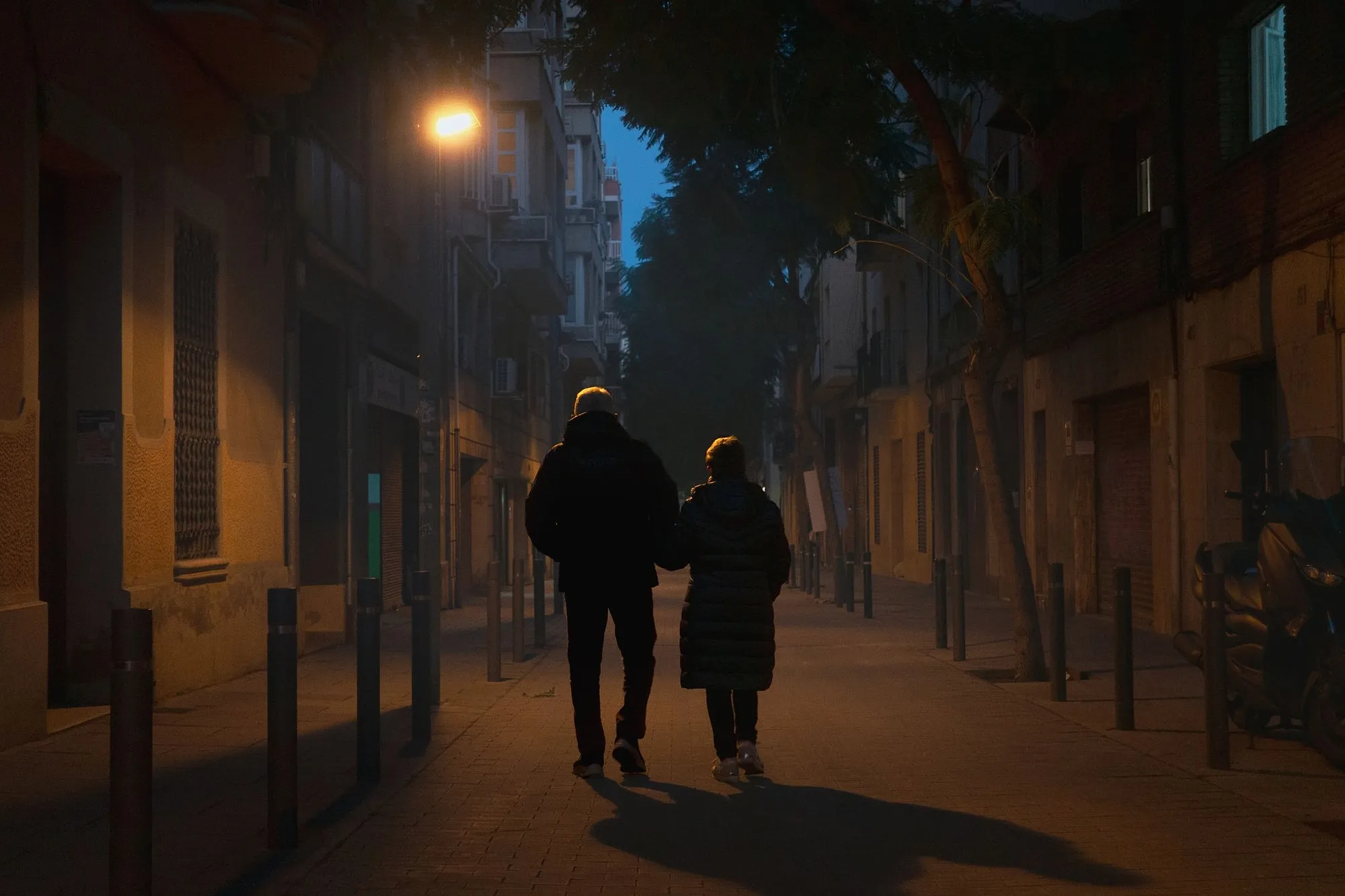
The Gothic Quarter after dark
By day it is a crowded stage set. By night it is a narrow city.
- How long it lasts
- 2 h
- Runs in
- EN · ES · CA
- Price
- 18 €
Never more than 20 people
More in the journal
The Gothic Quarter
- The Generalitat says the cathedral is not really Catalan Gothic. It says Santa Maria del Mar is
- It has three naves and can look like seven, and the cathedral and the Generalitat cannot agree on how many bays
- There are thirteen geese in the cathedral cloister and nobody official will tell you why
- The street names are trades, and the city that keeps the register says do not trust them too far
- Europe's largest early-modern excavation is five per cent of what was demolished here, and it exists because somebody tried to build a library
- In one of these squares you can still swear a will out loud, under a procedure from the eleventh century