
Gothic Quarter
Nobody walks across the Pont del Bisbe, and that is what it is for
The single most photographed object in the old city is a private walkway, ninety-odd years old, and the last surviving fragment of a plan that was turned down.
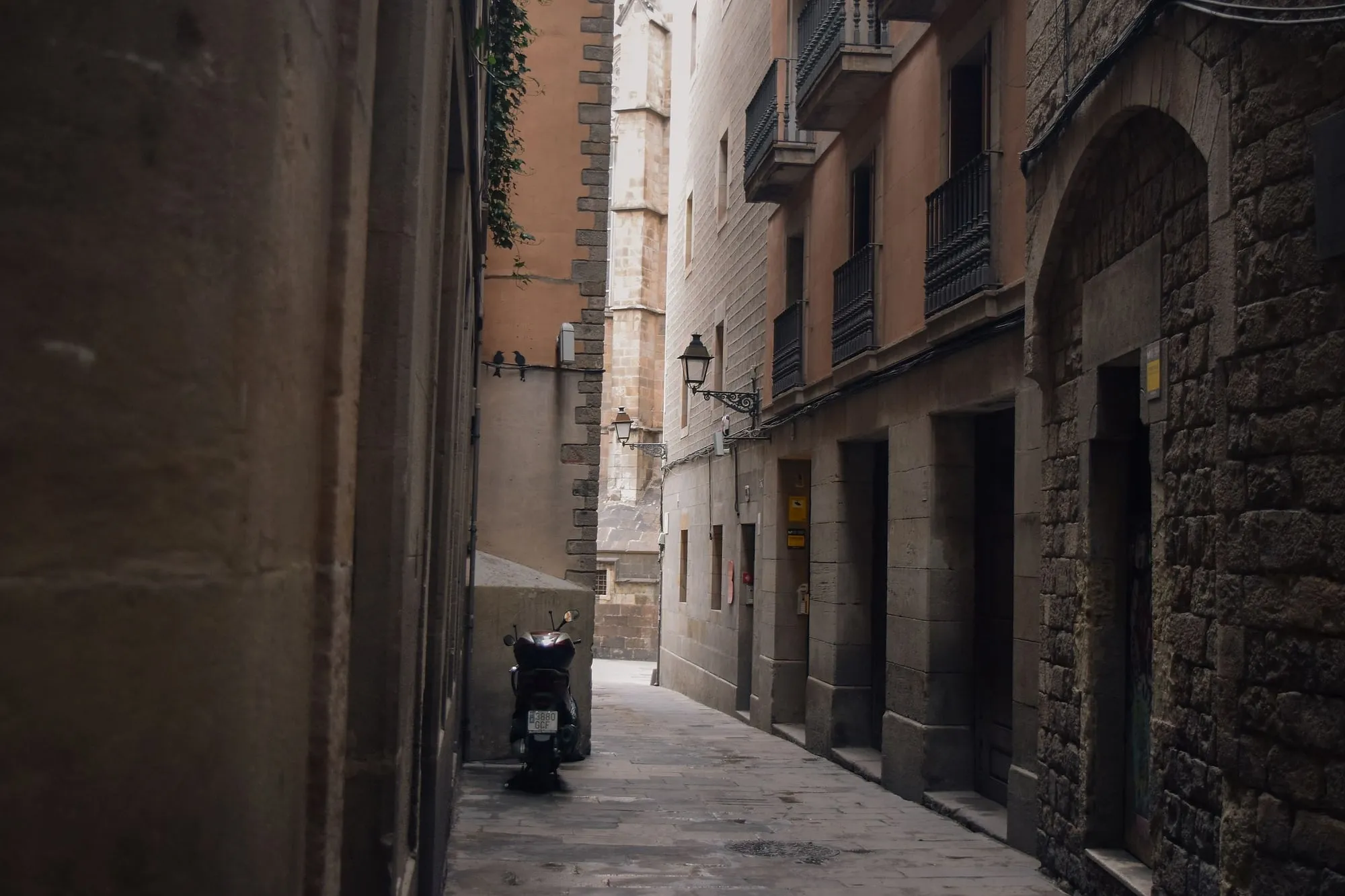
Everybody stops under it. Nobody notices that it goes nowhere you can go.
The Pont del Bisbe is not a bridge in the sense of a thing that carries the public from one side of a street to the other. It joins the Cases dels Canonges to the Palau de la Generalitat across carrer del Bisbe, as a covered passage between the two buildings. The Cases dels Canonges then became the official residence of the president of the Generalitat: Macià lived and died there, on Christmas Day 1933, and Companys and Tarradellas lived there after him. It is not a residence today — the building is used for meetings and events.
That is the design brief, and it explains the object completely. It is a corridor that happens to be outdoors, and it links two interiors rather than two streets.
1928
It was built in 1928, to a design by Joan Rubió i Bellver, at the request of the Diputació de Barcelona and its president, Milà i Camps — the Diputació had acquired the Cases dels Canonges the year before. It went up while the old quarter was being remodelled ahead of the 1929 International Exposition, a programme that from 1927 set about reconstructing and monumentalising the streets around the cathedral.
Rubió is not a footnote, either. The city’s own modernisme guide has him working in Gaudí’s studio and then as a regular collaborator, on Torre Bellesguard, Casa Calvet, the Colònia Güell housing and the Sagrada Família — the other buildings of that circle are a short metro ride away.
One institution dissents on the year: the Catalan encyclopedia dates the bridge to 1926. The architects’ own public catalogue of Catalan architecture records it as 1928, by Rubió i Bellver, listed as a national cultural asset, so that is what we use, and now you know there is an argument.
And one thing we owe you plainly, because this page exists to correct a different mistake. Who commissioned it is where the sourcing gets thin. It was not the city council — that attribution is wrong and it is the one this page was written to retire. The Diputació is what the literature says and what we have followed, but we have not been able to open a public institutional page that states it in those words. If you find one, we would like it.
So the most-photographed medieval object in Barcelona is roughly as old as sliced bread, and it is not concealing that. It never claimed to be old. It claimed to look old, which is a completely different offence and a much more interesting one.
The exhibition in the cloister
Rubió was not simply handed a bridge. In 1927 he put on a public exhibition, in the cathedral cloister, of his visions of the Tàber — the Tàber being the low hill the Roman town stood on — and published a pamphlet about it the same year.
So the man who designed the bridge had spent the previous year showing Barcelona pictures of what he thought the cathedral hill ought to look like. The bridge went up twelve months later.
What we are not going to tell you is that he submitted a grand scheme for the whole quarter and had it rejected, or that a great tower over the Generalitat was cut from it. Both are widely repeated. Neither is something we could find an institution stating, and the documented version — an architect exhibiting his visions in a cloister, then building one of them — is better anyway.
The skull
The underside is a star vault, and its keystones carry carved symbols. Some are plainly religious — the alpha and omega on the central boss. Others are not, and one of them is a skull pierced by a sword.
It is a sword, incidentally, not a dagger. Every guidebook says dagger; the Generalitat, which owns the building, says sword. And the carving is documented as part of Rubió’s design, which is worth stating clearly because the rest is not.
Everything else you will hear about it is folklore.
You will be told that looking at it brings bad luck, that making a wish under it works, that the city will fall if the blade is ever pulled out, or that Rubió carved it in anger at some slight. The Generalitat’s own description goes exactly as far as noting that the motif has given rise to various popular legends — and then stops, endorsing none of them and repeating none of them. Searching the city’s entire web archive for the collapse story returns nothing at all.
They are folklore: repeated constantly, attributed to nobody, with no traceable first telling.
We are not sneering at folklore. Folklore is interesting and this bridge has attracted a lot of it in under a century, which is itself the strangest fact about it — an object that started manufacturing legends almost immediately. But there is a difference between this is a story people tell and this is what happened, and a guide who blurs the two has spent your trust on something cheap.
What to do with four minutes
It is on the direct line between Plaça Nova, where the Roman gate is, and Plaça de Sant Jaume, where the city and regional governments face each other. You will pass under it without trying.
- Look up before you look at it from a distance. Almost everybody takes the photograph from twenty metres back and never sees the underside, which is where the carving is.
- Go early or late. Between about eleven and seven there is a standing crowd underneath, and the street is not wide enough for it. Under a street lamp it is better anyway — see the Gothic Quarter at night.
- Then look at what is around it, because the bridge is not an anomaly in this neighbourhood. It is the most visible member of a family.
The rest of the family
Two hundred metres away, the front of the cathedral — the face in every photograph — was built between 1887 and 1913, six centuries after the building behind it, to a drawing from 1408 that had never been executed, paid for by a banker.
A minute further, on Plaça del Rei, there is a fifteenth-century house that was dismantled on another street and rebuilt there around 1930 because a new avenue was coming through. The city has a word for buildings like it: edificis viatgers, travelling buildings, and there is a guild façade on Plaça de Sant Felip Neri that spent the 1940s in a warehouse.
And at Plaça Nova, forty metres away, the Roman gate is genuinely Augustan — but the curtain of wall that once joined its two towers, with a gateway and a room above it, was demolished in 1823, the Romanesque-looking windows high on the towers were put in around 1909 and 1920, and the aqueduct arch beside them is, in the city’s own words, a recreation made last century.
The full list, with the years attached, is the buildings that moved. What is genuinely ancient underneath all of it is the Roman city.
Even the name of the neighbourhood is modern. Nobody in the Middle Ages called this the Gothic Quarter; the area was known as the cathedral quarter, and the phrase barrio gótico turns up in print in 1911, in a magazine article proposing that Barcelona should go and make one.
Does knowing this spoil it
The opposite, in our experience, and we have watched a lot of faces find out.
A street that is simply old is scenery. A street that somebody assembled on purpose, in a decade you can name, for a fair you can date, out of an argument about what a city should look like to visitors — that is a decision, and you can agree or disagree with it while standing in it.
Barcelona built itself a historic centre. It did a superb job. The bridge is the best thing in it, and it is from 1928.
Being walked through it
That argument, in the streets, told by an actor rather than recited off a card, is our Gothic Quarter walking tour, two afternoons a week, twenty people because in Ciutat Vella that is the legal maximum. The after-dark version does the same streets when the bridge is lit and there is nobody standing underneath it.
If you are earlier in the decision than that: is the Gothic Quarter worth it, and Gràcia or the Gothic Quarter.
The bridge lands you in Plaça de Sant Jaume, where both governments keep their real front doors round the corner.
Where this comes from
- Pont del Bisbe del Palau de la GeneralitatCol·legi d'Arquitectes de Catalunya · arquitecturacatalana.catThe year — 1928 — the architect Joan Rubió i Bellver, and its listing as a Bé Cultural d'Interès Nacional. It does not name who commissioned it, which is the gap this page admits to.
- La Catedral — HistòriaCatedral de BarcelonaThat the cathedral's neo-Gothic façade and its two towers were paid for by Manuel Girona i Agrafel to Josep Oriol Mestres's plans, and that his sons finished the lantern tower in 1913.
Everything above that carries a date, a figure or a name is checked against these before it is published. Where we could not find a source, the page says so.
Quick answers
- When was the Pont del Bisbe built?
- 1928, to a design by the architect Joan Rubió i Bellver, during the remodelling of the old quarter in the run-up to the 1929 International Exposition. It is not medieval and it has never claimed to be.
- What is the Pont del Bisbe for?
- It joins the Casa dels Canonges to the Palau de la Generalitat across carrer del Bisbe, as a covered passage between the two buildings. It links two interiors rather than two streets, which is why it is a thing visitors photograph rather than a thing visitors use.
- What is the skull under the Pont del Bisbe?
- A skull pierced by a sword — not a dagger, whatever the guidebooks say — carved on one of the keystones of the star vault under the bridge, and part of Rubió's own decorative design. The stories attached to it are folklore: the Generalitat notes only that the motif has given rise to various popular legends, and endorses none of them.
- Is the Pont del Bisbe worth seeing?
- Yes, and it takes four minutes. It is on the direct line between Plaça Nova and Plaça Sant Jaume, so you will walk under it anyway. Go early or late: in the middle of the day there is a permanent scrum of people photographing it from directly underneath.
- Is it the oldest bridge in Barcelona?
- No. It is among the youngest things on the street it crosses, and it is younger than the front of the cathedral two hundred metres away, which went up between 1887 and 1913.
The tours this piece is about
The Gothic Quarter: a neighbourhood that invented itself
Barcelona's most photographed bridge dates from 1928.
- How long it lasts
- 2 h
- Runs in
- EN · ES · CA
- Price
- 15 €
Never more than 20 people
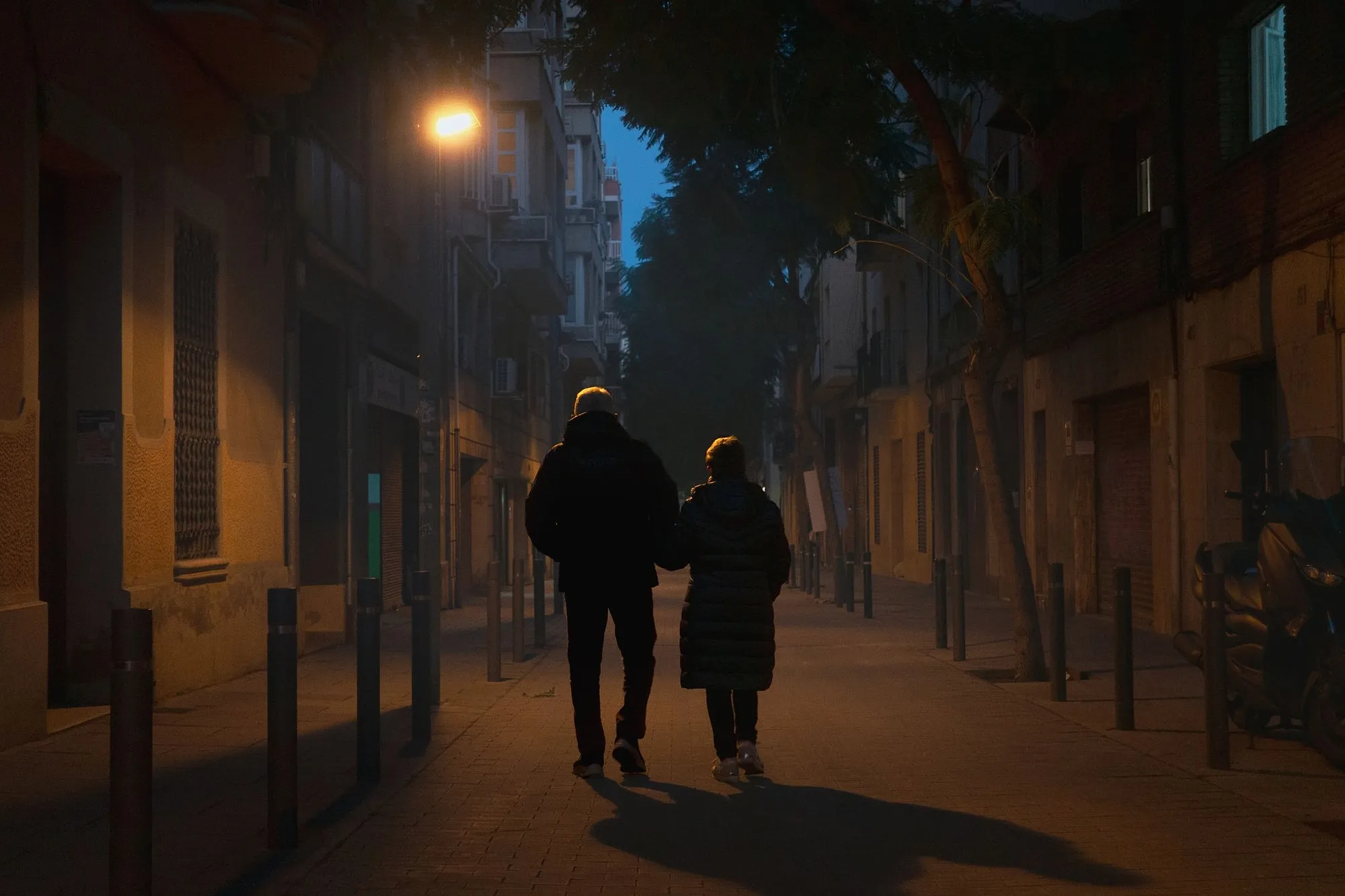
The Gothic Quarter after dark
By day it is a crowded stage set. By night it is a narrow city.
- How long it lasts
- 2 h
- Runs in
- EN · ES · CA
- Price
- 18 €
Never more than 20 people
More in the journal
The Gothic Quarter
- There are thirteen geese in the cathedral cloister and nobody official will tell you why
- The street names are trades, and the city that keeps the register says do not trust them too far
- Europe's largest early-modern excavation is five per cent of what was demolished here, and it exists because somebody tried to build a library
- In one of these squares you can still swear a will out loud, under a procedure from the eleventh century
- The Council of a Hundred had a hundred members for about ninety years, and kept the name for another four centuries
- Neither of the Renaissance façades on this square was rescued from a bomb, and the city's own page implies they were