
Gaudí
Is Casa Vicens worth it? An honest answer, with the drawbacks first
Short answer: worth it if you have more than two days and you care about Gaudí rather than about the famous silhouettes. If you have one day, skip it without guilt.
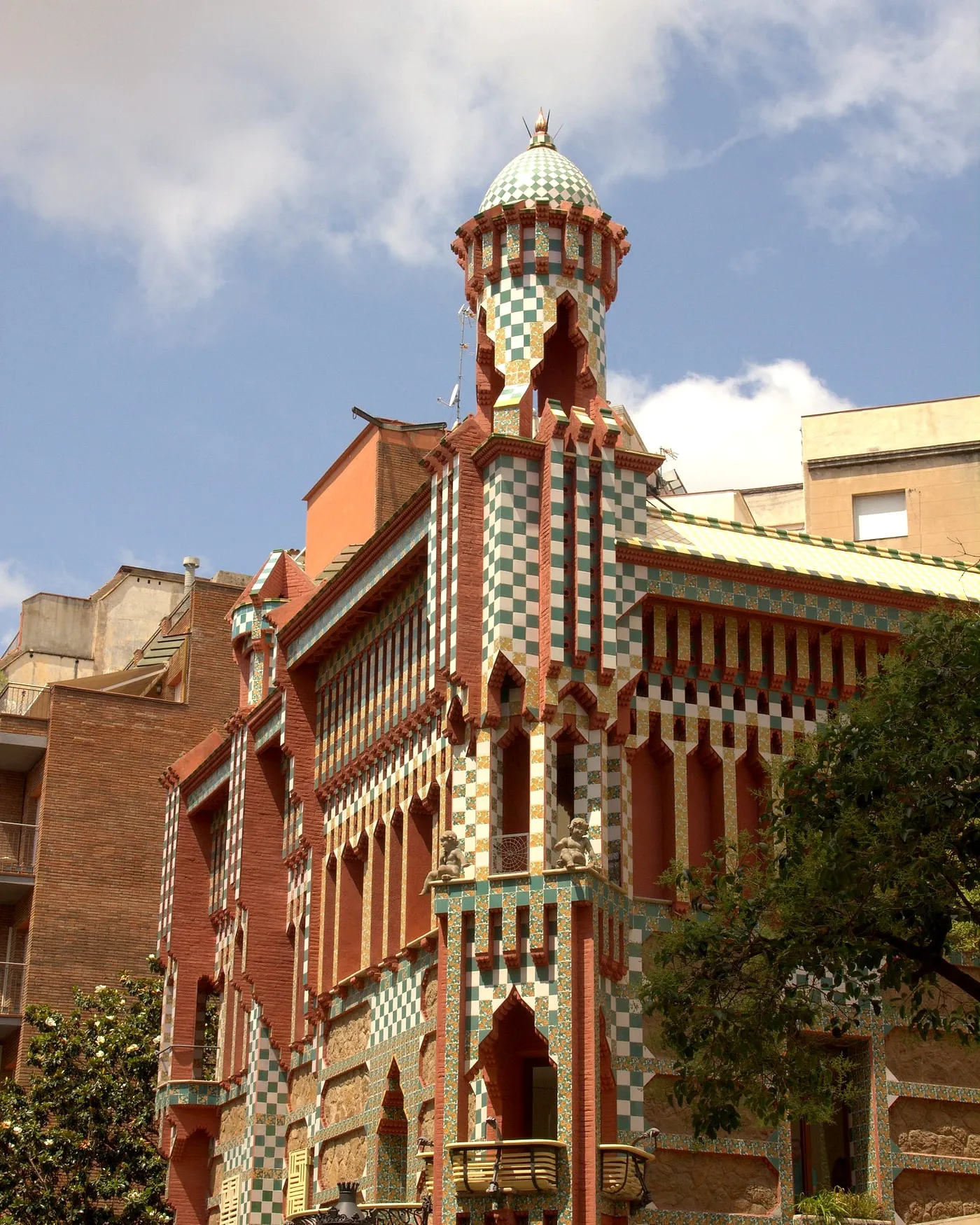
Go to Casa Vicens if you want to see Gaudí before he was Gaudí. Do not go expecting the house from the postcards — the one with the mask-shaped balconies and the scaled roof. That is Casa Batlló, it is down on Passeig de Gràcia, and the two look nothing alike.
What it actually is
It is the first house Antoni Gaudí ever built. It went up between 1883 and 1885 on carrer de les Carolines, which at the time was not in Barcelona at all: it was in the town of Gràcia, an independent municipality with its own mayor that Barcelona did not absorb until 1897 — a story with a shelling and a cracked bell in it, told in why Gràcia was its own town. A summer house, for one family, on the edge of a small town, commissioned from a thirty-one-year-old architect nobody had heard of.
UNESCO added it to the Works of Antoni Gaudí world heritage listing in 2005. But you could not go inside until 2017. For over a century it was somebody’s home, and anyone walking past saw exactly what you can still see from the pavement today, and no more than that.
What you get for the ticket
From outside: a green-and-white chequerboard climbing the whole façade, yellow ceramic flowers repeated up to the eaves, and a turret that serves no purpose whatsoever. That is the argument of the building in one glance — a young man given a free hand, using it.
Inside, the surprise is the scale. These are ordinary-sized rooms with ceilings that any competent architect of the period would have left flat, and Gaudí did not leave flat. One dining room painted with ivy. A small smoking room with a honeycombed ceiling. And one thing the big Gaudí attractions cannot give you: you can stop in front of something and stay there, because there is nobody behind you waiting for your spot.
The three drawbacks, up front
It is small. An hour covers it. If you come straight from Casa Batlló, where you are handed a device and given a show, this will feel quiet. For a lot of people that is the entire appeal. For others it feels thin for the money, and that reaction is fair.
The street will not let you photograph it. Carrer de les Carolines is narrow. There is not enough pavement opposite to frame the full façade, so the wide shot you have seen online was taken from the corner or with a very wide lens. That is not a fault of the house — it was built when the surrounding land was still market gardens.
It is off the circuit. The two famous Gaudí houses are visible from each other. Casa Vicens is several streets uphill inside a residential neighbourhood, next to Fontana metro. You have to decide to go. Half drawback, half the reason it is bearable.
The number that explains the whole thing
262,600 people visited in 2024, up 31 % on the year before, according to Casa Vicens’s own press note of 11 February 2025. By Barcelona standards that is small. The city’s tourism observatory tracks the ten areas visitors actually go to — the Sagrada Família is reached by 80.6 % of tourists, Park Güell by 49.4 % — and the Gràcia neighbourhood does not appear on that list at all.
Which is the answer to “is it worth it”, stated as a measurement rather than an opinion. Casa Vicens is a ten-minute walk from Passeig de Gràcia and it behaves as though it were in a different city.
If you go, do not leave immediately
The common mistake is to go in, come out, and walk straight back down to the shopping street. You are in Gràcia. Five minutes away there is a square with a clock tower whose bell set off an uprising in 1870; a brick chimney still stands where the factory around it was demolished; and there are cellers where the vermouth comes out of a barrel rather than a bottle. It is all laid out in what to see in Gràcia, in the order that walks well — and if you are working out which hour to come out of the house at, a day in Gràcia has the neighbourhood’s own timetable, which is not the museum’s.
If you would rather be told than read, our Gràcia tour passes the front of Casa Vicens and ends in one of those cellers.
Casa Vicens is also the obvious answer for anyone building a Gaudí trip around a basilica ticket they could not get — that trip is written out in Barcelona without the Sagrada Família.
One correction worth carrying in with you, because you will be told the opposite outside: Manel Vicens was not a tile manufacturer. The house’s own record calls him a currency trader and stockbroker. He and the other people who paid for these buildings are in who paid for each Gaudí building, and the rest of the stories that do not survive checking are in things you will be told about Gaudí that are not true.
One thing to look at here that you will not find anywhere else in his work: these tiles are whole. The chequerboard marches flat up a flat façade. Twenty years later he was cladding double-curved chimneys in broken marble and bottle glass, because a flat tile cannot follow a surface that curves two ways at once — trencadís is that story, and this house is the argument before he needed the technique.
If you are weighing this against one of the big two on Passeig de Gràcia, the comparison is Casa Batlló or La Pedrera.
And if you want the modernisme that comes without a ticket office, the neighbourhood has seventy-seven listed modernista buildings and Casa Vicens is not one of them — the catalogue files it as neo-Arab. What the rest of them are.
Where this comes from
- Press kit (PDF)Casa Vicens GaudíThat Manel Vicens was a stock and currency broker, and that the house was built between 1883 and 1885.
- The house — Heritage and recognitionsCasa Vicens GaudíListed as BCIN, and added to the UNESCO «Works of Antoni Gaudí» on 15 July 2005.
- Press note, 11 February 2025 — 262,600 visitors in 2024Casa Vicens GaudíThe 262,600 visitors in 2024, 31 % up on the year before, and that the house opened to the public in November 2017.
- Informe de resultats: perfil i hàbits dels turistes a Barcelona ciutat 2025 (PDF, table on p. 73)Observatori del Turisme a BarcelonaThe 80.6 % who reach the Sagrada Família and the 49.4 % who reach Park Güell — and the absence of the Gràcia neighbourhood from the list.
Everything above that carries a date, a figure or a name is checked against these before it is published. Where we could not find a source, the page says so.
Quick answers
- How long do you need inside?
- An hour, comfortably, without hurrying. It is a family house rather than a palace — normal-sized rooms that you walk through quickly. Budget a morning and you will have morning left over.
- Can you see it from the street without a ticket?
- Yes, and it is one of the few Gaudí buildings in Barcelona you can see whole from the pavement. It faces carrer de les Carolines, which is narrow, so the usable angle is from the corner rather than from directly opposite.
- Is it near the other Gaudí houses?
- Not really. Casa Batlló and La Pedrera face each other along Passeig de Gràcia. Casa Vicens is several streets uphill, inside the Gràcia neighbourhood, next to Fontana metro on the green line. Nobody walks past it by accident.
- Is it less impressive than Casa Batlló?
- It is quieter and it is smaller, and if you measure by spectacle then yes, Batlló wins. It is also the one where you can stand still in front of a ceiling for as long as you like, which Batlló does not offer at any price.
- Do you need to book ahead?
- Book through Casa Vicens itself rather than a reseller. It is a small building with a limited number of people inside at once, which is exactly why it is pleasant and exactly why turning up on spec is a gamble.
The tours this piece is about
Gràcia: the town that rang the bell
A bell, a bombardment, and a vermouth at the end of it.
- How long it lasts
- 3 h
- Runs in
- EN · ES
- Price
- 36 €
Never more than 10 people
Gaudí comes alive
You will recognise the guide because he will be Antoni Gaudí.
- How long it lasts
- 1 h 30
- Runs in
- EN · ES · CA
- Price
- 30 €
Never more than 15 people
More in the journal
Gràcia
- What to see in Gràcia, in the order that walks well
- Is Gràcia worth visiting? Half a day, and here is the measurement
- Chillida hung fifty-four tonnes of concrete over a quarry pool, and said the water made half of it
- Gràcia is five neighbourhoods, and three of them used to belong to Horta
- Gràcia was its own town until 1897, and the street plan never forgave it
- April 1870: the bell of Gràcia cracked, and went on ringing