
Barcelona
When to go to Barcelona, from the only two datasets that exist
Two questions decide when to come — what the weather does and how full the city is — and both have published answers. One of them is older than you would expect, and nobody who quotes it says so.
Two things decide when to come to Barcelona: what the weather is doing, and how many other people had the same idea. Both are published, month by month, by public bodies. Almost nobody who writes about this quotes either.
We are going to, and the first thing to say is awkward.
There are no current climate normals for Barcelona
The standard reference period for climate averages is thirty years, and the current one internationally is 1991-2020.
Barcelona does not have it.
The national meteorological agency publishes valores climatológicos normales for two Barcelona stations, and both pages state their period plainly: 1981-2010. There is no selector for a newer one. The Catalan meteorological service says the same thing out loud — that it is still working on the climatologies for the 1991-2020 reference period, and is provisionally showing older ones.
So every month-by-month table you will read about Barcelona is either 1981-2010, or it is not coming from a meteorological service. If a page gives you Barcelona’s 1991-2020 normals, it has made them up or it has computed them itself without saying so.
Everything below is 1981-2010, and it says so every time.
The airport station, month by month
Indicativo 0076, altitude four metres, on the coastal plain south of the city. The columns are the agency’s own.
| Mean | Max | Min | |
|---|---|---|---|
| January | 9.2 | 13.6 | 4.7 |
| February | 9.9 | 14.3 | 5.4 |
| March | 11.8 | 16.1 | 7.4 |
| April | 13.7 | 18.0 | 9.4 |
| May | 16.9 | 21.1 | 12.8 |
| June | 20.9 | 24.9 | 16.8 |
| July | 23.9 | 28.0 | 19.8 |
| August | 24.4 | 28.5 | 20.2 |
| September | 21.7 | 26.0 | 17.4 |
| October | 17.8 | 22.1 | 13.5 |
| November | 13.0 | 17.3 | 8.6 |
| December | 10.0 | 14.3 | 5.7 |
| Year | 16.1 | 20.3 | 11.8 |
Mean daily temperature, mean daily maximum and mean daily minimum, in degrees. And the water, from the same table:
| Rain, mm | Wet days | Storm days | |
|---|---|---|---|
| January | 37 | 3.7 | 0.3 |
| February | 35 | 4.0 | 0.4 |
| March | 36 | 4.5 | 0.8 |
| April | 40 | 5.1 | 1.3 |
| May | 47 | 4.7 | 1.7 |
| June | 30 | 3.6 | 1.5 |
| July | 21 | 1.8 | 1.3 |
| August | 62 | 4.5 | 3.5 |
| September | 81 | 5.2 | 3.5 |
| October | 91 | 6.3 | 2.8 |
| November | 59 | 5.1 | 1.2 |
| December | 40 | 4.4 | 0.4 |
| Year | 588 | 53.3 | 19.9 |
A wet day is one with a millimetre or more; the definitions are the agency’s.
Four things in that table are not what people expect.
August is not dry. It averages 62 mm, twice June and three times July, and it shares the year’s peak for thunderstorm days. The Mediterranean summer breaks in late August, not in September.
October is the wettest month, by a distance, at the airport and at the other station too.
The mean minimum in July and August is around twenty degrees. That is the number that decides whether you sleep, and it is why the middle of the summer is genuinely hard here in a way that a maximum of twenty-eight does not convey.
Fifty-three rainy days a year. Five hundred and eighty-eight millimetres arriving on fewer than one day in six. What that does to a trip is Barcelona when it rains.
There are two Barcelonas and the weather knows it
The agency’s second station is the Fabra observatory, up on the Collserola ridge at 408 metres. Same city, same period. The annual figures diverge in ways that are worth a moment:
| Airport, 4 m | Fabra, 408 m | |
|---|---|---|
| Mean temperature | 16.1 °C | 15.5 °C |
| Rain | 588 mm | 621 mm |
| Days with ≥1 mm | 53.3 | 57.1 |
| Days of fog | 9.4 | 43.7 |
| Days of snow | 0.4 | 2.0 |
| Clear days | 70.4 | 64.5 |
Half a degree of difference in temperature — and more than four times the fog. The ridge sits in cloud on days when the city below is clear, which is why the view from Tibidabo is a lottery and the view from the seafront is not. And snow, which the city effectively does not get, happens up there about twice a year.
The same split runs through everything about this city’s geography, including the hill Barcelona is built out of.
Now the other half: how full is it
The city publishes its own hotel figures, month by month. For 2025, in Barcelona city hotels:
| Month | Overnight stays | Occupancy |
|---|---|---|
| January | 1,275,562 | 51.7 % |
| February | 1,346,937 | 60.2 % |
| March | 1,579,583 | 62.9 % |
| April | 1,790,739 | 72.1 % |
| May | 1,805,400 | 71.0 % |
| June | 1,772,163 | 71.6 % |
| July | 1,921,838 | 74.8 % |
| August | 2,027,760 | 78.8 % |
| September | 1,725,300 | 69.5 % |
| October | 1,804,300 | 70.2 % |
| November | 1,536,195 | 61.9 % |
| December | 1,410,661 | 55.1 % |
The year totalled 8,337,054 hotel guests and 19,996,221 hotel nights in the city.
The peak-to-trough ratio is 1.59. August against January. That is much flatter than people assume, and it is the single most useful number here: there is no off-season in Barcelona, only a slightly quieter one. Anyone promising you an empty city in February is promising you a city at sixty per cent occupancy.
Note also what the shape is not. September, the month everyone recommends, is the quietest month between April and November on both measures. October is busier than September and nearly as busy as July.
And one number that explains the crowding better than the totals do. Average length of stay, every month of the year, is between 2.3 and 2.6 nights. Barcelona is a two-night city. Which means the number of arrivals is enormous relative to the number of beds, and it means that whatever month you come in, most of the people around you at the famous places arrived the day before yesterday and will leave tomorrow. What to do with two nights is two days in Barcelona.
What the residents think, since it is part of the answer
The city runs an annual survey on this, and the numbers are not comfortable reading.
76.7 % of people surveyed take the position that Barcelona has reached the limit of its capacity to receive tourists — up 2.3 points on the previous year.
57.6 % say they have avoided visiting some area of the city because of tourism, up 3.6 points in a year and 8 points in two. Among people who live in tourist neighbourhoods it is 60.9 %.
We include that not to make anybody feel bad about coming. We include it because it is a straightforward piece of information about what the crowded parts of the city are like — six in ten locals route around them — and because it points at the practical answer: the version of Barcelona that residents have not abandoned is a real and better trip. What that looks like in practice is non-touristy things to do in Barcelona, and the whole argument for Gràcia, a neighbourhood the city’s own visitor survey does not even measure.
So: when
If you can choose freely — late April, May, or the first half of November. April and May give you a mean maximum of eighteen to twenty-one degrees, long light, and occupancy in the low seventies rather than the high seventies. November is the underrated one: still thirteen degrees mean, occupancy back down to sixty-two, and the wettest month is behind you.
If you want warmth without August — late June. Twenty-five degrees mean maximum, the driest month bar July, and fewer thunderstorm days than either August or September.
If you want the city at its emptiest — January or December. Cold by Mediterranean standards, not by northern European ones: a mean maximum near fourteen degrees, and seventy clear days a year concentrate disproportionately in winter. The old city is at its best in low winter light. And in December and January the closures matter — a lot of small places shut, including us on two specific days.
If you are coming in August anyway — that is fine. Come, and rearrange the day rather than the trip. The heat is a middle-of-the-day problem and Barcelona has an enormous amount of shade and a coastline. It is also the month of the Festa Major de Gràcia, which is free, extraordinary and genuinely the best week in the city’s calendar — and which we would come in August for.
And whenever you come, expect rain to be possible and not likely. Fifty-three days a year, weighted to autumn, arriving in a hurry.
The one thing that does not change with the month
Whatever week you pick, the timed entries are the constraint on the trip rather than the weather. Which things genuinely have to be booked, and which are sold to you as urgent and are not, is what to book in advance in Barcelona. How the days themselves are best shaped is one day, two or three.
Our own walks run all year, in most weathers, and there are exactly two days in the calendar when they do not run at all: 25 December and 1 January. Everything else — dates, languages, meeting points — is on the Gothic Quarter and Gràcia pages, which are kept current in a way that an article never can be.
The rest of that survey — which places residents name, and which kinds of visitor the city says it would like more of — is on its own page.
Where this comes from
- Valores climatológicos normales: Barcelona Aeropuerto (0076)AEMET · Agencia Estatal de MeteorologíaThe monthly and annual normals used in this article for the airport station, indicativo climatológico 0076, altitude 4 m, for the period the page itself states: 1981-2010. Annual values: mean temperature 16.1 °C, mean daily maximum 20.3 °C, mean daily minimum 11.8 °C, mean precipitation 588 mm, mean relative humidity 69 %, 53.3 days with precipitation of 1 mm or more, 0.4 days of snow, 19.9 days of storm, 9.4 days of fog, 3.8 days of frost and 70.4 clear days. The legend definitions are AEMET's own.
- Valores climatológicos normales: Barcelona, Fabra (0200E)AEMET · Agencia Estatal de MeteorologíaThe same series for the Fabra observatory, indicativo 0200E, altitude 408 m, also for 1981-2010: annual mean temperature 15.5 °C, precipitation 621 mm, 57.1 days with 1 mm or more, 2.0 days of snow, 16.6 days of storm, 43.7 days of fog and 64.5 clear days — against 9.4 fog days and 0.4 snow days at the airport.
- Informe de l'activitat turística a Barcelona 2025 — Càpsula 1 (PDF)Observatori del Turisme a Barcelona · Ajuntament de BarcelonaFor Barcelona ciutat, hotels, 2025: 8,337,054 tourists and 19,996,221 overnight stays, against 7,880,740 and 20,054,797 in 2024. The chart 'Estacionalitat de les pernoctacions en hotels' gives the twelve monthly figures quoted here, from 1,275,562 in January to 2,027,760 in August; summed they come to within about two hundred of the published annual total, which is how we know they are the 2025 city series and not another one. The chart 'Estacionalitat de l'ocupació hotelera (places)' gives monthly occupancy from 51.7 % in January to 78.8 % in August, and 'Estacionalitat de l'estada mitjana en hotels' gives an average stay of between 2.3 and 2.6 nights in every month of the year.
- Percepció del turisme a Barcelona 2025 (PDF)Ajuntament de Barcelona · Oficina Municipal de DadesThat 76.7 % of those surveyed take the position that the city has reached the limit of its capacity to receive tourists, up 2.3 points on 2024; and that 57.6 % have avoided visiting some area of Barcelona for that reason, up 3.6 points on the previous year and 8 points on two editions earlier, rising to 60.9 % among residents of tourist neighbourhoods against 56.7 % elsewhere.
Everything above that carries a date, a figure or a name is checked against these before it is published. Where we could not find a source, the page says so.
Quick answers
- What is the best month to go to Barcelona?
- On the two things you can measure, the shoulder months win. April, May and October have the warmest weather that is not August heat, and October in particular has the second-highest hotel occupancy of the year, so it is not quiet. If you want warmth and space at the same time, late March into April and the first half of November are the honest answers.
- Is August a bad time to visit Barcelona?
- It is the busiest month by hotel nights and the fullest by occupancy, and it is the hottest. It is also not the driest month — it averages more rain than June or July, with the joint-highest number of thunderstorm days in the year. Many small businesses close for part of it. If August is your only option, come anyway and plan around the middle of the day.
- How many days does it rain in Barcelona?
- About fifty-three a year with at least a millimetre, at the airport station, on the 1981-2010 normals. That is the whole point: the annual total of 588 mm arrives in a small number of days, which makes the average rather misleading.
- When is Barcelona least crowded?
- January, on the city's own hotel figures for 2025: 1.28 million overnight stays against 2.03 million in August, and hotel occupancy of 51.7 % against 78.8 %. February and December are the next quietest. It is also, unsurprisingly, when the weather is coldest and the days shortest.
- Are there really no 1991-2020 climate averages for Barcelona?
- Not published as station tables, no. The national agency's climate normals for both Barcelona stations state the period 1981-2010, and the Catalan meteorological service says openly that it is still working on the 1991-2020 reference period and is showing older ones in the meantime. Any page giving you Barcelona's 1991-2020 monthly normals is not quoting either of them.
The tours this piece is about
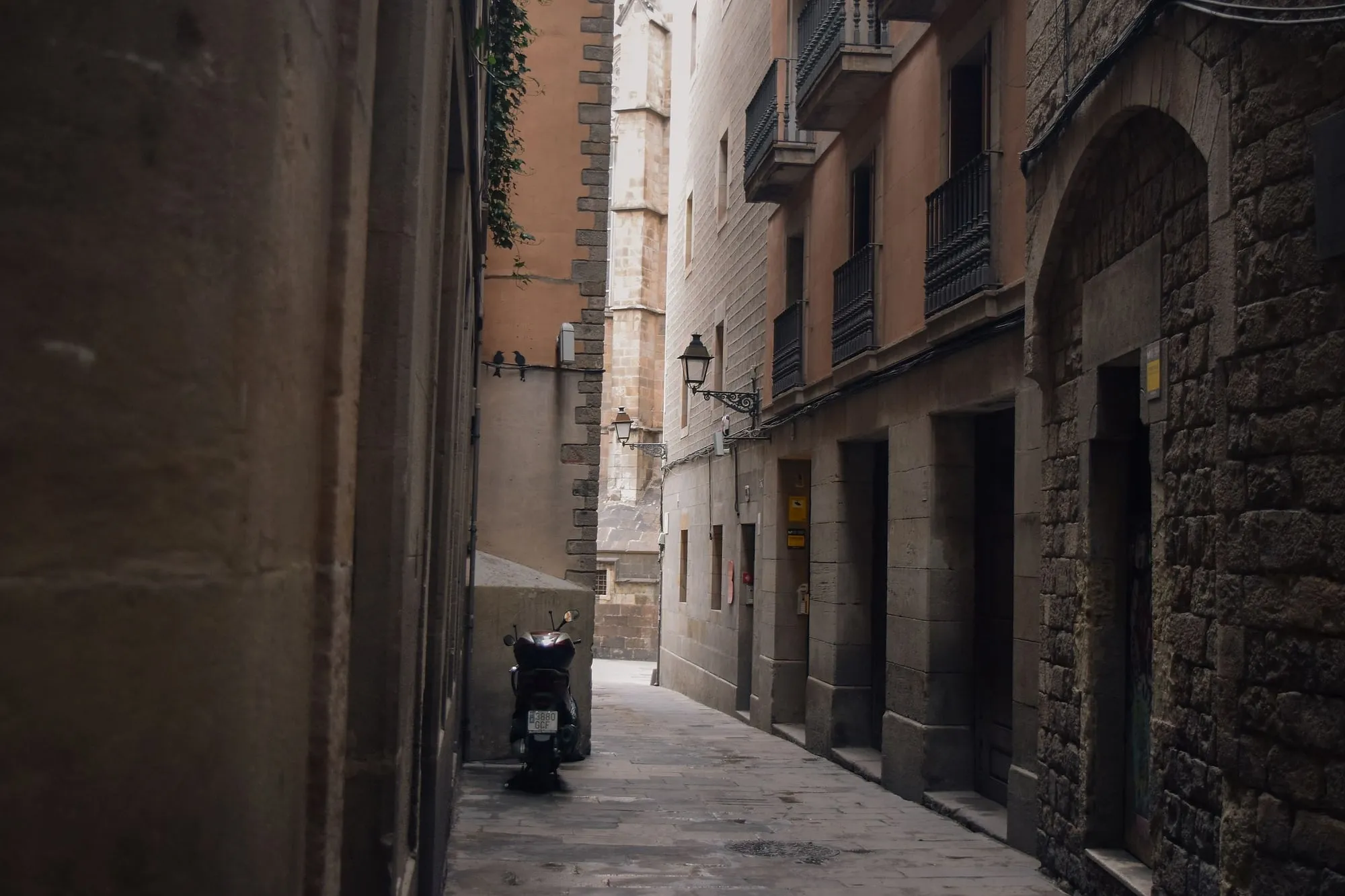
The Gothic Quarter: a neighbourhood that invented itself
Barcelona's most photographed bridge dates from 1928.
- How long it lasts
- 2 h
- Runs in
- EN · ES · CA
- Price
- 15 €
Never more than 20 people
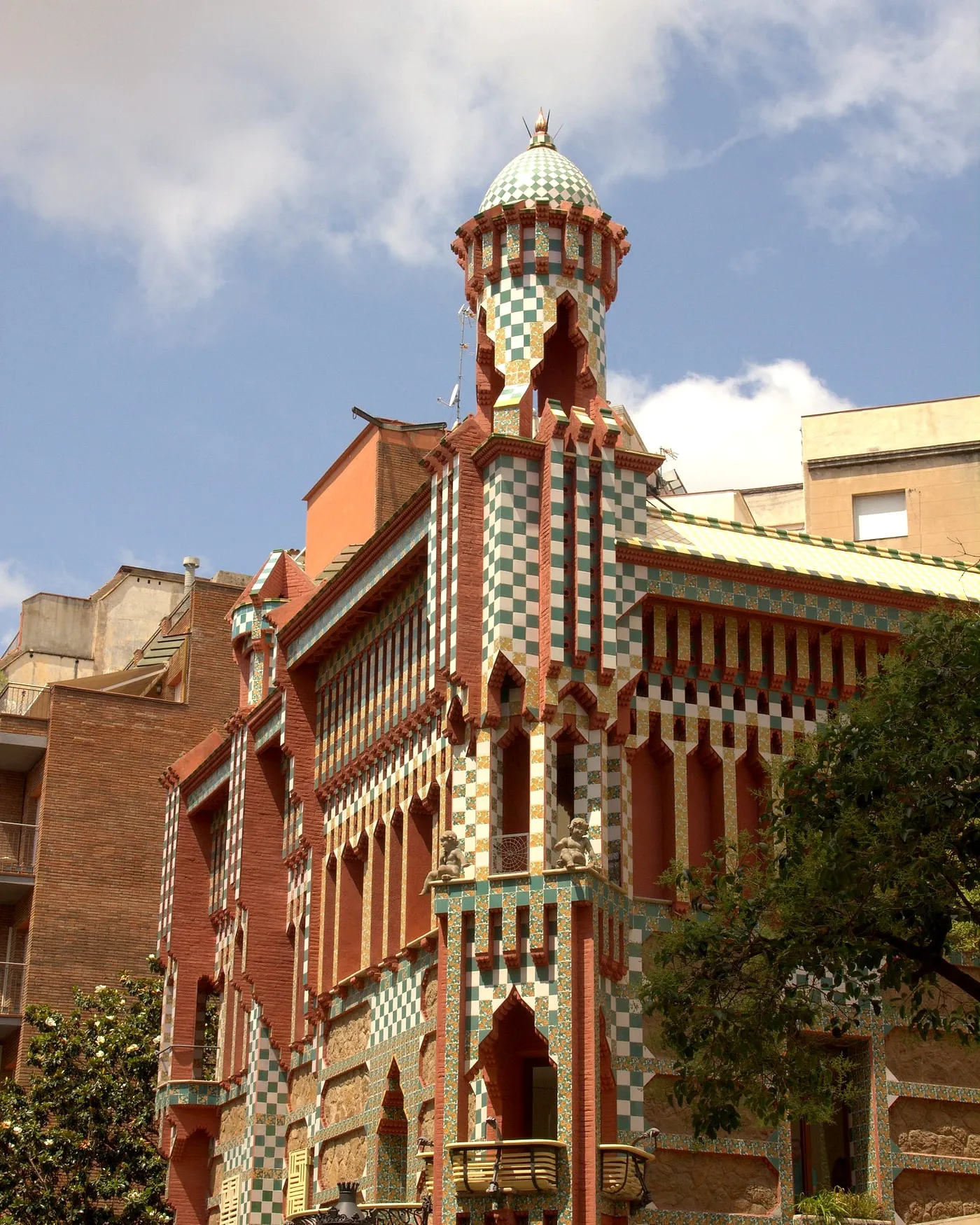
Gràcia: the town that rang the bell
A bell, a bombardment, and a vermouth at the end of it.
- How long it lasts
- 3 h
- Runs in
- EN · ES
- Price
- 36 €
Never more than 10 people
More in the journal
Planning your trip
- Barcelona rains about fifty-three days a year, and it does it all at once
- One day in Barcelona: the case for cramming, and why we argue with it
- Two days in Barcelona, planned backwards from the tickets
- Three days in Barcelona, and what the third one is actually like
- A Barcelona weekend, arranged around what only happens at weekends
- Barcelona with children: a short list, with the drawbacks attached