
Barcelona
Barcelona rains about fifty-three days a year, and it does it all at once
The useful fact about rain here is not how much falls but how few days it falls on. Eleven millimetres per wet day, on average, is not drizzle — and it decides which half of your plan survives.
Barcelona has a reputation for never raining, and the reputation is half right in the least useful way.
The national agency’s normals for the airport station give 588 millimetres a year, which is more than London. They also give 53.3 days a year with a millimetre or more, which is far fewer.
Divide one by the other — our arithmetic on the agency’s two columns, not a figure it publishes — and you get about eleven millimetres on a wet day. That is not weather you walk through with a hood up. That is weather that empties a square in ninety seconds and fills the gutters.
Which is the actual planning fact: it very probably will not rain on your trip, and if it does, it will not be gentle.
When it does it
Month by month, at the airport station, on the 1981-2010 normals — the only period published, as we set out elsewhere:
| Month | Rain, mm | Wet days | mm per wet day |
|---|---|---|---|
| January | 37 | 3.7 | 10.0 |
| February | 35 | 4.0 | 8.8 |
| March | 36 | 4.5 | 8.0 |
| April | 40 | 5.1 | 7.8 |
| May | 47 | 4.7 | 10.0 |
| June | 30 | 3.6 | 8.3 |
| July | 21 | 1.8 | 11.7 |
| August | 62 | 4.5 | 13.8 |
| September | 81 | 5.2 | 15.6 |
| October | 91 | 6.3 | 14.4 |
| November | 59 | 5.1 | 11.6 |
| December | 40 | 4.4 | 9.1 |
The last column is ours. Look at what it does across the year: eight millimetres per wet day in spring, fifteen in September. The number of rainy days barely moves — between about four and six every month — but the amount arriving on each of them nearly doubles.
September, October and November between them carry 231 of the year’s 588 millimetres, which is thirty-nine per cent of the rain in a quarter of the year. Again, our arithmetic on their table.
And the thunderstorms line up with it: 19.9 days of storm a year, peaking at 3.5 in both August and September. The Mediterranean autumn does not creep in. It arrives as a black sky over the sea in the afternoon.
The hill is a different city in bad weather
The second station, the Fabra observatory at 408 metres on the Collserola ridge, records 43.7 days of fog a year. The airport records 9.4.
More than four times as much. Which is the single most useful thing on this page for anybody planning a wet day, and it is not about rain at all: when the weather is poor, the high ground is in cloud even when the city is not.
So the first thing to drop from a bad-weather day is not the walking. It is anything you are doing for the view.
What stops working
Park Güell. The ticketed part is an outdoor route with limited shelter, it runs one-way, entry is by date and time band bought in advance, and the operator caps it at seven hundred people every thirty minutes — so you cannot simply shelter and rejoin. And the reason to be up there at all is the hillside and the city underneath it. The free woodland half, which is genuinely the better half, is a pine wood on a slope. In the rain it is a pine wood on a slope.
The Turó de la Rovira, which people call the bunkers. The city’s museum service describes a heritage space with five information panels installed on site to support a self-guided visit — which is another way of saying there is nothing over your head. In rain it is a concrete platform in a cloud. It is worth going for what it is, which is not the view: the hill preserves both the anti-aircraft battery and the traces of the shanty settlement that stood there until 1990, part of an informal city that at the end of the nineteen-fifties housed seven per cent of Barcelona’s population.
Montjuïc’s gardens. Gardens. The museums up there are a different matter and we come back to them.
The beach and the seafront, obviously, and also the long straight walk along it, which is completely exposed.
What works better than people expect
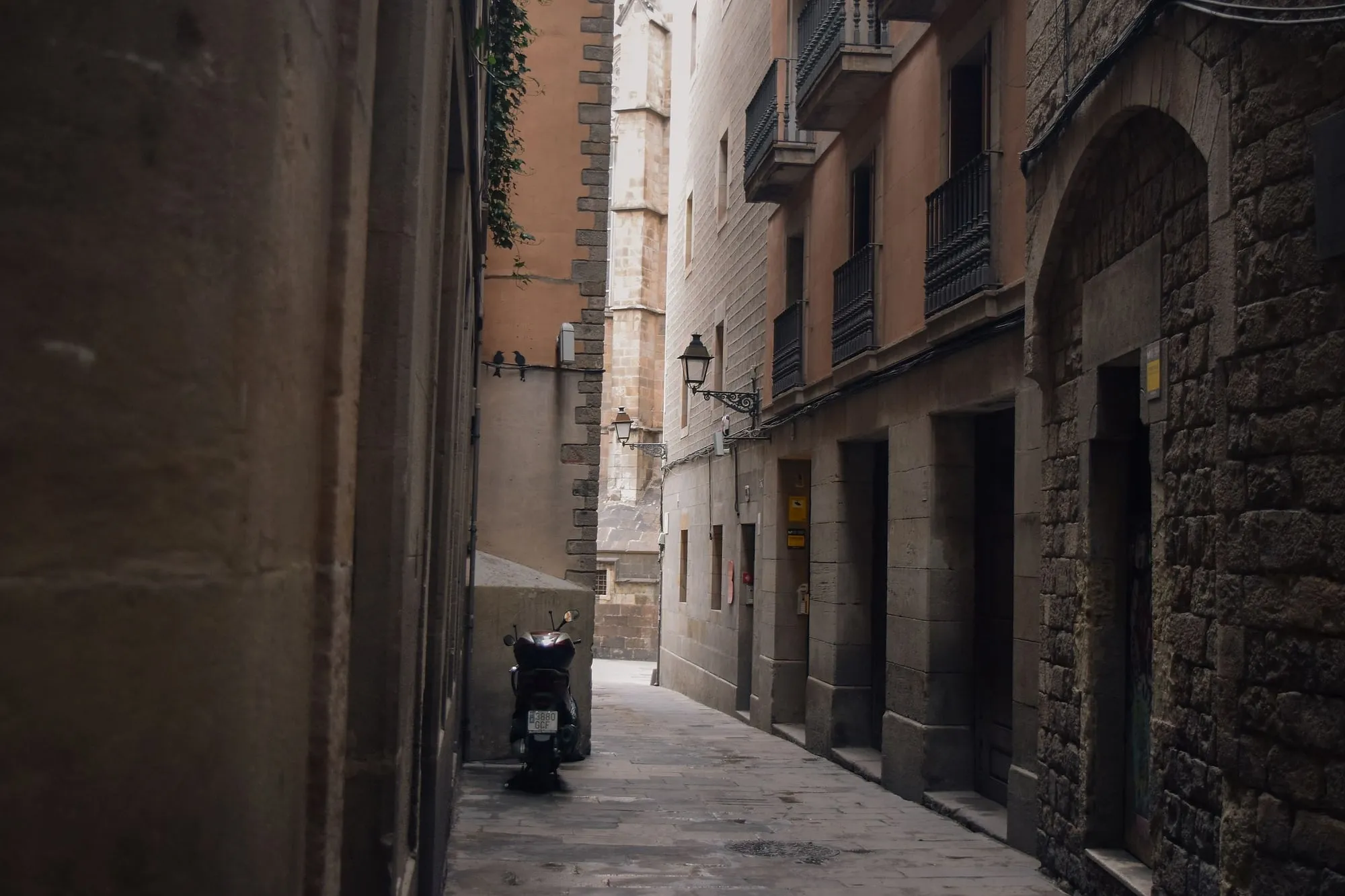
The old city, which is a roof made of buildings. This is the underrated one. The Gothic Quarter’s streets are narrow, often only a few metres across, mostly free of traffic, and lined with balconies. You get a surprising amount of shelter simply from the geometry. Compare that with the Eixample, where the pavements are wide, the corners are cut back into open squares of sky and there is nothing over your head for a hundred metres.
If it is raining, go where the streets are narrow. In an order that does not double back, that is what to see in the Gothic Quarter; the small squares that make it worth doing slowly are here.
Markets. Roofed, working, warm, and not designed for you — which is most of the point. Santa Caterina in the old city and the Llibertat up in Gràcia are both nineteenth-century iron halls that are still doing their job.
The archaeology underneath. The city runs a set of museum spaces that are literally below street level — Roman streets, a fourteenth-century shipyard, a Civil War shelter. Rain is irrelevant four metres down. The whole network is the MUHBA spaces, and what survives of the Roman city above ground is here.
Montjuïc’s indoor half. The national art museum, whose Romanesque halls are the best thing on the hill and hold frescoes that were taken off church walls in the mountains; the Miró foundation; and Casaramona, a modernista factory that is now an exhibition centre. Three roofs within a few minutes of each other, on a hill you would otherwise have written off.
Gràcia, for the specific reason that its whole appeal is indoors. Small rooms, small bars, a market, a vermouth poured from a barrel. The squares are what you photograph and the interiors are what you remember. Vermouth in Gràcia is a wet-afternoon activity that happens to also be the local one.
And children. Rain plus a five-year-old is its own problem, dealt with separately in Barcelona with kids.
Two practical notes and one refusal
Wait it out. Eleven to fifteen millimetres falling on a single day usually means a heavy hour, not a grey afternoon. The Barcelona habit is to go into a bar and come out later, and it is the correct response.
Watch the streets, not the sky. Heavy rain on a dense city with a steep hinterland runs off fast, and the gutters here are deep for a reason. Crossings flood before anything else does.
What we are not going to tell you is anything about the city’s drainage system, storm tanks or flood risk. We looked for a public municipal page that states it and could not open one. It is the sort of thing that reads well and that we have no source for, so it is not here.
Whether the walk still happens
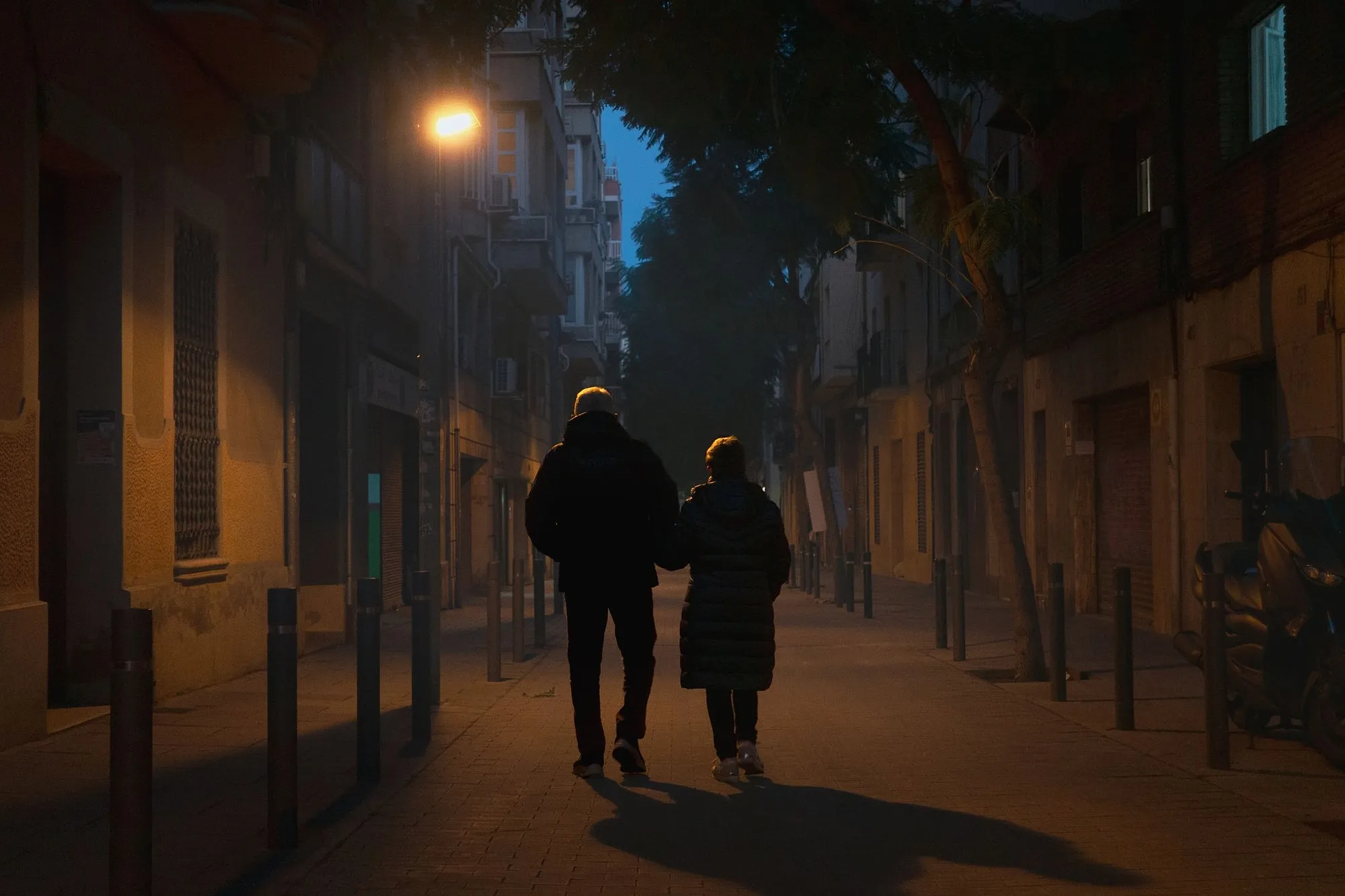
Ours do. They are outdoor walks, the rain here is usually short, and the Gothic Quarter route spends most of its time in streets that are three metres wide with four floors of building on either side, which is more use than an umbrella. The night version is, if anything, better on a wet evening — wet stone, low light, and nobody else out.
The three-hour Gràcia walk is more exposed, because it crosses squares, and it finishes indoors with a glass of vermouth, which on a wet day is not a small thing.
Departures, languages and the day’s actual timetable are on those pages, which are kept current. This one will not be. And there are exactly two days a year when nothing runs at all — 25 December and 1 January — rain or otherwise.
Where this comes from
- Valores climatológicos normales: Barcelona Aeropuerto (0076)AEMET · Agencia Estatal de MeteorologíaThe 1981-2010 normals for the airport station, altitude 4 m, used throughout: monthly precipitation in millimetres and the mean number of days with precipitation of 1 mm or more, month by month, together with the annual figures of 588 mm, 53.3 wet days, 19.9 days of storm, 9.4 days of fog and 70.4 clear days. The per-wet-day figures in this article are our own division of the agency's two published columns, not a figure AEMET publishes.
- Valores climatológicos normales: Barcelona, Fabra (0200E)AEMET · Agencia Estatal de MeteorologíaThe same normals for the Fabra observatory at 408 m: 621 mm a year over 57.1 wet days, 43.7 days of fog against the airport's 9.4, 2.0 days of snow against 0.4, and October as the wettest month at both stations.
- Turó de la RoviraAjuntament de Barcelona · Museu d'Història de BarcelonaThat the heritage space was inaugurated in March 2011 on a site until then 'força degradat, aïllat i desconegut', preserving the remains of an anti-aircraft battery that defended Barcelona during the Civil War and the traces of the shanty settlement of the barri dels Canons, which lasted until 1990 and formed part of the informal city of barraques that at the end of the 1950s sheltered 7 % of Barcelona's population; and that the museum has installed 'cinc plafons informatius que faciliten la visita autoguiada' along with two urban-history guides and a programme of guided visits. We could not find any mention of admission or a ticket on that page. The sentence about free entry that circulates elsewhere is attributed to a museum URL that now returns 404, and we could not reproduce it on the live page, so this article does not repeat it.
- Access regulationsAjuntament de Barcelona · Park GüellThat entry is by date and time band, that tickets must be bought in advance online, and that the maximum visitor capacity each thirty minutes is 700 people — a cap published per half-hour, not per hour.
Everything above that carries a date, a figure or a name is checked against these before it is published. Where we could not find a source, the page says so.
Quick answers
- How often does it rain in Barcelona?
- About fifty-three days a year with at least a millimetre, at the airport station, on the national agency's 1981-2010 normals. The annual total is 588 mm. Dividing one by the other gives roughly eleven millimetres on a wet day, which is why it tends to arrive as a downpour rather than as drizzle.
- What is the rainiest month in Barcelona?
- October, at both of the city's climate stations — 91 mm at the airport, over an average of 6.3 wet days. September is second at 81 mm. August is wetter than June or July, and shares the year's peak for thunderstorm days.
- What is there to do in Barcelona when it rains?
- The old city is the answer, and not only because of the museums. Its streets are narrow, largely traffic-free and often only a few metres wide, so they shelter you in a way that the Eixample's twenty-metre pavements do not. Markets, the museum spaces under the old city, and the museums on Montjuïc all work. What stops working is anything with a view.
- Does rain ruin Park Güell?
- It takes most of the point out of it. The ticketed area runs on a one-way route with limited shelter, and what you are there for is a hillside and a view of the city. The free woodland half is a wood on a slope in the rain. If the forecast is bad, move it.
- Do walking tours run in the rain?
- Ours do — they are outdoor walks and Barcelona's rain is usually short. The Gothic Quarter route is largely under narrow streets, which helps more than an umbrella does. Check the tour page for the day's departures rather than an article.
The tours this piece is about
The Gothic Quarter: a neighbourhood that invented itself
Barcelona's most photographed bridge dates from 1928.
- How long it lasts
- 2 h
- Runs in
- EN · ES · CA
- Price
- 15 €
Never more than 20 people
The Gothic Quarter after dark
By day it is a crowded stage set. By night it is a narrow city.
- How long it lasts
- 2 h
- Runs in
- EN · ES · CA
- Price
- 18 €
Never more than 20 people
More in the journal
Planning your trip
- When to go to Barcelona, from the only two datasets that exist
- One day in Barcelona: the case for cramming, and why we argue with it
- Two days in Barcelona, planned backwards from the tickets
- Three days in Barcelona, and what the third one is actually like
- A Barcelona weekend, arranged around what only happens at weekends
- Barcelona with children: a short list, with the drawbacks attached