
Gràcia
Gràcia has thirty passatges and only three of them are in Gràcia
Search for hidden passageways in Gràcia and you will be sent into the old town, where there are three. The other twenty-seven are further up, and the register that lists them explains the whole mechanism in a filing category: Propietat.
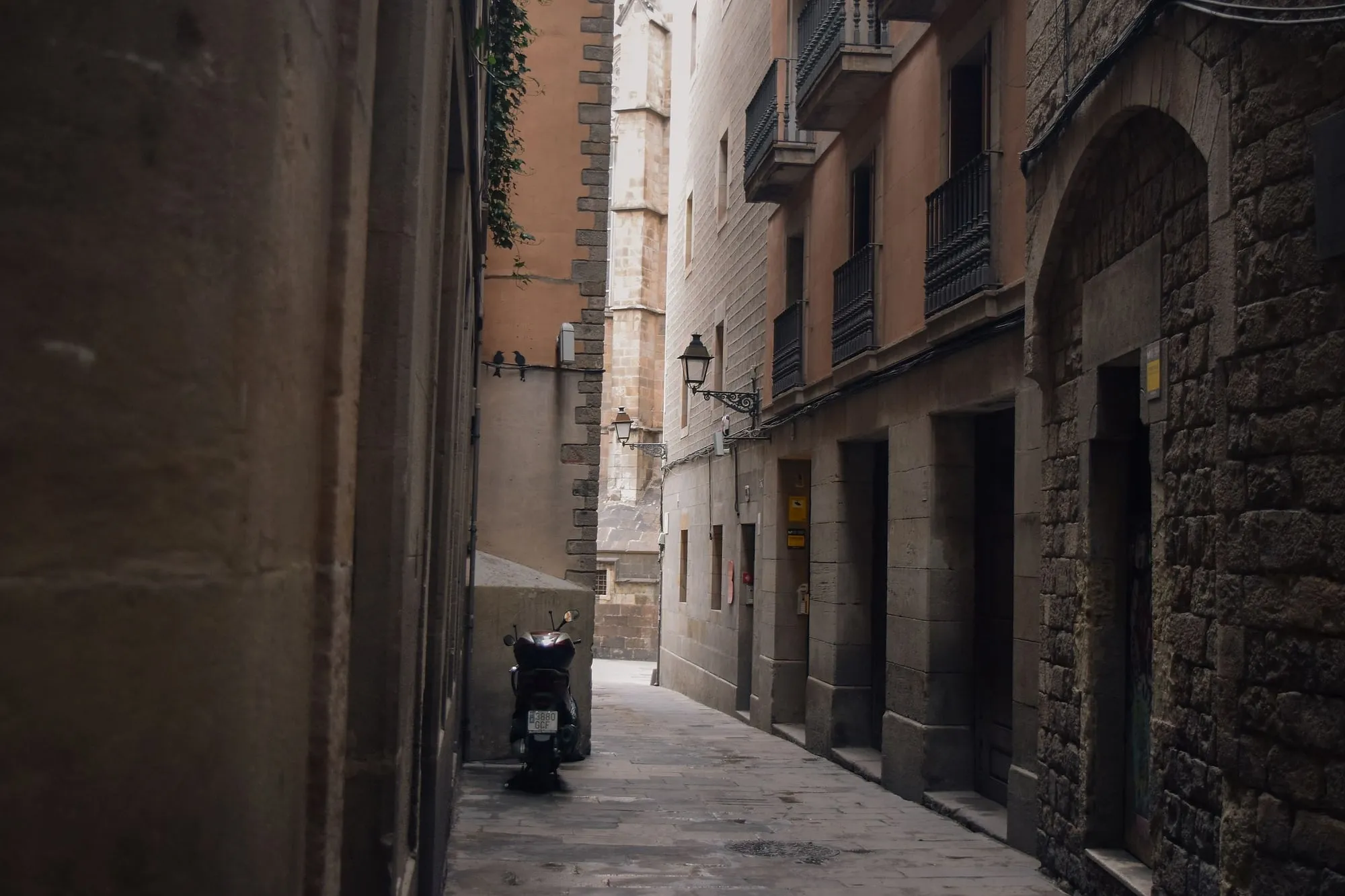
The internet will tell you Gràcia is full of hidden passageways. It will show you a photograph of a narrow lane with washing across it and a strip of sky, and it will not tell you where that is.
We went and counted, in the register the city publishes for exactly this purpose. In the district of Gràcia there are thirty named passatges.
In la Vila de Gràcia — the old town, the part everyone means, the part with the squares — there are three.
Where the other twenty-seven are
Up the hill. All of it up the hill, in the neighbourhoods that were annexed to this district in 1984 and mostly used to belong to Horta.
| Neighbourhood | Passatges |
|---|---|
| Vallcarca i els Penitents | 11 |
| el Camp d’en Grassot i Gràcia Nova | 9 |
| la Salut | 8 |
| el Coll | 6 |
| la Vila de Gràcia | 3 |
Those add up to more than thirty because several straddle a boundary; the register lists two neighbourhoods for eight of them.
Set against the same register’s count of twenty-one named squares in la Vila de Gràcia against three passatges, the old town’s reputation resolves cleanly. It is a place of squares. Square by square, that is here.
What a passatge is, according to the people who name them
The city publishes definitions for every category of public way it uses. The relevant one:
Passatge — a short street with no cross-street, which generally links two more important ones and may have restricted vehicle access.
There is a smaller category underneath it, which is worth knowing exists because it is very Barcelona:
Passadís — a passatge of little consequence and not much more than a metre wide.
Neither definition says anything about who built it or why. For that you have to look at how the entries are filed — and this is where the register gives away the whole mechanism.
The filing category is the story: Propietat
Every entry in the register carries a classification. A street named after a person is filed under Home or Dona and then a field of activity: music, politics, architecture.
Go through Gràcia’s thirty passatges and the field that keeps coming up is not a profession. It is Propietat — property.
Passatge de Nogués. Caterina Nogués i Tapís (Barcelona, 1831–1883). Wife of Ignasi Ventalló i Llobateras, a lawyer in Terrassa and owner of four and a half mujades from 1862. The dedication is to a landholding.
Passatge de Ministral. Joaquim Ministral i Lloveras (la Bisbal d’Empordà, 1852–1924). Owner of the land from 1922. That is the entire entry.
Passatge de Mariner. The lineage of the owners who opened and urbanised the public way. No first name required.
Passatge de Ros. Two owners, and a date for the cut itself: Joan Baptista de Ros, owner of the land, opened the passatge in 1870; Baudili Ros, a builder, bought the ground from Miquel Hortal in 1877.
Passatge de Camil Oliveras. Originally just passatge Oliveras, for the brothers Josep and Marcià Oliveras i Casellas, who held the lands until 1925.
Read four of those in a row and the picture is unambiguous. A passatge in this district is not a piece of town planning. It is a line a landowner cut through his own field so he could sell the plots on both sides of it, and then put his name on. The old town below was subdivided the same way — that is where Torrent de les Flors gets a surname instead of a stream — but up here the estates were bigger and later, so the cuts got their own category.
The four best entries
Passatge de Mercedes, in la Salut, is dedicated to Mercedes Güell i López (Barcelona, 1889–1954), daughter of Eusebi Güell, count of Güell, owner of the lands hereabouts, from 1899.
That is the Park Güell estate, named from the far side. Güell bought the hill in 1899 to build houses on it; the houses did not happen; the passatge did, and it carries his daughter’s name. Elsewhere in this journal there is a Mercè Güell i López, Eusebi Güell’s youngest daughter, who in 1945 gave Palau Güell to the provincial council on condition it be preserved for culture. Catalan and Spanish forms of the same name, and the register uses one and the Diputació the other. We are noting the pair rather than asserting they are one woman; nobody we can cite says so in those words.
Passatge de Napoleó, on the same slope, is the best-written entry in the district. Not the emperor: Antonio Fernández i Soriano (1827–1916), a photographer established on La Rambla and known by the nickname Napoleó, who bought a piece of land here in 1875 from the Maignon family, of French origin, and married the photographer Anne Tiffon i Cassan, known as Anaïs Napoleón.
And then the clause that tells you exactly how a passatge came into existence:
the couple undertook to give up the four metres of width of the passatge when they built on it.
Four metres of private land, surrendered as a condition of development, in 1875. That is a passatge, in one sentence, written by a municipal clerk.
Passatge de Llavallol, in Gràcia Nova, is the one that is not about an owner at all:
a tribute by the Grassot brothers to the line of tenant farmers who looked after their lands, and who had to leave the masia of Can Grassot in 1876 when it was demolished.
The developers named a street after the family they had just evicted. The register records it without comment, which is somehow worse.
Passatge d’Alió, a few streets away, shows the other half of the process — the erasing. It was passatge Román, because it was the property of Romà de Grassot i Elías. In 1922 the city took the owner’s name off it and put a composer’s on. The old name is still in the record, dated 30 October 1879.
The three in the old town, which are the exceptions that prove it
None of the Vila de Gràcia’s three is named after the man who owned the ground.
Passatge de Frígola — Bonaventura Frígola, a composer from Castelló d’Empúries. Named in 1922. It used to be called Paloma.
Passatge de Ròmul Bosch — a politician and shipowner who was mayor of Barcelona in 1905.
Passatge d’Isabel Vicente — named in 2018, and the newest name in the old town by a century. Isabel Vicente (Almansa, 1917 – Barcelona, 2000) was a textile worker, who at fourteen went to work at La Sedeta, the silk mill in this district, and there joined the united socialist youth. She fled to France after the war, was held in internment camps, was deported in 1939, and was in the women’s prison at Les Corts from 1941 to 1947. She went back in 1951 for the general strike and again in 1958. In 1968 she helped found a committee to support prisoners. In 1977 she stood for parliament.
The register gives her more words than it gives any landowner on this page, and the passatge she got is fifty-two metres long.
La Sedeta, which is where that biography starts, is in the account of industrial Gràcia — the mill that ran nearly around the clock and closed in 1975, whose site is now a school and a civic centre.
Two things in the data that do not work, said out loud
We are quoting a municipal dataset all the way down this page, so here is where it is visibly wrong.
The century field. Passatge de Mercedes is filed as eighteenth century — and its own text names a woman born in 1889 and land bought in 1899. Passatge de Ministral is filed as eighteenth century, and names an owner from 1922. Montornès and Manlleu, the same. Four entries whose century contradicts their own description, in the same register.
The neighbourhood field. The entry for Passatge de Montornès says it belongs to a group of streets in the barri del Coll dedicated to towns of the province of Barcelona — and the register then files the passatge itself under Vallcarca i els Penitents. Both statements are in the same record.
We cannot resolve either, and we would rather leave the seams showing than quietly pick the version that reads better. It is the same discipline that produced the note about the two different figures the city publishes for the Fossar de la Pedrera.
The good ones that are not about property at all
Passatge de la Farigola — the aromatic herb, thyme. And, the register adds, also known as passatge letter B. Somebody clearly ran out of ideas and then somebody else fixed it.
Passatge d’Isabel — dedicated to Isabel II, until the annexation of Horta to Barcelona produced a duplicate street name, at which point it became simply Isabel’s. It stands on the old camp dels Albes, where there was a house with land that had been an inn called la Farigola. So there are two thyme place-names on this hillside and they are not the same thing.
Passatge de Torres — known as de les Torres when it was opened, in reference to the villas still existing there. The towers in the name are the summer houses that Vallcarca and Gràcia Nova were built out of, most of which are gone.
Passatge de Tona — one of the group named after towns of the province, and the register cannot resist telling you that in 1401 Tona asked to be joined to Barcelona under the formula of carreratge, by which it was counted as a street of Barcelona and its people had the same rights as the capital’s. A town that was legally a street, remembered by a lane that is legally a passatge.
So what do you actually do with this
Do not go to Gràcia looking for passatges. The old town has three and none of them is the photograph.
Do look, if you are already up there. If Park Güell is in your plan — and the free half of it is genuinely worth the walk, see Park Güell without a ticket — then Mercedes, Napoleó, Espíria and Garcia i Robles are on that slope. They are ordinary residential lanes. What makes them interesting is knowing that each one is the shape of a nineteenth-century property transaction.
And read the street signs. Barcelona publishes why every one of them is called what it is called, free, in a database of 4,647 entries, and it is the single most useful thing in this city for anybody who likes knowing what they are standing on.
Or have it pointed out
Our Gràcia walking tour stays down in the old town, where the squares are and where the annexation happened, guided by a working actor. Three hours, ten people, vermouth at the end.
It does not go up the hill. Now you know what is up there, and that it is not what the photographs promised.
Where this comes from
- Nomenclàtor de Barcelona (dataset of street names)Open Data BCN · Ajuntament de BarcelonaThe published register of the city's 4,647 named public spaces, with the district, neighbourhood, length, century and approval date of each. The counts used here are taken from it: thirty entries of type Passatge in the district of Gràcia; three of them touching la Vila de Gràcia; eleven touching Vallcarca i els Penitents, nine el Camp d'en Grassot i Gràcia Nova, eight la Salut and six el Coll; and twenty-one squares against three passatges inside la Vila de Gràcia.
- Tipologia de viesAjuntament de Barcelona · Nomenclàtor de BarcelonaThe city's own definition: 'Passatge — Carrer curt sense cap travessia, que generalment n'enllaça dos de més importants i que pot tenir limitat el trànsit de vehicles.' And, for contrast, 'Passadís — Passatge de poca entitat i de no gaire més d'un metre d'amplada.'
- Passatge de MercedesAjuntament de Barcelona · Nomenclàtor de BarcelonaFiled under Dona / Propietat: 'En homenatge a Mercedes Güell i López, (Barcelona, 1889-1954), filla d'Eusebi Güell, comte de Güell, propietari dels terrenys de l'indret, des de 1899.' The record's century field reads Segle XVIII, which cannot be reconciled with its own text.
- Passatge de NapoleóAjuntament de Barcelona · Nomenclàtor de BarcelonaFiled under Home / Propietat: Antonio Fernández i Soriano (Casas Ibáñez, 1827 - Barcelona, 1916), a photographer established on La Rambla and known by the nickname Napoleó, who bought a piece of land in 1875 from the Maignon family, of French origin, and married the photographer Anne Tiffon i Cassan, known as Anaïs Napoleón; and that 'el matrimoni es va comprometre a cedir els quatre metres d'amplària del passatge en edificar-lo'. Name approved 07/03/1939; earlier names Napoleón, Julio, Antonio Napoleón (1875).
- Passatge de LlavallolAjuntament de Barcelona · Nomenclàtor de BarcelonaFiled under Família / Professió: 'Es tracta d'un homenatge dels germans Grassot al llinatge dels masovers que tenien cura dels seus terrenys que van haver d'abandonar la masia de Can Grassot, el 1876, al ser enderrocada.'
- Passatge d'AlióAjuntament de Barcelona · Nomenclàtor de BarcelonaThat the passatge, in the old paratge of Caputxins vells de Gràcia, 'fou propietat de Romà de Grassot i Elías, raó per la qual s'anomenava passatge Román fins que se substituí pel d'Alió', after the composer Francesc Alió i Brea (Barcelona, 1862-1908); name approved 29/03/1922, earlier name Román (30/10/1879).
- Passatge de NoguésAjuntament de Barcelona · Nomenclàtor de BarcelonaFiled under Dona / Propietat: Caterina Nogués i Tapís (Barcelona, 1831-1883), wife of Ignasi Ventalló i Llobateras, a lawyer in Terrassa and owner of four and a half mujades from 1862.
- Passatge de RosAjuntament de Barcelona · Nomenclàtor de BarcelonaThat Joan Baptista de Ros, owner of the land, opened the passatge in 1870, and that Baudili Ros i Rodés (Sant Boi de Llobregat, 1831 - Barcelona, 1905), a builder, became owner by purchase from Miquel Hortal i Martí in 1877.
- Passatge de MinistralAjuntament de Barcelona · Nomenclàtor de BarcelonaFiled under Home / Propietat: Joaquim Ministral i Lloveras (la Bisbal d'Empordà, 1852 - Barcelona, 1924), owner of the land from 1922 — while the same record's century field reads Segle XVIII.
- Passatge de MarinerAjuntament de Barcelona · Nomenclàtor de BarcelonaFiled under Família / Propietat: 'Llinatge dels propietaris que obriren i urbanitzaren la via pública.' Name approved 19/11/1929; earlier names Castelldefels (1907-1929) and Mariné.
- Passatge de la FarigolaAjuntament de Barcelona · Nomenclàtor de BarcelonaFiled under Flora / Planta, for the aromatic herb, and 'conegut també per passatge lletra B'.
- Passatge d'IsabelAjuntament de Barcelona · Nomenclàtor de BarcelonaThat the street was dedicated to Isabel II, but 'amb l'agregació d'Horta a Barcelona es produí una duplicitat en el nom del carrer, que des d'aquell moment s'anomenà passatge d'Isabel'; that it stands on the old ground of the camp dels Albes, where there was a house with land that was the inn of la Farigola. Earlier names: Isabel II (1836), Cristina, Farigola.
- Passatge de TorresAjuntament de Barcelona · Nomenclàtor de BarcelonaThat it was known as de les Torres when it was opened in the paratges of Travessera, Torrent Pregon or Lligalbé, 'en referència a les torres existents encara a l'indret'.
- Passatge de TonaAjuntament de Barcelona · Nomenclàtor de BarcelonaThat Tona is a municipality of Osona and a street of Barcelona, and that in 1401 the town asked to be joined to Barcelona under the formula of carreratge, by which it was considered a street of Barcelona and its inhabitants enjoyed the same rights and privileges as those of the capital.
- Passatge de MontornèsAjuntament de Barcelona · Nomenclàtor de BarcelonaThat it takes the same dedication as carrer de Montornès and 'pertany a un conjunt de carrers del barri del Coll dedicats a pobles de la província de Barcelona' — although the register files the passatge itself under Vallcarca i els Penitents, and gives its century as Segle XVIII.
- Passatge d'Isabel VicenteAjuntament de Barcelona · Nomenclàtor de BarcelonaThat Isabel Vicente (Almansa, 1917 - Barcelona, 2000) was a textile worker and anti-Franco fighter who at fourteen went to work at the La Sedeta textile factory in Gràcia, where she came into contact with the JSUC; that after the Republican defeat she fled to France and was held in internment camps; that she was deported in 1939 and imprisoned in the Presó de Dones de les Corts from 1941 to 1947, returned there in 1951 for taking part in the general strike of that year, and again in 1958 in the Model prison; that in 1968 she took part in founding the Comitè d'Ajuda a Presos Solidaritat; and that she stood for the PSUC in the 1977 general election. Name approved 15/02/2018.
- Passatge de FrígolaAjuntament de Barcelona · Nomenclàtor de BarcelonaThat it is named after the composer Bonaventura Frígola i Frígola (Castelló d'Empúries, 1829-1901), that the name was approved on 29/03/1922 and that its earlier name was Paloma.
- Passatge de Ròmul BoschAjuntament de Barcelona · Nomenclàtor de BarcelonaThat it is named after Ròmul Bosch i Alsina (Calella, 1846 - Barcelona, 1923), politician and shipowner, mayor of Barcelona in 1905; earlier name Rómulo Bosch.
Everything above that carries a date, a figure or a name is checked against these before it is published. Where we could not find a source, the page says so.
Quick answers
- How many passatges are there in Gràcia?
- Thirty, in the district, on the city's register of named public spaces. Only three of them touch la Vila de Gràcia — the old town, which is the part people mean: passatge de Frígola, passatge de Ròmul Bosch and passatge d'Isabel Vicente. The rest are up the hill in Vallcarca i els Penitents, el Camp d'en Grassot i Gràcia Nova, la Salut and el Coll.
- What is a passatge, exactly?
- The city defines it as 'a short street with no cross-street, which generally links two more important ones and may have restricted vehicle access'. In practice, in this district, it is what a landowner cut through his own field when he subdivided it — which is why the register files most of them under the heading Propietat and names the owner.
- Where are Barcelona's covered passageways in Gràcia?
- Mostly not in the old town. Vallcarca i els Penitents has eleven passatges, el Camp d'en Grassot i Gràcia Nova nine, la Salut eight and el Coll six. Several straddle two neighbourhoods, which is why those numbers add up to more than thirty.
- Which passatge in Gràcia is worth a detour?
- None of them individually, and we would rather say so than send you up a hill. What they are worth is knowing about while you are already up there for Park Güell — Mercedes, Napoleó, Espíria and Garcia i Robles all sit on that slope, and three of them are named after the people who owned the ground.
- Is Gràcia a place of squares or of passageways?
- Squares, and the register settles it. In la Vila de Gràcia there are twenty-one officially named squares against three named passatges. The reputation for passageways belongs to the parts of the district that were never the town.
The tours this piece is about
More in the journal
Gràcia
- Shopping in Gràcia: the street and the neighbourhood are not the same place
- Why the streets of Gràcia are like that: two roads, four streams and a convent
- The man who built modernista Gràcia was not allowed to sign it, and the city's catalogue names who did
- Gràcia has a Liberty street and a Fraternity street, and the jewels are a silversmith's sales pitch
- Mercat de la Llibertat: the iron hall a town built for itself, nine years before it stopped being a town
- The Abaceria: a market that has been in a marquee since 2019, and the cotton mill they found underneath it