
Gràcia
The Abaceria: a market that has been in a marquee since 2019, and the cotton mill they found underneath it
You will walk past a building site on Travessera de Gràcia and not know it was a market. The archaeology done under it in 2024 is the most specific thing anybody has published about industrial Gràcia — including two things that were supposed to be there and were not.
There is a market in Gràcia that most visitors never find, because it is not there.
The Mercat de l’Abaceria Central has been trading out of a temporary hall on Passeig de Sant Joan since 11 July 2019, which is a fifteen-minute walk from where it belongs and, as it happens, outside the old town of Gràcia altogether. Its own block on Travessera de Gràcia has been hoardings and cranes ever since.
That would be a dull piece of municipal news, except for what came out of the ground while it was empty.
First, what the market was
The city’s markets institute puts it in one sentence: built in 1892, the Abaceria Central is one of the city’s century-old markets. It has its origins in the open-air stalls set up in plaça de la Revolució, and before its present name it was also called the Santa Isabel market and the Revolució market.
Three names, then. And the reason for the building, from the city’s press service, is the same reason as everywhere else: to get the farmers off the square. They were selling in the open in plaça de la Revolució, a minute away, and the town put a roof somewhere to make them do it indoors.
The other century-old market up the hill got the same treatment four years earlier and is still standing and still working — that one is the Mercat de la Llibertat, where the argument is about who drew the ironwork rather than about what is underneath it.
And what was there before the market
This is the part that turns the page.
The land belonged to Francesc Puigmartí i Caparà, and on it stood his cotton mill, el Vapor Nou — the New Steam. The city’s account of it is unusually specific:
- raised on this site from 1839;
- 120 looms by 1852;
- 800 people employed at its height;
- visited by Queen Isabel II in 1861, during her visit to Barcelona;
- working until 1876, when it was razed by fire.
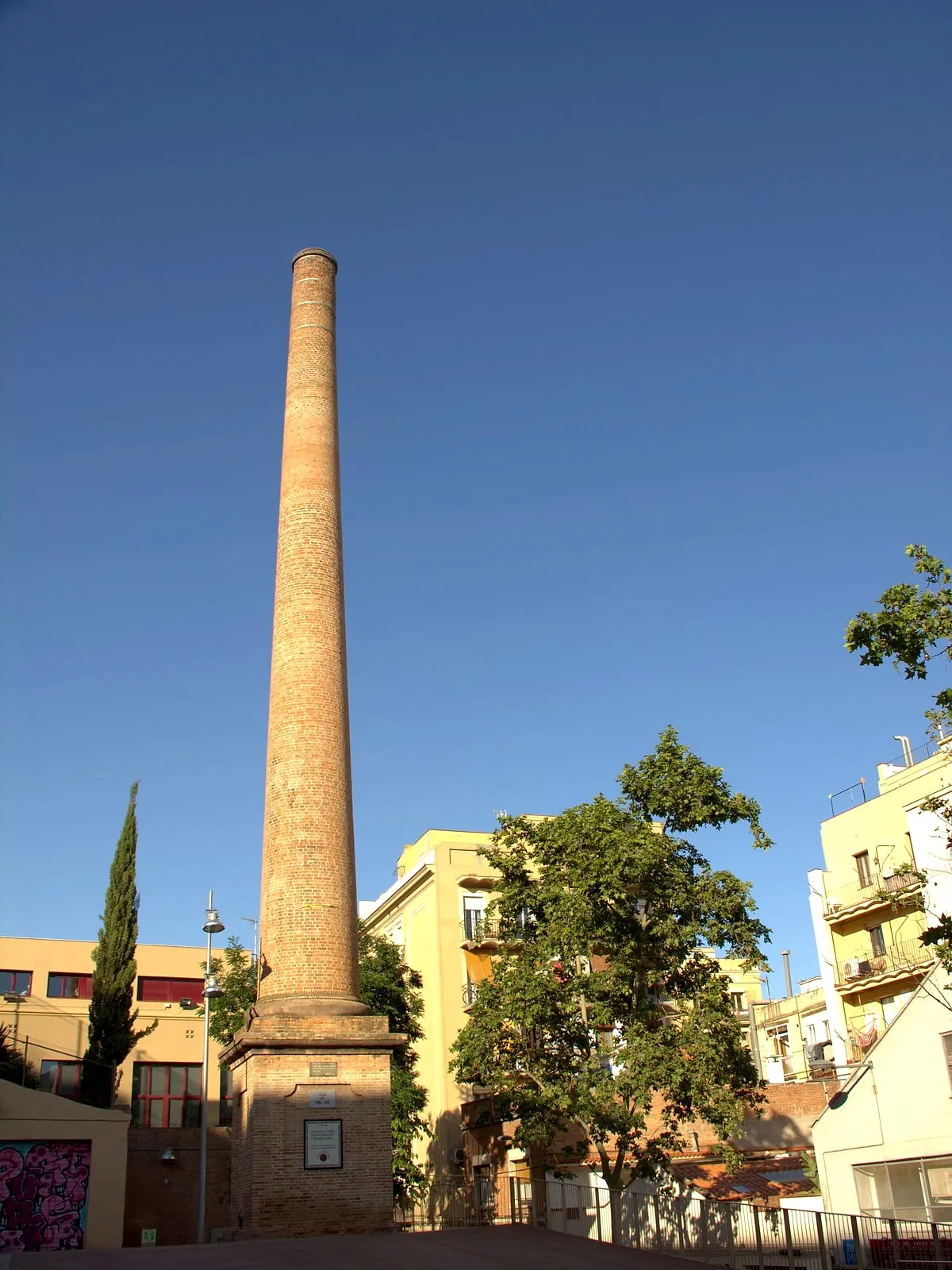
Its buildings were then dismantled to build the market. And of the whole mill, the city says, only one of the chimneys is still standing, in what is now plaça del Poble Romaní.
If that name is ringing a bell, it should. The single brick chimney standing among the flats with nothing attached to it — the only catalogued chimney in the entire district of Gràcia, which we had to write a retraction about after claiming there were several — is the chimney of this factory. The heritage catalogue files it as the chimney of the former Puigmartí works, el Vapor Nou. The full count, and what we got wrong, is the chimneys of Gràcia.
So the market and the chimney are two halves of the same object. A cotton mill burns down in 1876; sixteen years later a food market goes up on its footprint; one chimney is left standing a couple of streets away, and for a century and a half nobody joins the two facts up in front of you.
The dig, and what it found
In 2021 the city ran a first, exploratory phase: 38 trial trenches and three test pits. The site sits inside a designated Zone of Archaeological Interest, which means nothing can be done there without a preventive intervention first.
The trenches came back positive, and in February 2024 a full six-week excavation began. What it documented, in the city’s own words, occupies practically the whole surface of the site:
The main building. Running along the line of the market’s own central nave, with a documented length of 87.60 metres and a width of 14. The market was built directly over the mill’s spine.
The northern sector, with a run of annexes facing Travessera de Gràcia, and — the detail that makes it a workplace rather than a plan — circulation spaces for workers, vehicles and goods.
The factory yard, which the report calls the nerve centre of the factory, with two large underground tanks. The trenches found the paving that covered almost the whole yard floor: gravel and light-brown clay with calcareous nodules, heavily compacted. Somebody tamped that down by hand and it is still there.
And underneath all of it, vineyard trenches — the planting furrows of a vineyard, which the archaeologists date, cautiously, to possibly the seventeenth or eighteenth centuries.
Which gives you the whole sequence of this one block, in four layers: vines, cotton, food, and a hole in the ground.
The two things that were not there, which is the better story
This is the part we would put in front of anybody who wonders why we bother citing sources.
No Roman anything. The Roman road out of Barcelona runs, in the city’s words, broadly along the line of Travessera de Gràcia. It is one of the two axes that the town of Gràcia grew along — see why the streets of Gràcia are like that. Thirty-eight trenches went into a site fronting that road, and the report states plainly: no Roman material or remains were located.
No air-raid shelter. The municipal administrative archive records that Civil War shelters were near this site. Neighbours told the archaeologists that the entrance to shelter number 0008 was probably at the south-eastern end of carrer Torrijos. The excavation found no trace of them.
Both of those are negative results, and both are published by the city as such rather than quietly left out. That is exactly the discipline this journal tries to keep. Barcelona’s shelters, where they do survive and can be visited, are here.
What is protected, and what is not
Worth getting right, because it is routinely misstated.
The municipal heritage catalogue’s entry is called CONJUNT DEL MERCAT DE L’ABACERIA CENTRAL — the ensemble of the market. What it describes is a rectangular space of 45 by 85.50 metres with four streets converging on it, and the surrounding buildings. Its protection level is C, bé d’interès urbanístic, the lowest of the catalogue’s main tiers.
So the listing is on the urban block and its shape, not on the market building as a monument in its own right. Which is why the demolition could go ahead with only the catalogued metal structure retained.
One oddity, flagged rather than smoothed over: the catalogue gives that ensemble the date 1842. The market is 1892. 1842 falls inside the working life of the cotton mill, and it happens to be the year of the illustration the city reproduces — a plate attributed to Antoni Roca, published in Pi i Margall’s España: obra pintoresca, in which the Vapor Nou can be made out. We do not know whether those two facts are connected. Do not write that the market dates from 1842.
Where the market is, officially, and why the answer is wrong
Look up the Abaceria on the city’s own markets site today and the record says:
Address: Pg Sant Joan, 181. District: Gràcia. Neighbourhood: el Camp d’en Grassot i Gràcia Nova.
Meanwhile every press release about the works says the Mercat de l’Abaceria Central of la Vila de Gràcia, and gives the address as Travessera de Gràcia 186.
Both are municipal, and both are right about different things: the markets record has been updated to the marquee, and the marquee is genuinely in another neighbourhood. It is a small, honest artefact of a market that has been somewhere else for years — and a decent illustration of why the five neighbourhoods of Gràcia trip people up.
For the record, the real site is a whole block: Travessera de Gràcia, and the streets of Torrijos, Mare de Déu dels Desemparats and — of course — Puigmartí.
What is being built, and what we are not going to promise
The new building is to have 14,350 square metres over a ground floor, a mezzanine in two levels and three basement floors. Works began in October 2023.
As for when it opens: releases in 2024 and 2025 said the end of 2025. A release of March 2026 said July, with the market reopening after the summer. We are not printing a date. A page that promises a reopening is worse than a page that tells you to go and look, and the city’s markets pages are the place to look.
Whether any of this is worth your time as a visitor
Honestly? The building site is not. There is nothing to see behind hoardings.
What is worth ten minutes is the chimney, which is free, standing, and now means something: it is the last piece of a mill that employed eight hundred people, burned in 1876, and is still down there in plan under a market that has been closed since 2019. Where it stands, and what else survives of industrial Gràcia, is in the chimneys of Gràcia and in the walking order set out in what to see in Gràcia.
And if you want a working market rather than an archaeological one, the Llibertat is five minutes uphill and has been open the whole time.
The version with somebody telling you
Our Gràcia walking tour works this neighbourhood as it was when it was a separate town, factory hands and all. The guide is a working actor, which is a difference in the telling and not a costume. Three hours, ten people, and a glass of vermouth at the end, which is its own local institution.
The chimney is free, though, and it is not going anywhere.
Where this comes from
- Mercat de l'Abaceria CentralAjuntament de Barcelona · Institut Municipal de MercatsThat 'construït el 1892, l'Abaceria Central és un dels mercats centenaris de la ciutat. Té els seus orígens en els llocs a l'aire lliure instal·lats a la plaça de la Revolució, i abans del nom actual també es va denominar de Santa Isabel i de la Revolució.' And that the record's own address and neighbourhood fields currently read Pg Sant Joan 181, barri el Camp d'en Grassot i Gràcia Nova — which is the temporary hall, not the market's own site.
- Comencen els treballs d'excavació per catalogar les restes d'una fàbrica tèxtil sota el Mercat de l'Abaceria (28/02/2024)Ajuntament de Barcelona · Servei de PremsaThat the market opened in 1892 'per ordenar l'activitat dels pagesos que venien a la veïna plaça de la Revolució'; that the works were done on the land of Francesc Puigmartí i Caparà's Vapor Nou, one of the most important cotton factories of its day, which employed 800 people at its height, had 120 looms in 1852, was visited by Queen Isabel II in 1861, worked until 1876 'quan va quedar arrasada per un incendi', and of whose installations 'només n'ha quedat d'en peus una de les xemeneies, situada a l'actual plaça del Poble Romaní'. That the mill was raised on the site from 1839. That the site is in a Zona d'Interès Arqueològic. That a first phase between September and December 2021 opened 38 trial trenches and three test pits and 'no van localitzar cap material o resta d'època romana associades a la via romana que coincideix a grans trets amb el traçat de la Travessera de Gràcia. Tampoc s'han trobat indicis de presència de refugis antiaeris de la Guerra Civil'. That the remains occupy practically the whole site: the main building along the central nave with a documented length of 87.60 metres and a width of 14, the northern annexes towards Travessera de Gràcia, and the factory yard with two large underground tanks.
- En marxa els treballs d'excavació per catalogar les restes d'una fàbrica tèxtil sota el Mercat de l'Abaceria (12/03/2024)Ajuntament de Barcelona · Servei de PremsaThat the excavation had already left some of the mill's structures visible; that the site at Travessera de Gràcia 186 occupies 3,860 m²; that the works began on 28 February 2024 and were expected to last about six weeks; and that the excavation report is the Memòria de la Intervenció arqueològica preventiva a la travessera de Gràcia, 186 by Emiliano Hinojo García. The page also reproduces an 1842 illustration attributed to Antoni Roca, published in Francesc Pi i Margall's España: obra pintoresca, in which the Vapor Nou can be made out.
- Catàleg del patrimoni arquitectònic protegit de la ciutat de BarcelonaOpen Data BCN · Ajuntament de BarcelonaRecord 2693, CONJUNT DEL MERCAT DE L'ABACERIA CENTRAL, district 06: protection level Bé d'interès urbanístic - C, època 1842, original use 'Residencial, mercat i espai públic', described as a rectangular space of 45 by 85.50 metres with four streets converging on it. The protection is on the ensemble, not on the market building as an individual monument. The same dataset holds record 2672, the chimney of the former Puigmartí factory, El Vapor Nou, in district 06.
- Comencen les obres de millora dels entorns del Mercat de l'Abaceria (17/03/2026)Ajuntament de Barcelona · Servei de PremsaThat the new building will have 14,350 square metres of floor area over a ground floor, a mezzanine divided into two levels and three basement floors; that the market works began in October 2023; and that the site is bounded by Travessera de Gràcia and the streets of Torrijos, Mare de Déu dels Desemparats and Puigmartí. Also that the completion date has moved: this release expects the works to finish in July, where releases of 2024 and 2025 expected the end of 2025.
Everything above that carries a date, a figure or a name is checked against these before it is published. Where we could not find a source, the page says so.
Quick answers
- Where is the Mercat de l'Abaceria now?
- In a temporary hall on Passeig de Sant Joan, between carrer Indústria and Sant Antoni Maria Claret, where it has been trading since 11 July 2019. That is outside the old town of Gràcia. Its own site on Travessera de Gràcia has been a building site since.
- When did the Mercat de l'Abaceria open?
- 1892, on the city's own account, to bring order to the farmers who were selling in the open in the neighbouring plaça de la Revolució. The markets institute writes 'built in 1892'; the press service writes 'opened in 1892'. Before it was the Abaceria it was called the Santa Isabel market and the Revolució market.
- What was on the site before the market?
- A cotton mill. Francesc Puigmartí's Vapor Nou, raised there from 1839, with 120 looms by 1852 and 800 workers at its height, visited by Queen Isabel II in 1861 and destroyed by fire in 1876. Its buildings were dismantled to make room for the market. One chimney survived.
- What did the archaeologists find under the Abaceria?
- The mill, essentially intact in plan: the main building along the line of the market's central nave, documented at 87.60 metres by 14, annexes towards Travessera de Gràcia, and the factory yard with two large underground tanks. Below that, vineyard trenches that may be seventeenth or eighteenth century. What they did not find was any Roman material, or the air-raid shelter the municipal archive said was nearby.
- Has the new market opened?
- We are not going to tell you, because the answer changes and this page will not. The city's releases have promised completion in late 2025 and then in July 2026, and the most recent one we could find talks about reopening after the summer. Check the city's own markets pages rather than any article, including this one.
The tours this piece is about
More in the journal
Gràcia
- Why the streets of Gràcia are like that: two roads, four streams and a convent
- Gràcia has thirty passatges and only three of them are in Gràcia
- The man who built modernista Gràcia was not allowed to sign it, and the city's catalogue names who did
- Gràcia has a Liberty street and a Fraternity street, and the jewels are a silversmith's sales pitch
- Mercat de la Llibertat: the iron hall a town built for itself, nine years before it stopped being a town
- What is left of industrial Gràcia is one chimney, and we had been saying several