
Montjuïc
It is a copy of a hundred and seventeen buildings, and it never pretended otherwise
The complaint about the Poble Espanyol is that it is fake. That is not a criticism of it, it is a description of it, and it is the only thing on Montjuïc that has been honest about itself since 1929.
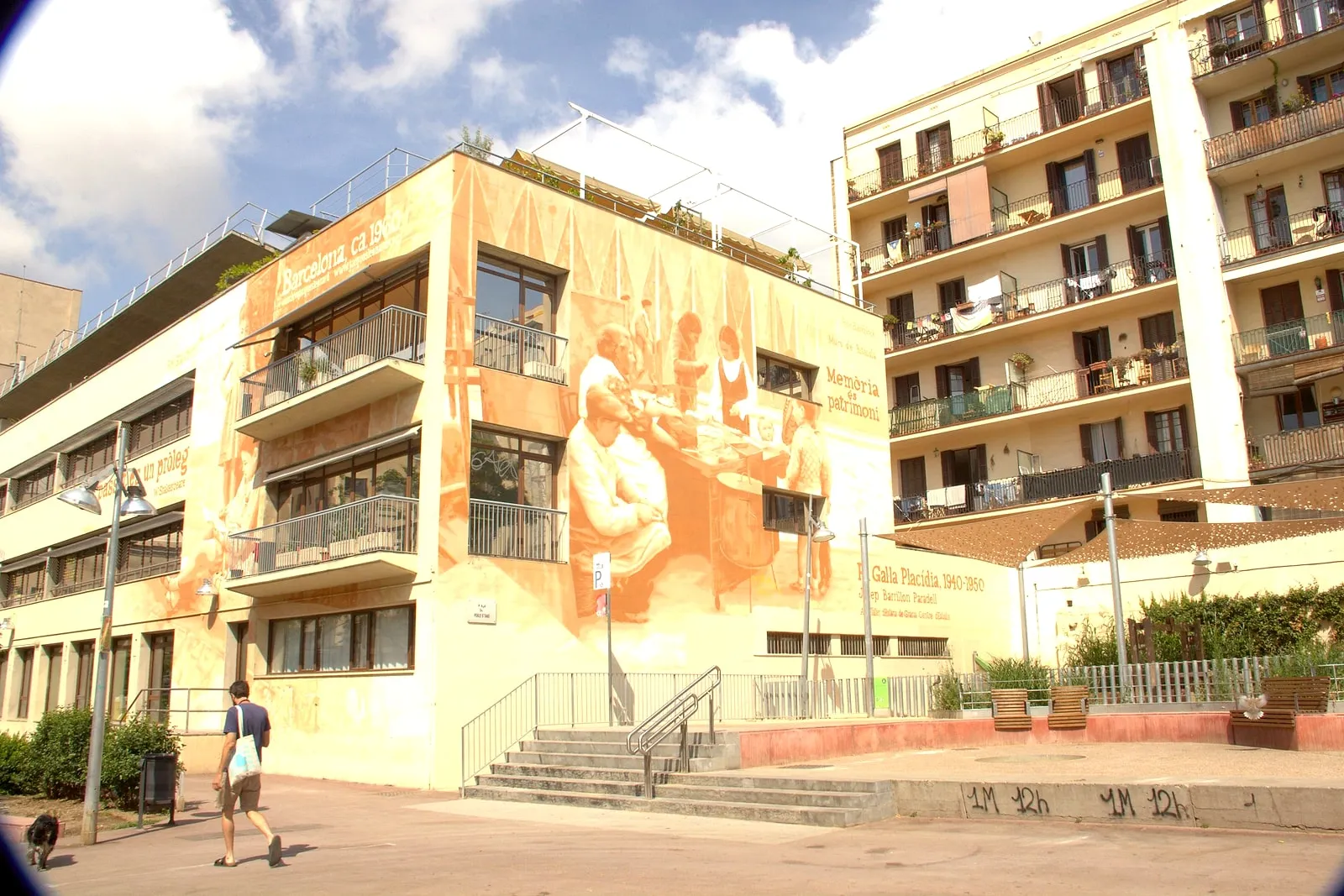
The standard verdict on the Poble Espanyol is that it is fake. That is not a review. That is what it is, it is what it was commissioned to be, and it has said so since 1929.
The useful question is a different one, and this page is about answering it: what is it a copy of, who made the copy, and is that worth an afternoon on a hill that also has a fortress and a national museum on it.
What it is
A village, on the flank of Montjuïc, assembled out of reproductions of real buildings from across Spain, built for the 1929 International Exposition.
The operator says 117 architectural recreations at real life scale. The Catalan encyclopedia gives no count at all and gives the area instead: 20,000 square metres. Those are two different institutions measuring two different things, and we are handing you both rather than picking the more impressive one.
It was meant to come down. Its own history is candid: the initial idea was to demolish it when the fair ended, its creators came round to the view that it should endure, and the demolition never happened.
That makes it the exact inverse of the other famous building on that hill. The German pavilion was taken apart in 1930 and rebuilt in 1986; the Poble Espanyol was built to be demolished and never was. Same fair, same eight months, opposite fates — which is the whole story of Montjuïc’s 1929.
The four men, and one correction
Both the encyclopedia and the operator name the same four, which is more agreement than most things on this hill get.
- Francesc Folguera — architect
- Ramon Reventós — architect
- Xavier Nogués — artist
- Miquel Utrillo — the operator describes him as engineer, painter and project leader
You will read that Utrillo was “the critic”. He was an art critic among other things, but that is not how either institution introduces him here, and project leader is the more useful description.
One trap, for anyone who goes to check us: the Catalan encyclopedia has an entry for a Ramon Reventós i Bordoy who was a humorist and writer, born 1880 and died in 1923 — five years before construction began. Different man. There is no encyclopedia biography of the architect. And the encyclopedia itself cannot decide between Raventós and Reventós, spelling it one way in three entries and the other in a fourth.
What it copies, building by building
This is the part nobody publishes and the encyclopedia does. If you go, go with this list:
- The entrance gate — a reproduction of the San Vicente gate of Ávila.
- The town hall — from Vall-de-roures, in the Matarranya.
- The calle de los Arcos — from Seville.
- The fountain — from Prades, in the Baix Camp.
- The church bell tower — from Utebo, in Aragon.
- The monastery, set slightly apart — and this one is important — condenses elements of several Catalan Romanesque churches. It is not a copy of one building. It is a composite, which is a different and more revealing thing.
- The Catalan section — imitations of buildings from Santa Pau, Besalú, Rupit, Camprodon, Isona, Montblanc, Premià de Dalt, la Garriga, Cornudella, Tàrrega and others.
Walking it with those names in hand turns the visit from a stroll through a stage set into something closer to a reading exercise: you are looking at what 1920s Barcelona thought the architecture of Spain was, in the order it thought it mattered.
What we could not verify
How far they travelled. The famous version is that the team drove thousands of kilometres across Spain photographing and measuring. No institution publishes a distance. The operator gives a town count — more than 1,600 villages on one page, 1,600 towns in a Hispano Suiza car on another, which is the same site disagreeing with itself. So: a lot of towns, by the operator’s own account, and no kilometre figure from anybody.
Who owns it. The operator documents only that its management was privatised in 1986 and passed to a group of businessmen in 1996, and that the operating company is Poble Espanyol de Montjuïc, S.A.U. Management is not ownership and we are not going to conflate them.
That it was a Primo de Rivera-era statement about a single unified Spain. This is the standard critical reading and it may well be right. We could not find it stated by an institution or in an academic source we could reach, so it stays out.
The Civil War, which the operator does not hide
Two claims here, and they have different weight.
The operator says the war saw its conversion into a prisoner internment camp. That is on the operator’s own site and it is the only source we have for it — the encyclopedia does not corroborate it. We are giving it to you as theirs.
The operator also says the Franco regime used the museum to disseminate violently anti-Catalanist messages. The encyclopedia corroborates the museum use.
Both are unusual admissions for an attraction to publish about itself, and they are worth knowing before you decide the place is harmless.
Is it worth it
Three honest answers, depending on who is asking.
If you have one or two days in Barcelona: no. Not because it is bad, but because you have not seen the things this city has that nowhere else has, and this is by definition a collection of things that are somewhere else. See two days in Barcelona.
If you have three or more days and you are giving Montjuïc a half day: probably still no, and this is the hard one. A Montjuïc afternoon that does the castle and the quarry behind it is already full, and adding a ticketed village to it means dropping one of those. That is a real trade — see is Montjuïc worth it.
If you are interested in architecture, or you are here with children, or it is raining: yes, and without apology. It is an open-air catalogue of vernacular building types you would otherwise need six weeks and a car to see, made by people who went and looked at the originals. The craft workshops are real work being done in front of you. And the Fran Daurel collection has been there since 2001.
The thing worth carrying in with you
The reason this place is interesting is not that it fools anybody. It never has. It is that it is the most honest object on a hill that is full of reconstructions pretending to be survivals.
Two hundred metres away, a German pavilion that did not exist for fifty-six years is presented as one of the great buildings of the twentieth century, and it is. Down in the old city, a fifteenth-century house that was carried across the neighbourhood is the entrance to the history museum, and a bridge from 1928 is the emblem of the medieval quarter.
The Poble Espanyol is the only one of them that says copy on the door.
Where our walk goes instead
Our Montjuïc walking tour passes it and does not go in, and we will tell you why in one sentence on the way past: two and a half hours is enough for the fairground, the castle and the quarry, and the argument those three make together is the reason the walk exists.
If the village is what you want, do it separately and give it its own slot. It rewards two hours and it punishes twenty minutes, like most of this hill — how to get up here, and what else is on it.
The two buildings from the same fair that people mix up with this one are the German pavilion, which really was demolished, and the Magic Fountain, down the axis towards Plaça d’Espanya.
Where this comes from
- El Poble EspanyolGran Enciclopèdia CatalanaThat it was «built in 1926-29 for the International Exposition of 1929, designed by the architects Francesc Folguera and Ramon Raventós and by the artists Xavier Nogués and Miquel Utrillo»; that it occupies 20,000 m²; and the list of what the main pieces reproduce — the San Vicente gate of Ávila, the town hall of Vall-de-roures, the calle de los Arcos of Seville, the fountain of Prades, the church bell tower of Utebo, a monastery condensing elements of several Catalan Romanesque churches, and the Catalan section's imitations of buildings from Santa Pau, Besalú, Rupit, Camprodon, Isona, Montblanc, Premià de Dalt, la Garriga, Cornudella and Tàrrega. These are the encyclopedia's dates, and they do not match the operator's.
- The historyPoble Espanyol de MontjuïcThat «Miquel Utrillo, engineer, painter and project leader, Xavier Nogués, draughtsman and painter, Francesc Folguera and Ramón Reventós were tasked with designing a venue»; that construction began on 19 January 1928 and it opened with the fair on 20 May 1929; that the initial idea was to demolish it and its creators came to believe it should endure; the research journey through more than 1,600 villages; and the operator's own account of the Civil War and the Franco years. Where this contradicts the encyclopedia we say so.
- The Poble EspanyolPoble Espanyol de MontjuïcThe figure of «117 real life-scale architectural recreations», which is the operator's and has no institutional corroboration we could find.
- Francesc Folguera i GrassiGran Enciclopèdia CatalanaThat Folguera built the Poble Espanyol «together with Ramon Reventós and with the artistic advice of Xavier Nogués and Miquel Utrillo» — the second institutional confirmation of the four names, and the entry in which the encyclopedia spells the architect's surname Reventós rather than Raventós.
Everything above that carries a date, a figure or a name is checked against these before it is published. Where we could not find a source, the page says so.
Quick answers
- Is the Poble Espanyol worth visiting?
- It depends entirely on what you want from it. As an open-air catalogue of Spanish vernacular architecture, assembled in the 1920s by people who went and measured the originals, it is genuinely interesting and there is nothing else like it. As a substitute for the places it copies, it is not one and does not claim to be. If you have three days in Barcelona and you have not seen the castle or the museum on the same hill, do those first.
- Who designed the Poble Espanyol?
- Four people, and the Catalan encyclopedia and the operator agree on the names: the architects Francesc Folguera and Ramon Reventós, and the artists Xavier Nogués and Miquel Utrillo. The operator describes Utrillo — an engineer and painter — as the project leader.
- Which real buildings does the Poble Espanyol copy?
- The Catalan encyclopedia names them: the entrance gate reproduces the San Vicente gate of Ávila; the town hall is from Vall-de-roures in the Matarranya; the calle de los Arcos is from Seville; the fountain is from Prades; the church bell tower is from Utebo in Aragon; and the monastery condenses elements of several Catalan Romanesque churches rather than copying one. The Catalan section imitates buildings from Santa Pau, Besalú, Rupit, Camprodon, Isona, Montblanc, Premià de Dalt, la Garriga, Cornudella and Tàrrega.
- How big is the Poble Espanyol and how many buildings are there?
- The operator says 117 architectural recreations at real life scale. The Catalan encyclopedia gives no count at all and states the area instead: 20,000 square metres. We are giving you both figures with the institution attached to each, because they are measuring different things.
- Was the Poble Espanyol always going to be permanent?
- No. It was built for the 1929 International Exposition and the initial idea was to demolish it when the fair ended. Its creators came round to the view that it should endure, it was a success, and the demolition never happened. It is the opposite case to the German pavilion on the same hill, which was taken apart in 1930 and rebuilt in 1986.
- What is inside it now?
- The Fran Daurel art collection, which opened in 2001, more than fifteen craft workshops, and a venue used for concerts and events. The Catalan encyclopedia also records an Espai Guinovart from 2000. Admission arrangements change and we are not printing them.
The tours this piece is about
More in the journal
Montjuïc
- The best building of the 1929 Exposition spent fifty-six years not existing
- The paintings in the museum were peeled off the walls of churches two hundred kilometres away
- The man who built it also built the pavilion that held Guernica, and one of its exhibits is upstairs
- Barcelona's theatre district is an agricultural palace, a quarry and a workers' cooperative from Gràcia
- The most famous thing that happened in this stadium is the one thing nobody will confirm
- They built the roof on the ground and then lifted it forty-five metres into the air