
Gaudí
Every Gaudí building in Barcelona, and which ones are free
An inventory rather than a ranking. Where each building is, which needs a ticket, which you can see whole from the street, and the order that walks.
This is an inventory. No order of merit: addresses, and a note on whether you need a ticket.
The ones that need a ticket
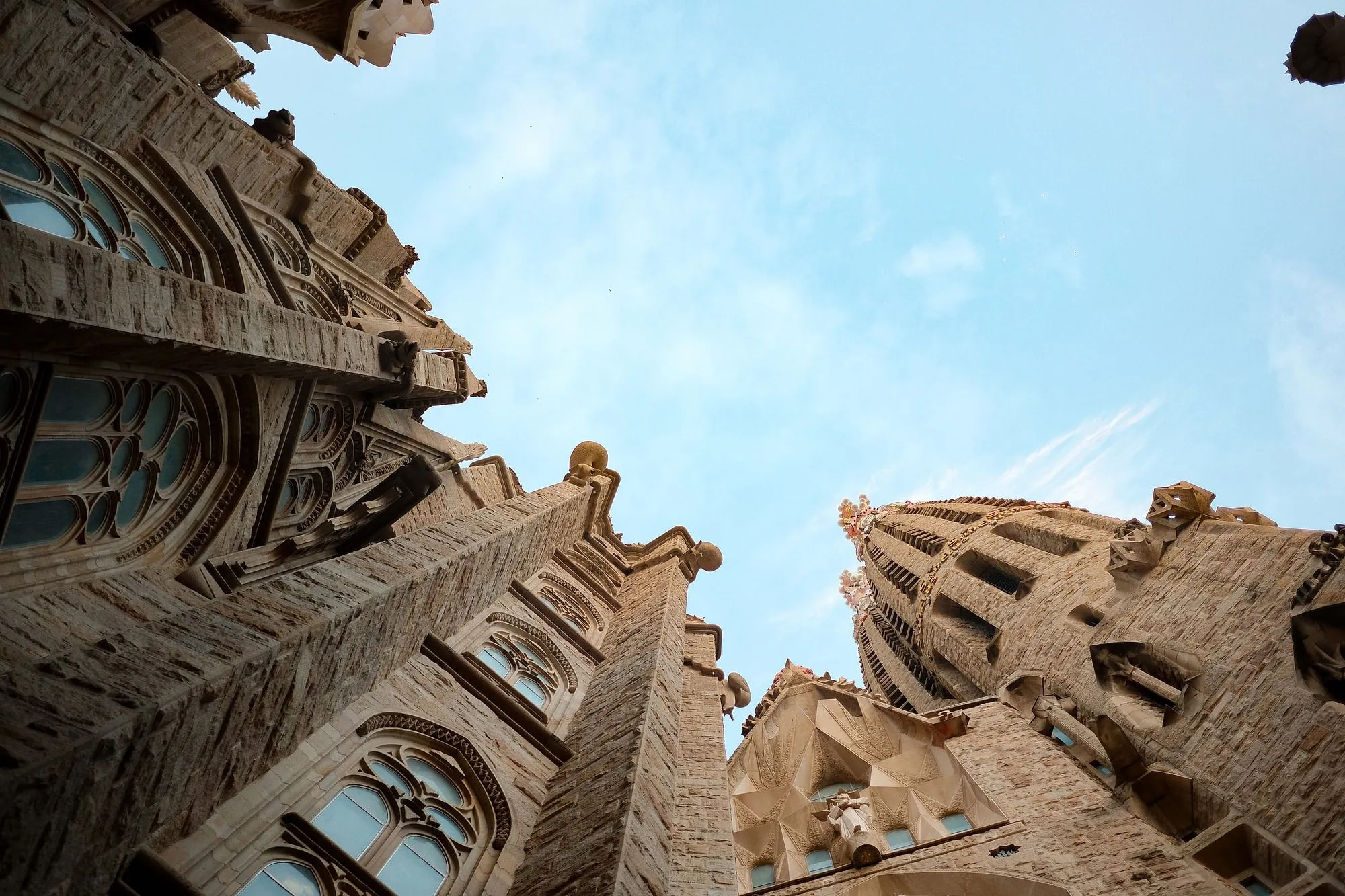
Sagrada Família — Eixample, between carrer de Mallorca and Provença. Gaudí took charge of the site in 1883, a year after work began, and stayed with it until his death in 1926. The Nativity façade and the crypt are the parts he finished, and they are the parts on the UNESCO listing; everything else has been built since, following his models.
The street lamps — two in Plaça Reial and two at Pla de Palau, outdoors and free, and not the same design at all.
Park Güell — above the Carmel, in the Gràcia district. The monumental zone, which holds the serpentine bench and the dragon, requires a timed ticket. The rest of the park is free, and there is a lot of it: you can walk up for the view without paying anything.
Casa Batlló — Passeig de Gràcia 43. The most spectacular inside and the most heavily staged as an experience. Also the most people per square metre.
Casa Milà, La Pedrera — Passeig de Gràcia 92, two hundred metres from the last one. The chimney roofscape is the part almost nobody skips.
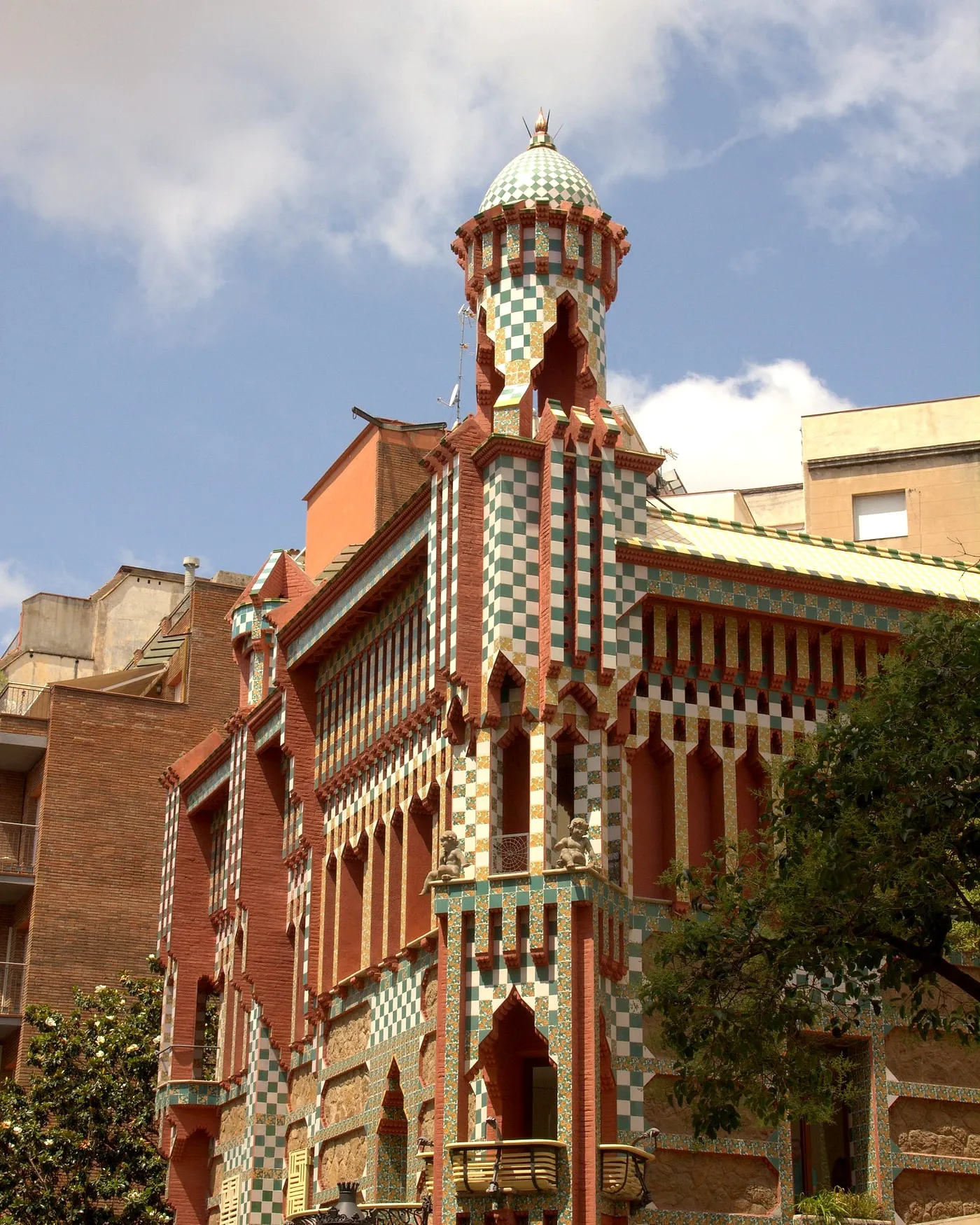
Casa Vicens — carrer de les Carolines, in Gràcia. His first house, 1883 to 1885. It is off the circuit, which is why you can stand still inside it; the full argument with the drawbacks is in is Casa Vicens worth it.
Palau Güell — carrer Nou de la Rambla, just off La Rambla in the Raval. A commissioned town palace: dark, vertical, with a roof terrace of trencadís chimneys. The most consistently underestimated building on this list.
Torre Bellesguard — at the foot of the Collserola hills in the upper city. Lightly visited, limited opening, and with medieval history underneath it: Gaudí built on the remains of the residence of the last king of the House of Barcelona.
The ones you can see free from the pavement
The dragon gate of the Finca Güell — Avinguda de Pedralbes. A wrought-iron gate with a five-metre dragon on it. Visible whole, from the street, at any hour, with no ticket office involved.
The Miralles gateway — Passeig de Manuel Girona. An undulating wall with a door in it, on a pavement full of people who have no idea whose it is.
The lampposts in Plaça Reial — in the square, lit every night. They were a city commission given to a very young Gaudí, and they are among the few works of his still doing the job they were made for.
Casa Calvet — carrer de Casp, near Urquinaona. Not a museum: offices and a restaurant. The façade is fully visible from the opposite pavement, which happens to be wide — something that is not true at Casa Vicens.
Col·legi de les Teresianes — carrer de Ganduxer. A working school, not open for general visits. From the street you get the run of parabolic arches along the façade, which is the thing worth seeing anyway.
The one outside Barcelona
Colònia Güell crypt — Santa Coloma de Cervelló, about twenty kilometres out, on the FGC train from Plaça Espanya. This is where Gaudí tested, with hanging models made of string and weights, the structural system he later used at the Sagrada Família. Half a day including travel, and for anyone interested in Gaudí the engineer rather than Gaudí the decorator, the single most informative stop on this list.
How to group them so you are not crossing the city three times
The Passeig de Gràcia group. Casa Batlló and La Pedrera are two blocks apart. Carry on up to the Jardinets and turn, and Casa Vicens is ten minutes’ walk. Three buildings, one walk, no metro.
The Ciutat Vella group. Palau Güell and the Plaça Reial lampposts are five minutes apart, both a step off La Rambla.
The outliers. The Sagrada Família has its own metro stop and will eat a morning with its queue. Park Güell requires climbing. Bellesguard, the Finca Güell and the Teresianes are all in the upper city and only pay off if you do more than one.
One warning about tickets
The five big ones sell timed entry and, in season, sell out days ahead. Buy from each building’s own website rather than from a reseller: the first page of Google results for almost any of these is occupied by intermediaries charging a commission to sell you exactly the same ticket.
If you would rather have Gaudí told to you
Our Gaudí tour is performed by an actor playing Antoni Gaudí, standing in front of his own work. And the Gràcia tour passes the front of Casa Vicens, which is where everything else on this list starts.
Two questions come up constantly against this list and both have their own page: is Park Güell overrated, answered by people with no ticket to sell there, and what a Gaudí trip looks like when the basilica is sold out, in Barcelona without the Sagrada Família.
Four more pages hang off this one. The street-by-street lap of the basilica, which costs nothing, is how to look at the Sagrada Família from the street; the small carved things almost everybody misses are in the things people walk past; the stories attached to these buildings that do not survive checking are in things you will be told about Gaudí that are not true; and the clients who actually paid for each one, with their trades, are in who paid for each Gaudí building.
If you get to the end of this list and want more, there are two directions. Out of the city, to the unfinished crypt at the Colònia Güell. Or sideways, to the architects the map leaves out, in modernisme beyond Gaudí.
Since this list was written we have gone through it building by building. The two on Passeig de Gràcia turn out not to be the same kind of object at all, and choosing between them is Casa Batlló or La Pedrera. The one we call the most underestimated on this page has its own case now: Palau Güell. What a Park Güell ticket actually covers, and where the free part is, is Park Güell without a ticket.
And the list itself turns out to be shorter than the city’s. Barcelona’s heritage catalogue credits Gaudí with a parish church interior, a sculptural fountain, a shade house and two separate sets of street lamps: the Gaudí works not on the map. Three more are outside Catalonia altogether, and his first three buildings were for a workers’ cooperative in Mataró: Gaudí outside Barcelona.
If all you want is the shortest route that does not wreck the day, it is Gaudí in one day.
Two on that list repay a page of their own, because both were proposed to UNESCO in 2005 and neither was inscribed: Casa Calvet and Bellesguard. And the one building on it that most people photograph from outside and never understand from inside is the Sagrada Família’s interior.
Where this comes from
- HeritageLa Pedrera · Casa MilàThat Casa Milà, Park Güell and Palau Güell were declared World Heritage on 2 November 1984.
- The house — Heritage and recognitionsCasa Vicens GaudíThat Casa Vicens was added to the «Works of Antoni Gaudí» listing on 15 July 2005.
Everything above that carries a date, a figure or a name is checked against these before it is published. Where we could not find a source, the page says so.
Quick answers
- How many Gaudí works are UNESCO World Heritage?
- Seven, all under one listing. Park Güell, Palau Güell and Casa Milà were inscribed in 1984; Casa Vicens, Casa Batlló, the Nativity façade and crypt of the Sagrada Família and the Colònia Güell crypt were added in 2005.
- Which Gaudí buildings can you see without paying?
- The façades of Casa Vicens and Casa Calvet, the dragon gate of the Finca Güell in Pedralbes, the Miralles gateway and the lampposts in Plaça Reial. Plus the outsides of Casa Batlló, La Pedrera and the Sagrada Família, which is what most people settle for anyway.
- Can you see them all in one day?
- No, and forcing it goes badly. They are spread across the Eixample, Gràcia, the Raval, Sarrià and Pedralbes, and one is outside Barcelona. Two well-grouped half days achieve far more than one day spent on the metro.
- If I only go inside one, which should it be?
- Depends what you want. Spectacle: Casa Batlló. Architecture: La Pedrera. Scale and crowds: the Sagrada Família. To see where all the rest came from: Casa Vicens, which was the first.
- Is Park Güell free?
- The monumental zone is not — timed ticket required. The rest of the park is free, and it is a substantial park.
The tours this piece is about
Gaudí comes alive
You will recognise the guide because he will be Antoni Gaudí.
- How long it lasts
- 1 h 30
- Runs in
- EN · ES · CA
- Price
- 30 €
Never more than 15 people
Gràcia: the town that rang the bell
A bell, a bombardment, and a vermouth at the end of it.
- How long it lasts
- 3 h
- Runs in
- EN · ES
- Price
- 36 €
Never more than 10 people
More in the journal
Gaudí and Modernisme
- One day of Gaudí is two timed tickets at opposite ends of a city, unless you plan it backwards
- Casa Batlló or La Pedrera: one is a refit, the other is a building
- The only Gaudí home that nobody was left alone with
- The city's own Gaudí list has things on it that no tour goes to
- The city that made him has nothing he built, and says so on its own website
- Casa Calvet and Bellesguard: the two Gaudís that UNESCO turned down