
Barcelona
Gràcia or the Gothic Quarter: which one, and in which order
They are not alternatives. One is the city that made the decisions and one is the town that refused them, and the order you do them in changes what you understand.
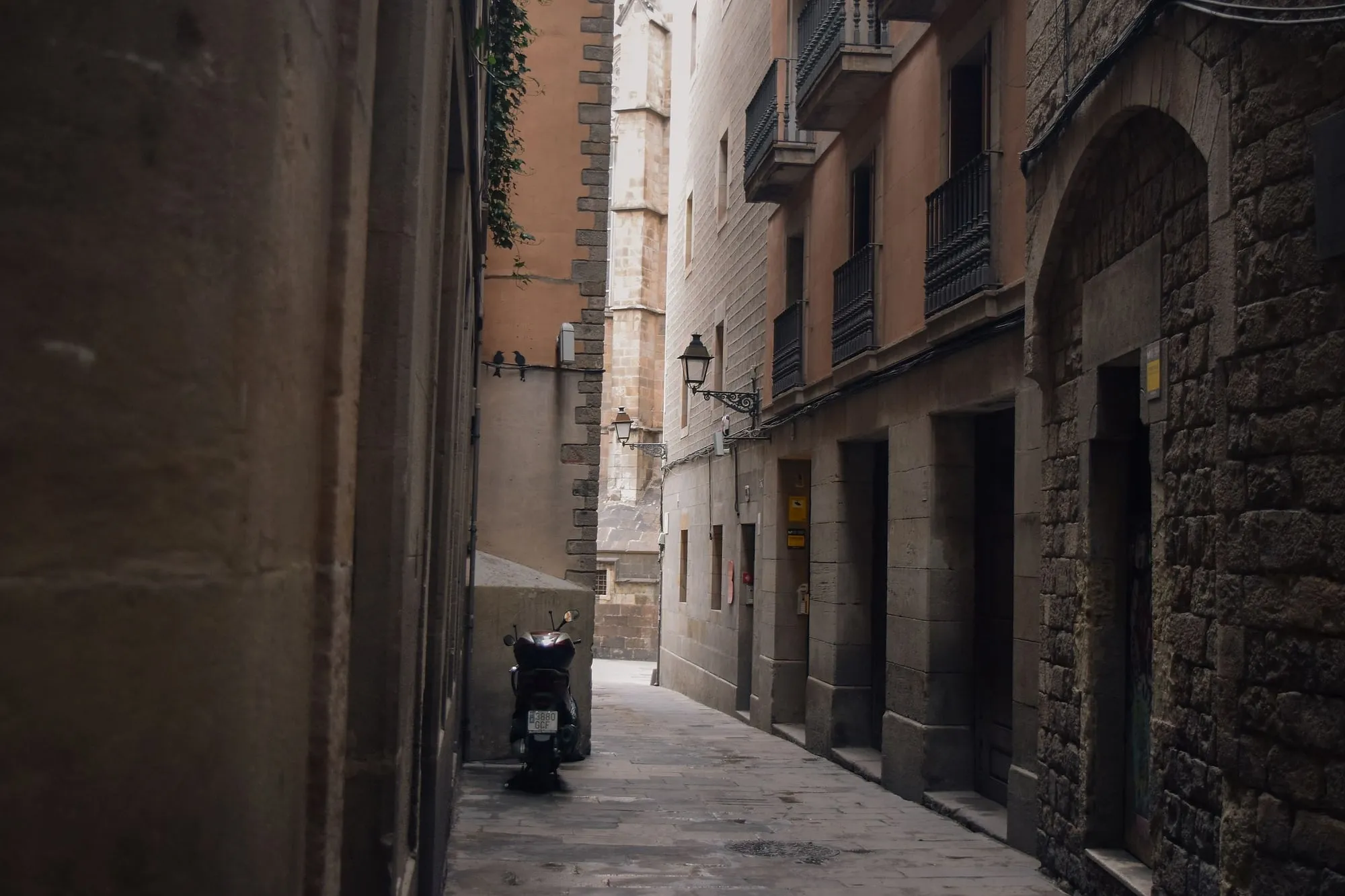
Do both, and do the Gothic Quarter first. What follows is the reasoning, plus the two or three practical facts that nobody puts in the comparison because they are inconvenient.
They answer different questions
The Gothic Quarter is the old city: the cathedral, the Roman wall, the guild streets, the seat of every institution that ever decided anything about Barcelona. It is where the city’s official version of itself lives.
Gràcia is what happened outside the walls. It was a separate municipality from 1850 until 1897, with its own mayor and its own taxes, and its street grid was laid out for factory workers rather than for canons and merchants. It is the same century twice, from two sides — set out at length in why Gràcia was its own town.
The rule that changes the group you are standing in
Since 1 March 2023 a Ciutat Vella by-law — published in the Barcelona provincial gazette on 25 November 2022 and extended to 2028 — caps guided groups at twenty people inside the Gothic Quarter, El Raval, Sant Pere–Santa Caterina–la Ribera and la Barceloneta. Fines run to 1,500 €, and to 3,000 € for a repeat. Loudspeakers and megaphones are banned outright; radio receivers, contrary to what several operators will tell you, are not compulsory.
Gràcia sits outside that perimeter. No cap applies there, which cuts both ways: it means an operator can take whatever group size it likes up the hill, and it means the small groups you find in Gràcia are a choice rather than a legal ceiling. Worth asking before you book, in both neighbourhoods.
The part of the Gothic Quarter that is not old
The bridge on carrer del Bisbe — the arched, carved one under which every visitor stops — was built in 1928, designed by Joan Rubió i Bellver at the request of the Diputació de Barcelona, while the streets around the cathedral were being reconstructed and monumentalised in the run-up to the 1929 International Exposition. It is a very good piece of work and it is not medieval — what it is actually for.
It is not the only case, and the list is longer than most people expect: the front of the cathedral is from 1887 to 1913, and one house on Plaça del Rei was carried there from another street in the 1930s — what was moved, and when. A good deal of what reads as fourteenth-century in those streets was assembled, moved or invented in the twentieth. That is not a scandal, it is a design decision taken by a city that wanted a historic centre and built one, and it is the most interesting thing about the neighbourhood once you know it.
Gràcia has the opposite relationship with its own age. Nothing there is pretending. The streets are narrow because they were cheap, the squares are small because nobody was commissioning a ceremonial one, and a single brick chimney is still standing in the middle of the flats because everything else around it was demolished to open a square. That last detail is the subject of a correction we had to make to our own pages.
Time, ground and transport
| Gothic Quarter | Gràcia | |
|---|---|---|
| Ground | Dense, everything within a few hundred metres | About 3 km of walking, flat, spread out |
| Time it wants | Two hours | Half a day |
| Metro | Liceu (L3), Jaume I (L4) | Fontana or Lesseps (L3), Joanic (L4), Diagonal (L3/L5) |
| Crowd | Heavy, all year | Local, and heaviest in mid-August |
| Guided groups | Capped at 20 by law | No legal cap |
The order, and the reason for it
Gothic first, because it gives you the institutions, the walls and the official account. Gràcia second, because everything it did in the nineteenth century was a reaction to those institutions — including the afternoon in 1870 when it rang the alarm bell against military conscription and the army answered with artillery from Montjuïc.
Do it the other way round and both walks still work. You just lose the joke.
One practical note on the comparison, since it is the question that arrives next: the old city is where Barcelona’s crowds and its pickpocketing concentrate, and Gràcia is not that kind of crowd. What the city actually publishes on the subject, and what it does not, is in is Gràcia safe. And the two neighbourhoods diverge most after dark, not during the day — Gràcia at night is a residential evening, the Gothic Quarter at night is an emptied city.
If you would rather be walked round them
The two routes exist as guided walks, both led by the same working actor: the Gothic Quarter walk, which is largely about how much of that old city is a twentieth-century construction, and the Gràcia walk, which is about the bell and ends with vermouth from the barrel. If you would rather do the old city on your own, the walkable version is what to see in the Gothic Quarter and the honest yes-and-no is is the Gothic Quarter worth it. If you are trying to work out which format of tour suits you at all, that is a separate question and it is answered in how to choose a Barcelona walking tour. And if the real question is how many days you have for either of them, start at three days in Barcelona.
Where this comes from
- Gràcia (barri de Barcelona)Gran Enciclopèdia CatalanaGràcia as an independent municipality between 1850 and 1897.
- Catedral de BarcelonaGran Enciclopèdia CatalanaThat the cathedral's outer façade and its two side towers are nineteenth-century work by Josep Oriol Mestres, on a 1408 design, paid for by Manuel Girona.
- Comença el control dels grups turístics a Ciutat Vella (3-3-2023)Ajuntament de Barcelona · Sala de premsaThe twenty-person cap on guided groups, which applies in Ciutat Vella and not in Gràcia, and the fines behind it.
- Pont del Bisbe del Palau de la GeneralitatCol·legi d'Arquitectes de Catalunya · arquitecturacatalana.catThat the bridge on carrer del Bisbe is from 1928 and is Joan Rubió i Bellver's.
Everything above that carries a date, a figure or a name is checked against these before it is published. Where we could not find a source, the page says so.
Quick answers
- Can you do both in one day?
- Yes, and it is a long day. The Gothic Quarter is dense and can be done in two hours; Gràcia is three kilometres of walking and wants a half day. If you compress both into one day, do the Gothic in the morning and take the metro up afterwards.
- Which is more crowded?
- The Gothic Quarter, by a distance, and it is not close. The city caps guided groups there at twenty people precisely because of it. Gràcia has no crowd to manage.
- Is the Gothic Quarter actually Gothic?
- Parts of it are genuinely medieval and parts of it are not. The arched bridge on carrer del Bisbe that appears in every photograph was built in 1928, to a design by Joan Rubió i Bellver for the Diputació de Barcelona, while the quarter was being remodelled ahead of the 1929 International Exposition. It is younger than most of the buildings in Gràcia.
- Which is better for a first visit to Barcelona?
- The Gothic Quarter, without hesitation. It is where the city started and it is next to everything else you are going to do. Gràcia is the second or third day.
- How far apart are they?
- Both sit on the green metro line, a handful of stops apart: Liceu for the Gothic Quarter, Fontana for Gràcia. On foot it is a long, mostly uphill walk along Passeig de Gràcia, which is a pleasant thing to do once.
The tours this piece is about
Gràcia: the town that rang the bell
A bell, a bombardment, and a vermouth at the end of it.
- How long it lasts
- 3 h
- Runs in
- EN · ES
- Price
- 36 €
Never more than 10 people
The Gothic Quarter: a neighbourhood that invented itself
Barcelona's most photographed bridge dates from 1928.
- How long it lasts
- 2 h
- Runs in
- EN · ES · CA
- Price
- 15 €
Never more than 20 people
More in the journal
Planning your trip
- A Barcelona weekend, arranged around what only happens at weekends
- Barcelona with children: a short list, with the drawbacks attached
- Coming back to Barcelona: what changes on a second visit
- Non-touristy Barcelona: a method, not a list of places
- Getting around Barcelona: six trips in ten are made without a vehicle
- What actually has to be booked in advance in Barcelona — it is a shorter list than you think